


[The AI and ESG dilemma ©ESG.ONL/ESG Today, Google]
As of July 2025, there is a common conundrum companies worldwide face. Google announced it would invest 75 billion dollars in AI infrastructure this year. At the same time, it also reported that its greenhouse-gas emissions increased 13% in 2023. That very conundrum is the contradiction that, if you use AI to aim for ESG-based results, the environmental impact from AI's own energy consumption grows.
The Reality of AI Energy Consumption
MIT researchers have stated that a generative-AI training cluster consumes 7–8 times more power than ordinary computer operation. The more AI becomes personalized and reasons through complex problems, the more power consumption and carbon emissions inevitably increase. There is also a forecast that by 2028, more than half of U.S. data-center power will go to running AI. The "Stargate Initiative," a 500-billion-dollar cooperation project led by OpenAI and SoftBank unveiled this past January, aims to build cutting-edge AI infrastructure across the United States. The core project of the Stargate Initiative, planned to be pursued over four years, is the construction of AI data centers. Starting with Abilene, Texas, some 20 data centers are planned to be located within the U.S. It is a point at which we should of course be concerned about expanding a stable power-supply network for data centers and the enormous carbon emissions that follow.
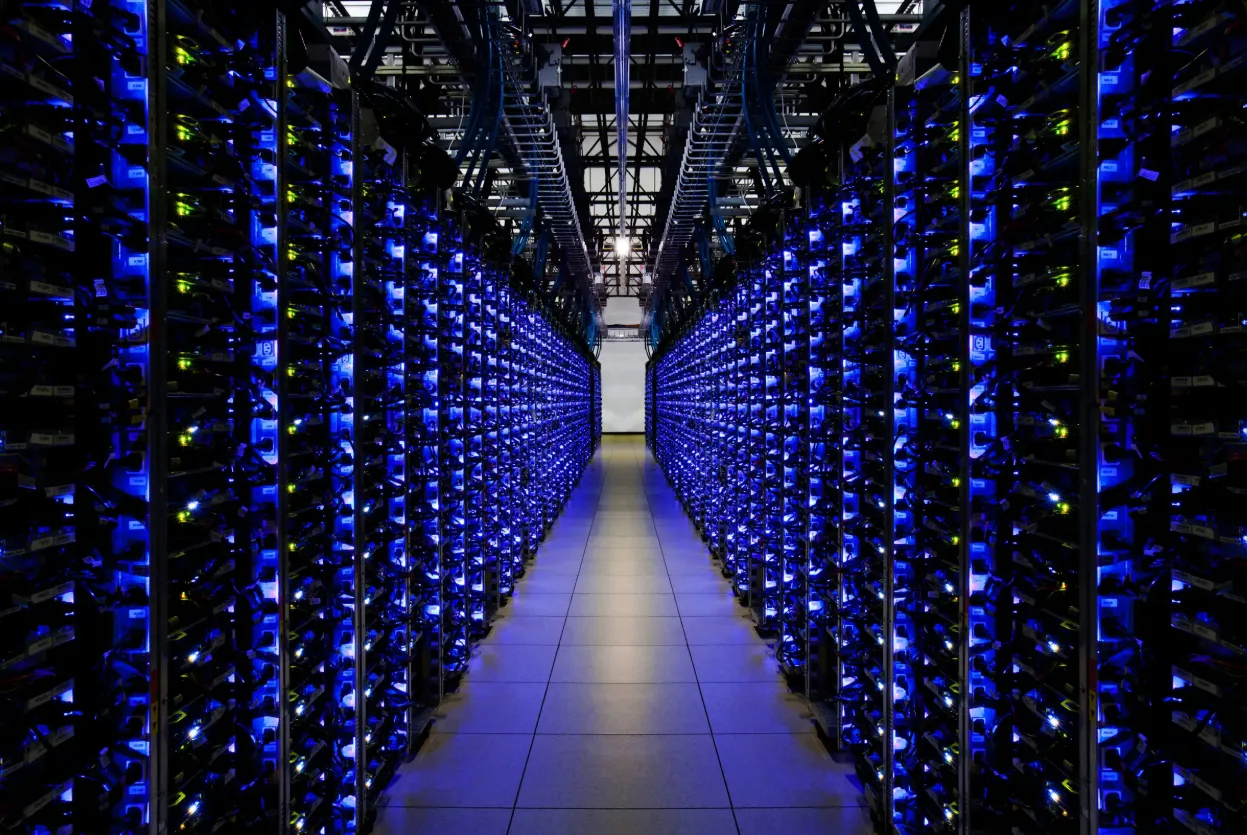
[Google's Georgia data center ©Google]
The Difficulty of Measuring AI Technology's Contribution to ESG, and Companies' Efforts to Cover Energy
It is not easy to accurately measure how much AI will affect ESG. The global AI-ESG market is expected to grow from 1.24 billion dollars in 2024 to 14.87 billion dollars in 2034, at an average annual rate of 28.2%. But quantifying whether there will be an actual ESG-improvement effect relative to AI investment, and to what degree, is still a challenge. The generative-AI field is leading the overall market growth, but investors are expressing both the expectation of ESG improvement through the use of AI and concern about the environmental impact caused by AI. In a situation where companies must find a balance among AI-adoption costs, environmental costs, and ESG-improvement effects, some companies are also trying to solve the problem in the direction of raising AI's own efficiency. Google announced that its next-generation "6th-generation Tensor Processing Unit (TPU)" chip is 67% more energy-efficient than the previous generation. Through this, it expects to be able to reduce the energy needed for AI-model training by up to 100-fold and related emissions by up to 1,000-fold. Microsoft and Meta are pursuing the operation of new nuclear power plants. Microsoft stated last September that it would cover the energy for its AI and data centers by purchasing power from Unit 1 of the "Three Mile Island" nuclear power plant in Pennsylvania, and Meta stated this June that it would do so by purchasing power from the "Clinton Clean Energy Center" nuclear power plant in Illinois.
The AI-ESG Dilemma Is the Most Complex Challenge Companies Face in 2025
Faced with the reality of surging energy consumption—as great as the opportunities of the rapidly growing AI and ESG markets—companies are striving to find a new balance. They cannot give up AI adoption itself. In that case, through building a transparent effect-measurement system and securing efficiency, they must prove ESG-improvement effects while minimizing the environmental costs AI creates. Companies that find the way will be able to continue opening a sustainable AI era.
by Editor N