

Amid the International Energy Agency (IEA) stating that last year's carbon emissions recorded an all-time high, "Carbon Majors," a civic group that analyzes carbon-emitting-company data, announced on the 4th that energy companies' carbon emissions account for 80% of global emissions. The point is that, after the Paris Agreement, the carbon emissions of energy companies producing coal and cement actually increased.
Literally translated, the name of the group that reported this fact, "Carbon Majors," means "the chief culprits of carbon." The group is known to have started on the occasion of a HuffPost article in 2013 that pointed out that a mere 90 companies accounted for two-thirds of global carbon emissions. Back in 2017, too, CDP (Carbon Disclosure Project)—a global civic group engaged in carbon-emission-reduction activities—revealed the fact that the carbon emissions of 100 energy companies accounted for 70% of global emissions. As Carbon Majors' data released this month revealed that energy companies' carbon emissions increased after the Paris Agreement—which targeted the reduction of greenhouse gases including carbon—voices continue that we must be vigilant about the climate crisis.
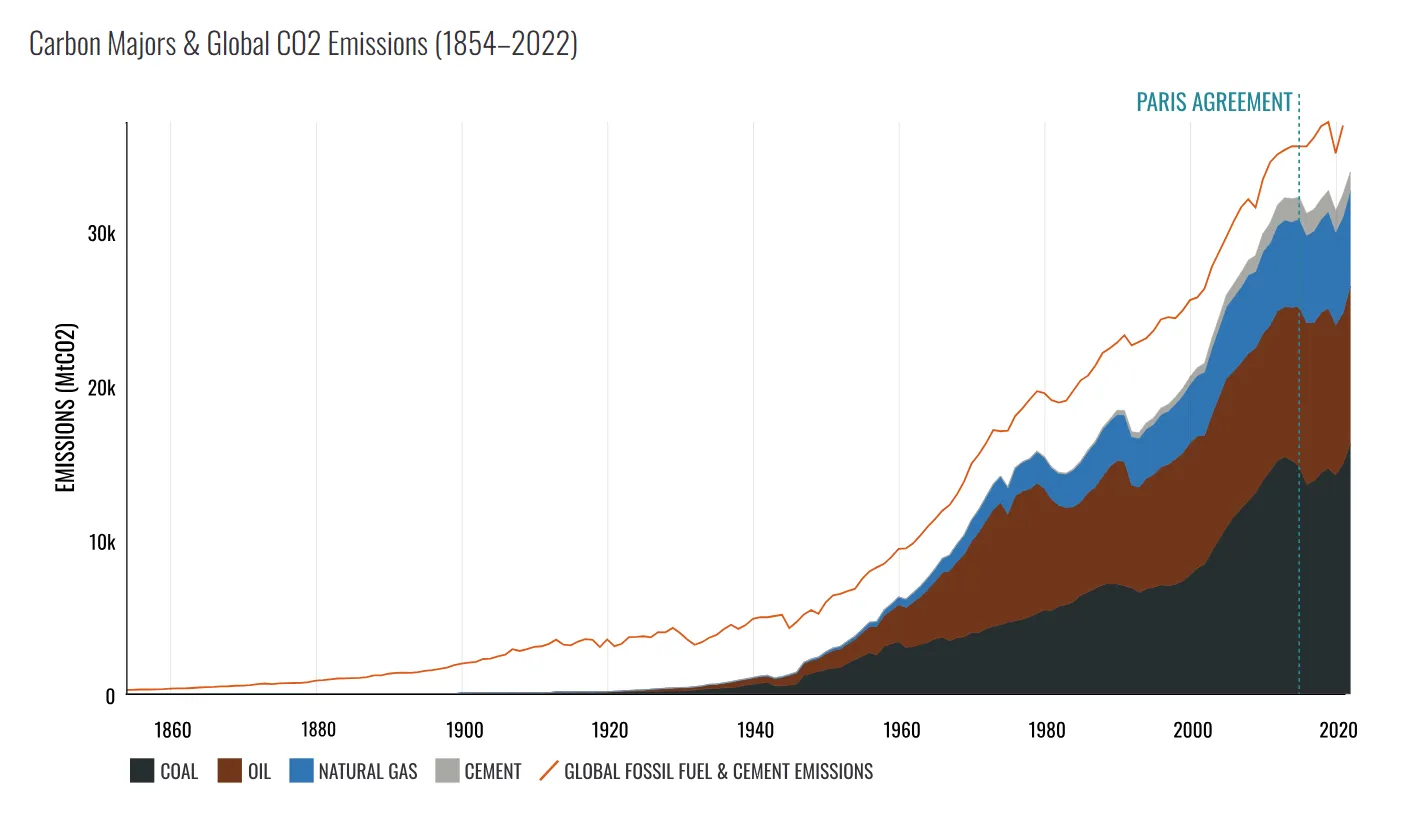
[A graph of the increasing trend of global carbon emitted by major carbon-emitting companies ©Carbon Majors]
Carbon Majors, which tracked the greenhouse-gas emissions of 122 energy companies, pointed out in its report that from after the Paris Agreement until 2022, a mere 57 energy companies were the chief culprits producing 80% of global carbon emissions. Over the same period, 117 companies produced 88% of global carbon emissions, and among these, state-owned enterprises directly operated by the state or belonging to the government amounted to 69%, while private companies amounted to 31%.
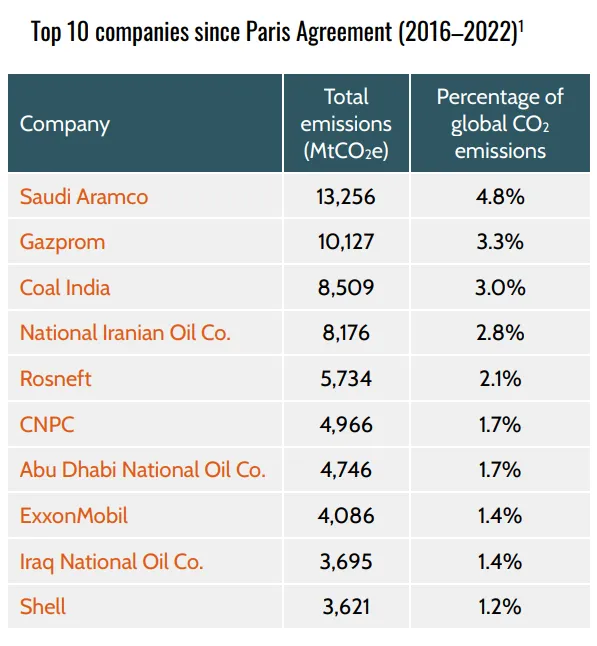
[The top 10 companies with the highest carbon emissions after the Paris Agreement ©Carbon Majors]
Among these, the energy companies with the highest shares are Saudi Aramco, Gazprom, Coal India, and others. According to Reuters, in reporting on these figures, Saudi Aramco refused to answer, and Gazprom and Coal India did not immediately respond. Carbon Majors' corporate carbon-emission data was also cited in a lawsuit filed this past March by a Belgian farmer against the French oil-and-gas company "TotalEnergies." That lawsuit is proceeding with the issue that TotalEnergies—one of the top 20 companies with the highest carbon emissions—bears some responsibility for causing the climate crisis and inflicting damage on agriculture.
The Paris Agreement is a term referring to the 21st UN Framework Convention on Climate Change, held in Paris, France, in 2015, and has the significance that 195 countries worldwide participated in greenhouse-gas reduction. The Paris Agreement is meaningful in that, going beyond the 1997 Kyoto Protocol—which imposed greenhouse-gas-reduction obligations only on developed countries—it drew out an agreement in which the vast majority of countries worldwide would set greenhouse-gas-reduction targets and join in. The common goal adopted in the Paris Agreement is "preventing the Earth's average temperature from rising 2 degrees or more above pre-industrial levels." It is time to look back on the Paris Agreement's principle that each country's government has the obligation to slow global warming by demanding carbon-emission reductions from its own companies.
by Editor N