
[The EU formalizes its 2040 target of a 90% carbon-emission cut ©ESG.ONL/ESG Today]
The European Union (hereafter EU) has presented a concrete roadmap toward its 2050 carbon-neutrality goal. On the 2nd, the European Commission announced that, through an amendment to the EU Climate Law, it had officially proposed the interim target of cutting net greenhouse-gas emissions by 90% compared with 1990 by 2040.
This proposal reflects the recommendation of the "European Scientific Advisory Board on Climate Change (ESABCC)," set as a feasible target based on the 90–95% reduction range. The path toward the EU's 2030 reduction target appears smooth. As of the end of 2023, the EU's greenhouse-gas emissions had achieved a 37% reduction compared with 1990. It was confirmed that over the same period economic growth was also achieved at the level of 68%. This also shows that the "decoupling" of economic growth and greenhouse-gas reduction is a feasible goal.
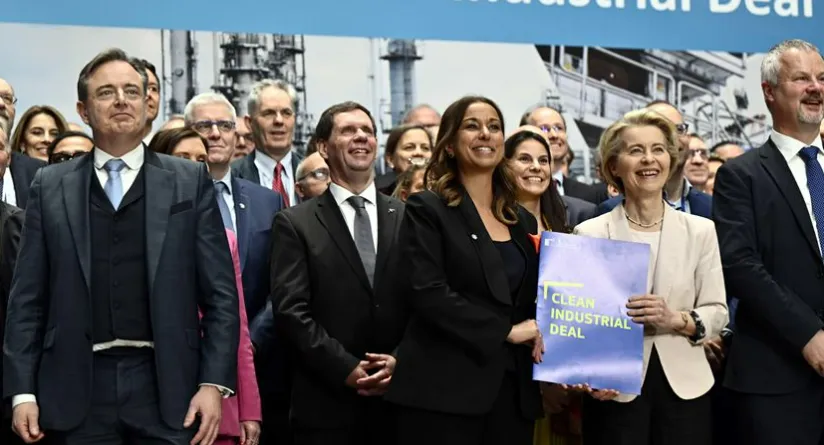
[The announcement of the "Clean Industrial Deal" ©The Parliament Magazine]
Simultaneously Strengthening Clean-Industry Competitiveness and Global Climate-Diplomacy Leadership
This target is closely connected to the EU's economic strategy, beyond a mere environmental policy. The strategy is to secure the leadership of EU companies in the clean-technology market and private investment by signaling long-term, consistent policy in connection with the "Clean Industrial Deal"—pursued this past February to simultaneously strengthen the EU's industrial competitiveness and achieve decarbonization—and to strengthen energy independence by reducing dependence on fossil fuels. There is also strategic significance in global climate diplomacy. Combined with the U.S.'s withdrawal from the Paris Agreement, this EU target-setting can be seen as carrying even greater significance. Ahead of the 30th UN Framework Convention on Climate Change Conference of the Parties (COP30), to be held in Brazil this November, the EU plans to induce other major emitters to set more strengthened targets through the submission of its 2035 "Nationally Determined Contributions (NDC)." In particular, with major emitters such as China, India, Japan, Australia, and Mexico set to announce updated plans within nine months, the ripple effect of the EU's preemptive target-setting on global climate action is drawing attention.
Checkpoints of This EU Target
The EU's ambitious target-setting also offers several implications for us. First, from the perspective of the "Carbon Border Adjustment Mechanism (CBAM)," which will be implemented in earnest in 2026, Korean companies need to re-examine their response strategies. As the EU presents stricter greenhouse-gas-reduction standards, an expansion of the CBAM's scope and a strengthening of standards are also expected. If this happens, one cannot but consider the direct impact on the steel, chemical, and automotive industries—Korea's main export industries. It is a situation where the decarbonization of our companies' production processes and their transition to renewable energy will be actively required. When our government sets mid- to long-term targets through 2040—going beyond the 2030 national greenhouse-gas reduction target of a 40% cut compared with 2018—it is highly likely to also reference the EU's approach.
This proposal is to be finally adopted after review by the European Parliament and Council, followed by the ordinary legislative procedure. Experts assess that this target will be technically feasible, but they also emphasize that problems remain to be solved—large-scale renewable-energy expansion, a sharp reduction in fossil-fuel use, improved energy efficiency, and the sweeping electrification of end-use sectors. Attention is on whether this ambitious roadmap the EU has presented can become a new reference point for global climate action, and whether it can draw the participation of other major economies.
by Editor N