

Every year when November approaches, the shelves of convenience stores and supermarkets are filled with Pepero gift sets. Pepero Day, which has established itself as a nationwide event since Korean media began covering it in earnest in 1996, is a commemorative day for both consumers and the retail industry.
However, November 11 has a different original protagonist: ‘Farmers’ Day.’ Farmers’ Day was elevated and designated as a statutory commemorative day in 1996 to help the public recognize that agriculture is the foundation of the national economy and to encourage pride and self-esteem among farmers. Its origins are said to trace back to 1964, when the Wongseong-gun Federation of the Rural Improvement Club designated November 11 as Farmers’ Day and held the first commemorative event in Wonju City (then Wongseong-gun). Since the Chinese character 土 (to, meaning soil) can be separated into 十 (ten) and 一 (one), November 11 — where 11 overlaps twice — was chosen to embody the agricultural philosophy of ‘born of the soil, living alongside the soil as a companion, and ultimately returning to the soil.’
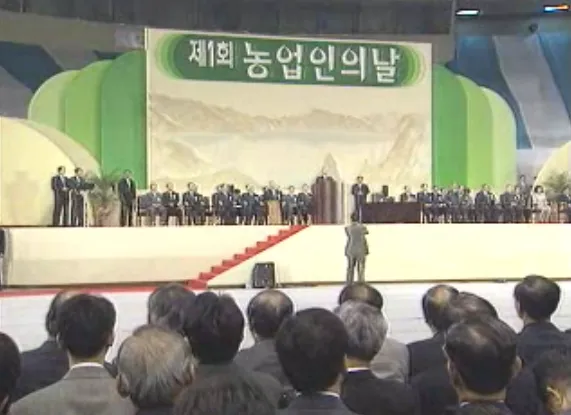
[President Kim Young-sam’s speech scene at the 1st Farmers’ Day Ⓟ Ministry of the Interior and Safety National Archives of Korea]
The Counter to Pepero Day: The ‘Garaetteok Day’ Korean Agricultural Products Movement
Even if Farmers’ Day has a longer history and tradition, what most people think of when November 11 arrives is probably Pepero Day. To overcome this, there were attempts to support Farmers’ Day. South Korea’s first-generation IT company AhnLab (formerly Ahn Cheol-soo Research Institute) launched a movement in 2003 to give and receive garaetteok (long cylinder-shaped rice cakes) instead of Pepero to commemorate Farmers’ Day. The purpose was to promote rice consumption at a time when the declining rice consumption of the younger generation was emerging as a social phenomenon.
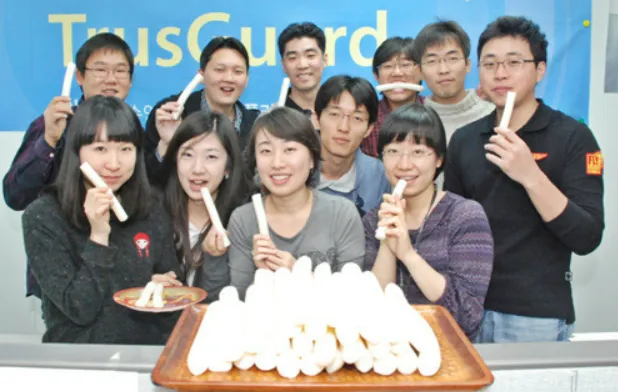
[AhnLab employees commemorating Garaetteok Day in 2010 Ⓟ AhnLab]
When the Ministry of Agriculture, Food and Rural Affairs officially designated Garaetteok Day as a commemorative day in 2006 and expanded it into a government-level campaign for the consumption of Korean agricultural products, Garaetteok Day rose as a formidable counter to the mighty Pepero Day. On Garaetteok Day, held to commemorate Farmers’ Day, related agencies of the Ministry of Agriculture, Food and Rural Affairs and agriculture-related local governments run various campaigns targeting the younger generation each year.
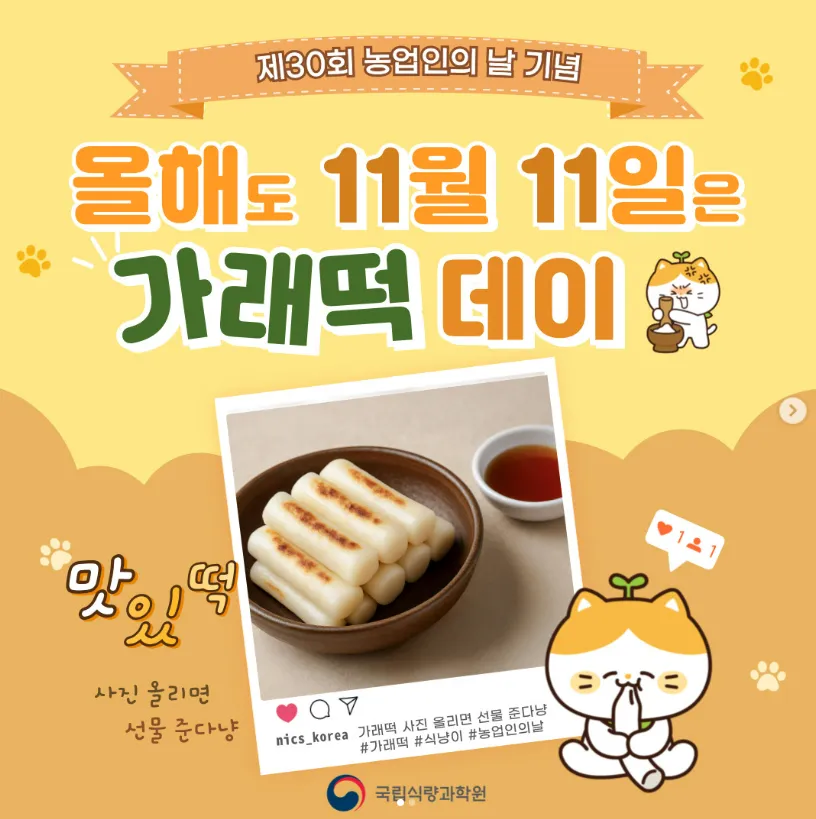
[National Institute of Crop Science Garaetteok Day Event Ⓟ NICS Instagram]
The Reality of Declining Rice Consumption and Wheat Import Dependence
The need to promote rice consumption that Garaetteok Day emphasizes is no different from the early days of Garaetteok Day. For farmers, Garaetteok Day is not a mere campaign but something closer to an urgent reality. According to Statistics Korea, the annual per capita rice consumption in 2024 was 55.8 kg, less than half of the 120.5 kg consumed in 1994.
While rice consumption has declined, wheat consumption has surged. Annual per capita wheat consumption is approximately 33 kg, about half that of rice, but South Korea’s wheat self-sufficiency rate is only around 1%. Over 99% of the 3.2 to 3.7 million tons of wheat consumed annually is dependent on imports. Over the past three years, the average domestic wheat import volume has reached 4.08 million tons. Major importing countries include Australia, the United States, Canada, Russia, and France.
The government set a target of achieving a wheat self-sufficiency rate of 5% by 2025 and 10% by 2030 through the ‘1st Wheat Industry Development Basic Plan’ in 2020, but the target has been difficult to achieve to date. As consumption of wheat flour-based foods such as bread, ramen, and pasta has increased due to Westernized dietary habits, concerns are growing that food sovereignty is being threatened. As instability in the international grain market rises — such as the Russia-Ukraine war and India’s wheat export ban — the call for self-sufficiency in a minimum level of grain from the perspective of food security is also growing louder.
The Future of Food Sovereignty to Recall When Making Consumption Choices
Is November 11 Pepero Day or Garaetteok Day? It may be excessive to say we should participate in this competition and even think about wheat imports and food sovereignty. Yet the fact remains unchanged that the choice of traditional foods made from our rice is a matter that will determine food sovereignty and the future of agriculture. As the trends of meaning-out and value consumption spread, particularly centered on the MZ generation, interest in Korean agricultural products is rising. Evidence of this includes the increasing use of local food direct transaction platforms and the growing number of young consumers pursuing eco-friendly and sustainable consumption.
How will we commemorate November 11? This year, in the realm of value consumption, let us think about the future that today will create.
by Editor N