
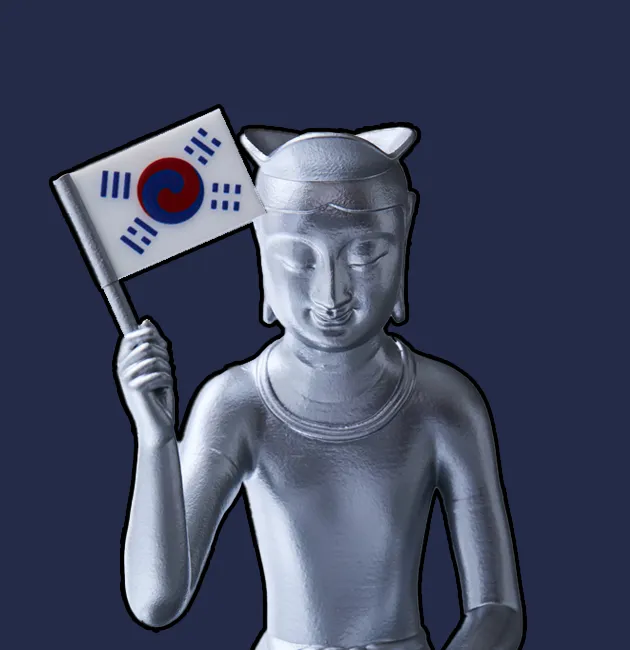
The merch sold at the National Museum of Korea is becoming the starting signal of a new consumption trend. The "Pensive Bodhisattva Liberation Edition" and "Deny Taegeukgi keyring" sellout frenzy, which occurred this year marking the 80th anniversary of Liberation, is being treated as a phenomenon beyond mere souvenir popularity. Companies' merch fervor is already a familiar picture—bookstores including Kyobo Book Centre hold online events that sell Liberation Day special souvenirs on the side. The point to note in the renewed merch craze is not the merch itself but the fundamental change in consumption culture hidden behind it.

[The National Museum of Korea online merch shop screen showing sold-out status ©National Museum Foundation of Korea online shop]
Looking Back at the Value-Consumption Trend on Liberation Day
These days, the most popular space at the National Museum of Korea is not the exhibition hall but the souvenir shop, the merch shop. The National Museum of Korea's merch, rooted in our traditional culture, has risen to a "it-item" that stimulates the collecting desire of a broad range of consumers, including the MZ generation. The fervor for National Museum of Korea merch, whose influence is expanding globally, can be seen as arising from three reasons. First, consumers want to know the "story" of merch containing history and culture. Second, they want to share the story they learned this way on social media and express their own "cultural taste." Third, they want merch that expresses their taste this way to become a tool that explains themselves.
On online channels where the MZ generation gathers, the scene of sharing the backstory—"this badge is actually a design inspired by Joseon folk painting"—has become a fairly familiar daily occurrence. Now merch is not simply an object a consumer owns but a means of revealing someone's cultural sense and identity. The merch drawing attention in the National Museum of Korea merch craze faithfully performs this role. A paradigm shift from conspicuous consumption to meaningful consumption is also taking place together.
The Meaning of the Successive Sellouts of NMK Merch
The phenomenon of the National Museum of Korea's 80th-anniversary-of-Liberation merch selling out one after another was fully expected. Following sellouts, there is already much merch available only through pre-orders that endlessly stack up rounds. The Pensive Bodhisattva Liberation Edition, of which 500 were to be released, quickly sold out and 1,500 additional units went into production, and the Deny Taegeukgi keyring exhausted its initial batch of 1,000, with about 3,000 additional units currently in production. Purchase reviews poured out comments such as "because I want to remember the meaning of history in daily life," "to explain the meaning of Liberation to my child," and "as a resolve not to forget the sacrifice of the grandfather generation." This response is not a flow suddenly created this Liberation Day. It is the result of "value consumption," which has been called an MZ-generation consumption trend. A consumption trend that pays attention to the value and story behind a product, beyond its function and price, has taken root at the base of daily life.

[The Pensive Bodhisattva miniature Liberation Edition, an 80th-anniversary-of-Liberation limited product scheduled for restock in mid-September ©National Museum Foundation of Korea online shop]
The "Condition of Authenticity" That Brands Did Not Miss
"Starbucks," another brand that draws attention with merch, also leaves a meaningful message around Liberation Day each year. Last year, the 79th anniversary of Liberation, it released dancheong merch supervised by Kim Seok-gon, a transmission-trainee of the state-designated intangible heritage dancheong master. The reason the dancheong merch drew attention at the time was not simply because it used a Korean design. The authenticity shown by merch supervised by a transmission-trainee of the intangible-heritage dancheong master, and the act of donating part of the proceeds to a national-heritage protection-activity fund, was recognized. This year, marking the 80th anniversary of Liberation, Starbucks donated "Bungjeong Manri (鵬程萬里)," a handwritten calligraphy of Baekbeom Kim Gu, to the National Trust for Cultural Heritage. It also released collaboration merch themed on the National Museum of Korea's popular section "The Room of Quiet Contemplation," explained earlier. As consumers' standards rise in a way that distinguishes commercial marketing from authentic support for social value, it is a case for companies and brands to reference in how they should approach history and culture.

[The Starbucks Liberation Day dancheong merch released in 2024 ©Starbucks Korea]
The consumption of 80th-anniversary-of-Liberation merch appears to be a point where personal satisfaction and social-value creation connect. The act of posting a purchase verification photo on social media leaves the social message that one is "a person who remembers history." If companies and brands want to naturally join this context, they must create the common denominator of authenticity. Not simply following a trend, but when the value the product contains and the brand's philosophy align, it moves consumers' hearts.
by Editor N