

Global Big Tech companies' ESG-investment competition is growing to the level of megadeals. A representative company that closed a megadeal—meaning a large deal on the scale of a major corporation—is Google. On the 31st of last month, Google announced that it would invest 6 billion dollars (about 8.2 trillion won) in Visakhapatnam, Andhra Pradesh, India, to build Asia's largest data center and renewable-energy hub. The core of this project is the construction of a large-scale data center with 1-gigawatt capacity. Of the 6-billion-dollar amount for this project, which builds India's first large-scale data center, 2 billion dollars is to be invested in renewable-energy development.
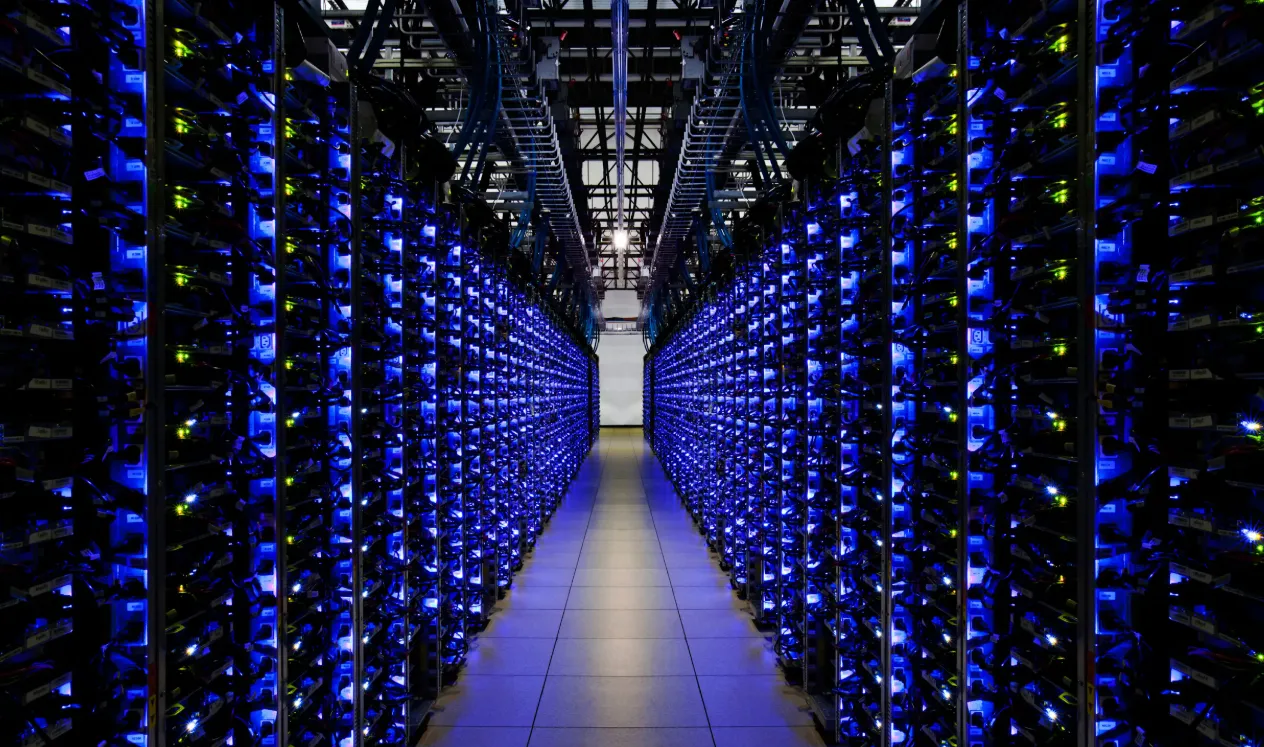
[Inside a Google data center ©Google]
Why India? India's Data-Center Hub Strategy and Policy Support
BEhind Google's investment is India's active data-center hub strategy. That the Indian government classifies data centers as "infrastructure" to ease financing and provides clear guidelines is attractive to tech companies. Moreover, with a renewable-energy generation cost of 4.98–4.99 rupees per unit (about 79 won)—cheaper than natural-gas generation, which requires 5.4 rupees per unit (about 86 won)—economic viability is also secured. Google already supplies 50% of its power with renewable energy at the Yotta NM1 data center near Mumbai, and it has set and is operating toward a goal of expanding this to 70% by 2025.
The Intersection of Surging Power Demand in the AI Era and a Decarbonization Strategy
This investment is also part of the 75 billion dollars Google planned to invest for global data-center expansion. In particular, it is directly connected to Google's "24/7 Carbon-Free Energy (CFE)" goal of covering the power demand surging with the spread of AI services with renewable energy. The carbon-free energy goal can be seen as an environmental goal one level higher than RE100, which matches annual renewable-energy purchases. This is because it is an aggressive plan to use only grid carbon-free power.
Google plans to operate the new data center in connection with the "Blue Raman submarine cable system," scheduled for completion in Q4 2025. The submarine cable system, with a landing station in Mumbai, will greatly expand bandwidth between India and the world. Nara Lokesh, IT Minister of India's Andhra Pradesh state, stated that "the state government has already secured commitments for 1.6 GW of data-center capacity and plans to build up to 6 GW within the next five years." He also added that by building three submarine-cable landing stations in Visakhapatnam, it will secure about twice the submarine-cable capacity Mumbai currently holds.

[The Big Tech ESG-investment megadeal rush ©ESG.ONL/ESG Today]
A New Direction in the Big Tech ESG-Investment Competition
Google's investment shows that the Big Tech industry's ESG-investment competition has entered a new dimension. In May last year, Microsoft signed a 10-billion-dollar renewable-energy development contract with Brookfield Asset Management to secure 10.5 GW of renewable-energy capacity between 2026 and 2030, and it recently signed a 10-year, 1.1-million-ton carbon-removal contract with Norway's Hafslund Celsio.
Amazon signed a 650-million-dollar nuclear-power-plant power-purchase agreement with Talen Energy in Pennsylvania, and Meta also announced a 13.5-billion-dollar contract to purchase 1.1 GW of nuclear energy for 20 years from the Clinton Clean Energy Center in Illinois.
What these companies have in common is that, beyond solar and wind, they include nuclear power, geothermal, and carbon-removal technology in their portfolios to try to achieve both the 24-hour power demand of the AI era and carbon-neutrality goals at once. We should pay attention to this investment competition in that the Big Tech companies leading the rapidly arrived AI era are leading not only technological pioneering but also the ways to achieve carbon-neutrality goals.
by Editor N
[Reference Article] The Evolution of Carbon-Neutrality Strategy—the Carbon-Removal Contract Between MS and Hafslund Celsio