
In Gyeonggi Province, approximately 13% of areas are agricultural and fishing villages where city gas supply is difficult. Since 2015, Gyeonggi Province has been creating energy self-sufficient villages by supporting solar power generation facilities centered on such energy-underprivileged regions. Previously called ‘Gyeonggi RE100 Villages’ or ‘Apartment RE100 Pilot Projects,’ these initiatives were consolidated in 2023 into ‘Gyeonggi RE100 Income Villages.’ Recruitment has begun for the ‘Gyeonggi RE100 Sunshine Income Villages’ (hereinafter RE100 Income Villages) — projects that draw resident participation, return income, and contribute to regional circulation. So what exactly is an RE100 Income Village?
Sunshine as Income, Income as Carbon Neutrality
RE100 Income Villages are resident-participatory renewable energy projects that install solar power facilities in villages or apartment complexes and return the generation revenue to residents in the form of sunshine income dividends, village fund accumulation, and electricity bill savings. Eligible recipients include areas without city gas supply, energy-vulnerable villages, and apartment complexes. For the village type, 70% of installation costs are subsidized (provincial funds 30%, municipal funds 40%), and for the apartment type, 60% of rooftop solar installation costs are subsidized (provincial and municipal funds 30% each).
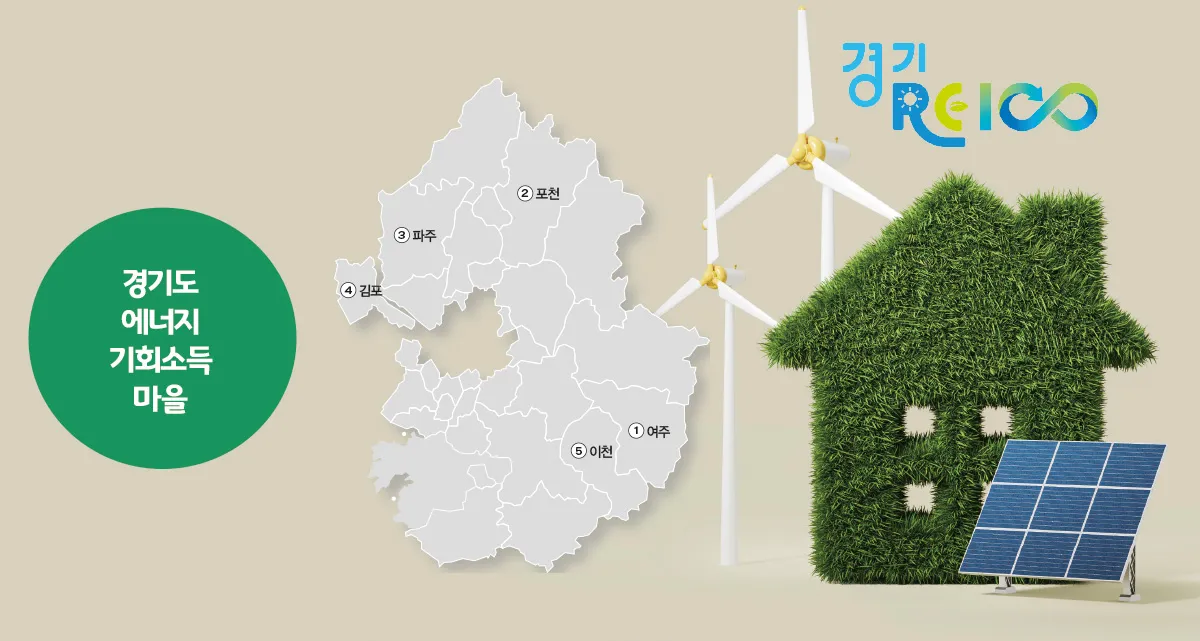
[Gyeonggi RE100 Income Village © My Gyeonggi]
From 2023, Gyeonggi Province expanded the initiative into the ‘Energy Opportunity Income Village Creation Project,’ subsidizing the installation costs of village communal solar power plants and providing monthly income to residents from the proceeds of solar electricity sales. The structure involves Gyeonggi residents, villages, and public facilities participating together to produce renewable energy, returning it as income, and then linking that income back to the renewable energy demand of companies. Under the name ‘Gyeonggi RE100,’ the province has connected villages and industry to regional carbon neutrality. As a result, approximately 1.7 GW of additional solar power facilities were expanded from 2022 to 2025 — a meaningful change for Gyeonggi Province, where renewable energy production had been difficult due to challenges in securing suitable sites.
Ten Years of ‘RE100 Income Village’ Results — What Is the Goal for 2030?
Over the past ten years, a total of 473 RE100 villages have been created across Gyeonggi Province. The Machimi Village in Pocheon is cited as a representative success story: in 2024, 33 households invested KRW 5.5 million each to achieve approximately KRW 40 million in generation revenue, and from 2025 onward, they receive an average monthly sunshine income dividend of KRW 200,000. The Eungol Village in Icheon also produced concrete results last year, distributing sunshine income of KRW 2.2 million per person annually. The apartment complexes in Suwon and Pyeongtaek that installed 120 kW of rooftop solar as a pilot project last year are also projected to achieve annual savings of KRW 30 million in communal electricity costs.
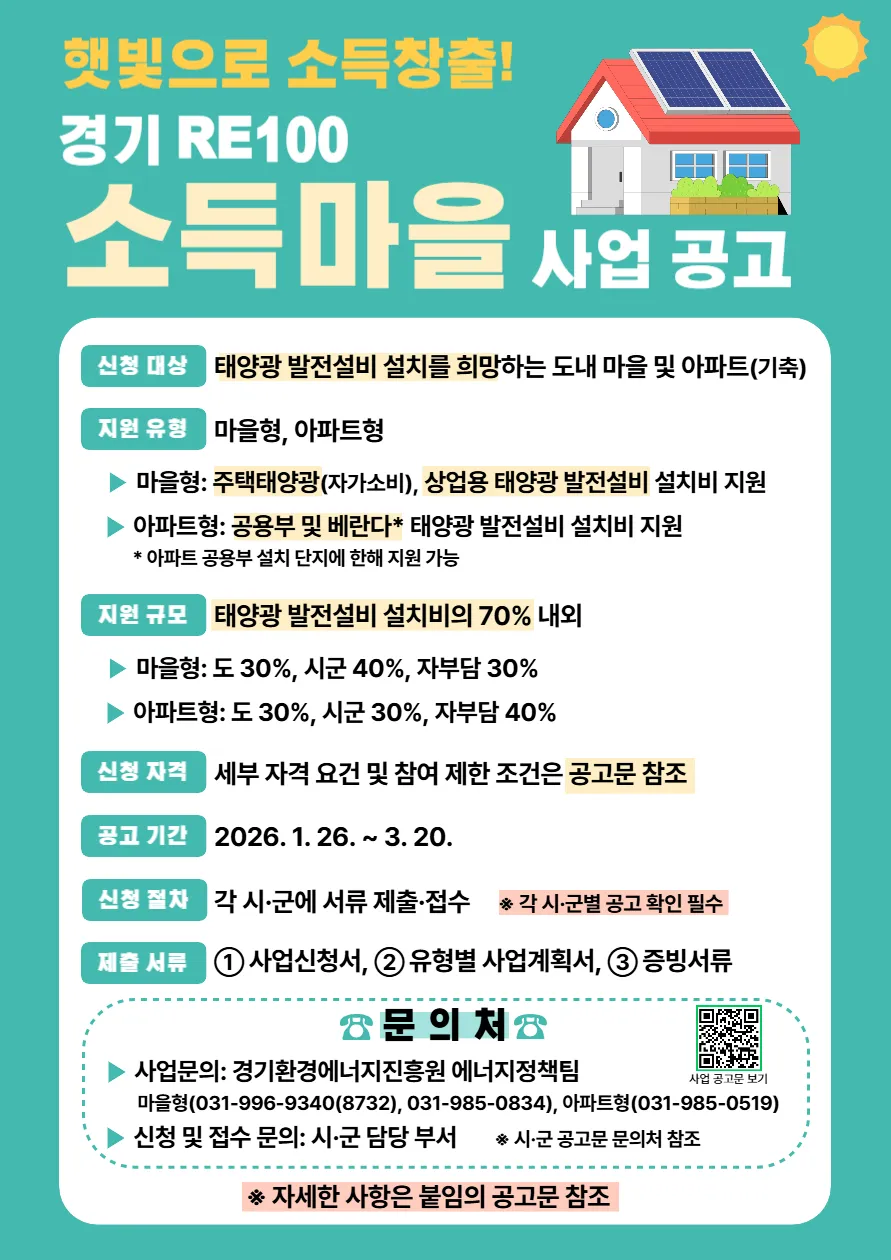
[Gyeonggi RE100 Income Village Project Announcement © Gyeonggi Environment and Energy Promotion Agency]
This year, Gyeonggi Province is investing KRW 12.8 billion in provincial funds to support 200 villages, pursuing the long-term goal of creating a total of 2,000 income villages by 2030. By activating a ‘one-stop support system’ through the Gyeonggi Environment and Energy Promotion Agency, the province plans to provide close support for administrative procedures such as permits and shorten the timeline to project implementation. If income villages spread, we can expect a virtuous energy cycle in which the welfare of energy-vulnerable areas improves and the renewable energy transition advances simultaneously.
Villages and apartment complexes wishing to participate in the RE100 Income Village creation project may submit project proposals and supporting documents through their respective cities and counties to the Gyeonggi Environment and Energy Promotion Agency by March 20 (see contact information below). RE100 Income Villages make a significant contribution to the practice of energy welfare, including reducing individual household electricity bills, creating village welfare funds, and generating opportunity income. A village where sunshine becomes income is not as far away as one might think.
☞ Gyeonggi Environment and Energy Promotion Agency — Gyeonggi RE100 Income Villages: Application Information Page
☏ Project Inquiries — Village Type: 031-985-0834 / Apartment Type: 031-985-0519
by Editor N