
On April 30, Korea's exposure draft of sustainability-disclosure standards was announced. Going forward, as in the U.S., domestic listed companies will have to disclose sustainability- and climate-related risk information in line with the disclosure standards. For example, if a company purchased greenhouse-gas-emission-reduction facilities in line with the Scope 1 standard, it can disclose the facility-purchase cost and the greenhouse-gas emissions that the facilities will reduce.
The timing of the disclosure's introduction has not been finalized. Scope 3* disclosure, which had been at the center of controversy, was classified as optional to ease the corporate burden. It appears that the mandating and timing of application will be decided through later discussion.
*Scope 3: a supplier's greenhouse-gas emissions
The exposure draft is broadly divided into three items: No. 1, general matters for the disclosure of sustainability-related financial information; No. 2, climate-related disclosure matters; and No. 101, additional disclosure matters considered for policy purposes. The purpose of this exposure draft is to provide sustainability information to help corporate investors' decision-making. According to the disclosure standards, a company must provide information on sustainability- and climate-related risks and opportunities that are expected to affect its management.
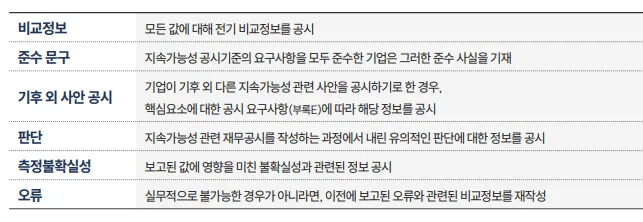
[A summary of the sustainability-disclosure-standards exposure draft, No. 1 General Requirements ©KSSB]
No. 1 includes content that must be complied with when preparing and reporting sustainability-related financial information. Going forward, companies must prepare prior-period comparative information, the fact of compliance with the sustainability-disclosure standards, key elements when disclosing non-climate matters, information on significant judgments in the process of preparing sustainability-related financial disclosures, measurement-uncertainty information, and information on previously reported errors. Besides the disclosure standards, it proposes referring to the standards of the "Sustainability Accounting Standards Board (SASB)" or the "Climate Disclosure Standards Board (CDSB)" for water and biodiversity.
No. 2 requires climate-related risk information regarding a company's governance, strategy, risk management, and metrics. Companies must disclose both the negative physical risks and the transition risks that climate will pose to the company. In the governance item, they state the decision-making body that will oversee climate-related risks and the climate-related risks that management considers in the decision-making process. In the strategy item, they disclose information on the impact of climate-related risks on the company's business model and value chain, along with information on the company's capacity to respond to its climate risks. The risk-management item records the process of assessing and monitoring climate risks and opportunities. In the metrics item, information belonging to the following seven metric categories must be indicated.
1. Greenhouse-gas emissions
2. Information on assets or business activities vulnerable to transition risk
3. Information on assets or business activities vulnerable to physical risk
4. Information on assets or business activities aligned with opportunities
5. Capital deployment
6. Internal carbon price
7. Executive compensation
Finally, the No. 101 exposure draft—an additional disclosure matter considering policy purposes—requires the disclosure of information already being disclosed under law, as well as additional information such as childcare-friendly management and safety management. It is part of a policy that proposes that companies, too, help solve social problems in line with the intent of ESG policy.
The Korea Sustainability Standards Board (KSSB) will hold an opinion-consultation period until August 31 and plans to seek stakeholders' opinions before announcing the final disclosure draft. The questionnaire for the disclosure-standards exposure-draft opinion consultation can be found on the Sustainability Standards Board's website.
by Editor N