

Humanity's carbon footprint is relentless. Even by burning our own dead bodies, we leave carbon dioxide in the atmosphere as we depart. Cremation, one of the methods of handling the deceased, is on a rising trend worldwide. In particular, in the East Asian countries with small national territories—Korea, Japan, and Taiwan—the cremation rate is said to exceed 90%. Japan's is close to nearly 100%. It is true that cremation is an alternative to cramped territory and complicated burial procedures. The words "When I die, just cremate me" sound almost like a thoughtful gesture to do less harm to the world and to those around us.
But in reality, that is not so for the Earth. Cremating a single body generates about 160 kg of carbon dioxide. The number of deaths in Korea in 2023 was 352,700. If we estimate that 90% of these were cremated, the carbon dioxide generated by cremation procedures in 2023 comes to about 50,000 tons (CO2eq). This is similar to the amount of carbon dioxide emitted in one year by about 10,000 internal-combustion vehicles. Cremation, which had seemed like the solution to a problem, has become a problem itself as the climate crisis arrives. Just like death with dignity, which has already settled in as an active social discussion, it is worth diligently pondering the environmental impact when choosing the process and method of one's own death.
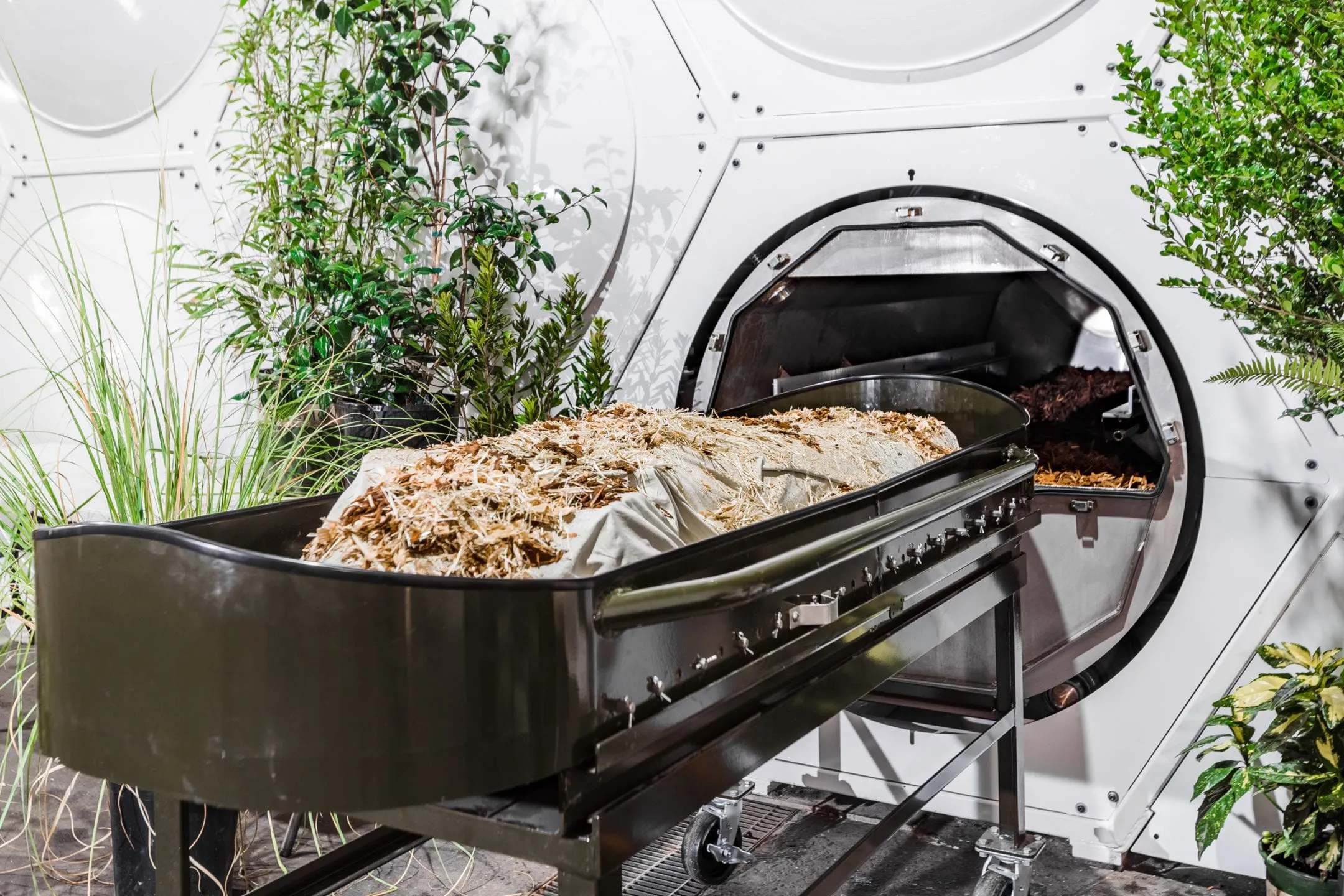
[The interment facility of "Recompose," a U.S.-based company that turns a body into soil in 30 days ©Recompose]
A Way to Return to the Soil
In May 2019, in the U.S. state of Washington, a "Human Composting" bill passed. Literally, it made it possible to turn a body into compost. Until that bill passed, burying or cremating a body were the only legal methods of handling it. A company called "Recompose" made a great effort in getting the law passed. Recompose, taking a hint from turning livestock carcasses into compost, succeeded in research on turning bodies into soil, and afterward, through meetings and discussions with policymakers, brought about the bill's introduction. After the bill passed, companies providing funeral services similar to Recompose sprang up one by one. And Colorado, Oregon, Vermont, and New York passed bills in succession.
A Way to Return to Water
There is also the "Alkaline Hydrolysis" method, which treats a body in an alkaline solution at high temperature and high pressure. When the body's decomposition ends, bones and a sterile liquid containing sugars, salts, and the like remain. Because the liquid is harmless to the environment, sewage treatment is possible, and the remains can be made into bone ash and returned to the family, the same as after cremation. This method—also called "Water Cremation"—is evaluated as using far less energy than burial or cremation. The U.S. state of Minnesota first passed a bill in 2003, and now water cremation is legally possible in more than 20 states. Outside the U.S., some Anglophone countries, such as the UK and four Canadian provinces, carry out water cremation.
Implementation Is Possible, but Practice Is Not Yet
Although the methods of handling bodies are thus gradually diversifying, worldwide the share of burial or cremation is still overwhelmingly high. The same is true even in regions where a bill has passed and implementation is possible. This is because it is still blocked by the walls of perception and custom. Burial is a time-honored method that humanity has practiced since 100,000 years ago. Cremation has a short history by comparison, but its share is gradually rising. Religious reasons are also large. Both Christianity and Islam have carried on the custom of burying bodies in the ground, and Buddhism has a cremation culture. When the human-composting bill passed in Washington State, the Catholic community even sent a letter to the Senate with the content that it was "a method lacking respect for the body." But whether confining a body in a hard-to-decompose coffin and burying it in the ground is a more respectful act toward the body than returning to a handful of soil and becoming nourishment for nature is a matter to think through and weigh.
by Editor N