

[An image of Ulsan City's hydrogen-electric tram ©Ulsan City]
Last week, 17 cities and provinces nationwide, including Seoul, each announced climate-crisis-response policies. Seoul stated that it would disclose the greenhouse-gas emissions of private buildings in 2026, and local governments submitted their First City/Provincial Basic Plan for Carbon Neutrality and Green Growth to the Ministry of Environment. They are drawing attention for having taken up the climate-crisis response through policy, but opinions continue that these policies are nothing more than a guideline role and have no policy effectiveness.
Seoul is implementing a "low-carbon building certification" policy by introducing LEED (Leadership in Energy & Environmental Design), an eco-friendly, low-carbon evaluation and certification system. On the grounds that 70% of Seoul's greenhouse-gas emissions occur in the building sector, it is pushing a project for 1 million low-carbon buildings and has also set out to introduce a total-cap system on building greenhouse gases. Representative LEED-certified buildings are Seoul's Gangnam Finance Center, Yeouido IFC, and Jamsil Lotte Tower. However, criticism follows that, without enforceability, it does not help actual greenhouse-gas-emission reduction. It has significance in being the first in Korea to set out to measure the total energy of private buildings, but the view is that it does not help actual reduction.
The U.S., which is actively taking up the climate-crisis response, has run the "Energy Star" system, which evaluates buildings' energy use, since the 1990s. It is a system for voluntarily measuring energy use, but New York City and Seattle are moving quickly for actual greenhouse-gas-emission reduction.
Under the Climate Mobilization Act enacted in 2019, New York City has been imposing fines from this year to reduce greenhouse gases emitted from mid- to large-sized buildings in New York by 2050. If a building's energy-efficiency grade is not submitted within the deadline, it is charged $1,250; if a report is not submitted within the deadline, $500; and depending on conditions, a fine of up to $2,000 per year is imposed. The fine system that Seattle will apply from 2031 carries a bit more enforceability. Buildings exceeding the greenhouse-gas-emissions standard are fined up to $10 per 0.1 square meter, depending on building type. Under alternative-payment rules, one may have to pay $190 per MTCO2e (million tons of carbon-dioxide equivalent).
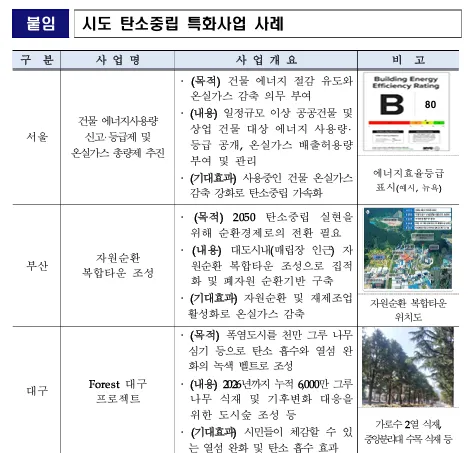
[Examples of region-specific projects in the First Basic Plan for Carbon Neutrality and Green Growth ©Ministry of Environment]
The First Basic Plan for Carbon Neutrality that the 17 local governments submitted to the Ministry of Environment is likewise evaluated as a plan lacking in concreteness and sincerity. This is because it appeared to focus only on region-specific projects instead of connecting energy sectors—such as district heating and cooling, which are effective for actual energy-use reduction. Besides the Seoul case, the basic plan contains content such as Daegu planting 60 million trees by 2026 and Ulsan newly establishing two tram lines operated by hydrogen-electric power by 2032. A skeptical view follows that, unlike the reduction targets set, it presents plans that still remain at the level of specifics, so it will have no effect on actual reduction.
This basic-plan submission was carried out according to nationwide local-government plans aligned with the national target of the Ministry of Environment reducing greenhouse-gas emissions by 40% compared with 2018 by 2030. Each local government, after considering on-site conditions and reflecting residents' opinions, prepared the basic-plan action guidelines through deliberation by the local Carbon Neutrality and Green Growth Committee. The Ministry of Environment is known to plan to report the analysis of the local governments' basic plans to the presidential "2050 Carbon Neutrality and Green Growth Commission" next month.
by Editor N