

"Exxon Mobil Corp.," the largest oil company in the U.S., recently filed a lawsuit against its own investors, "Arjuna Capital LLC" and "Follow This." For a company to sue its own shareholders is unusual even in the U.S., the land of lawsuits. Both of the investment firms Exxon Mobil accused are "activist investor groups" that demand a company's sustainable management as shareholders. This lawsuit shows, beyond the tension between fossil-fuel companies and activist investors, the "anti-ESG sentiment" arising in the U.S. in full.
The lawsuit began with the shareholder proposals that Arjuna Capital and Follow This submitted to place items on the agenda of the shareholders' meeting. Exxon Mobil claims that the two investment groups deliberately acquired small amounts of stock to obstruct corporate governance. The proposals mainly contained content demanding a reduction of Scope 3 emissions, and the argument is that these proposals are unrealistic and, in the long term, run counter to shareholder value.
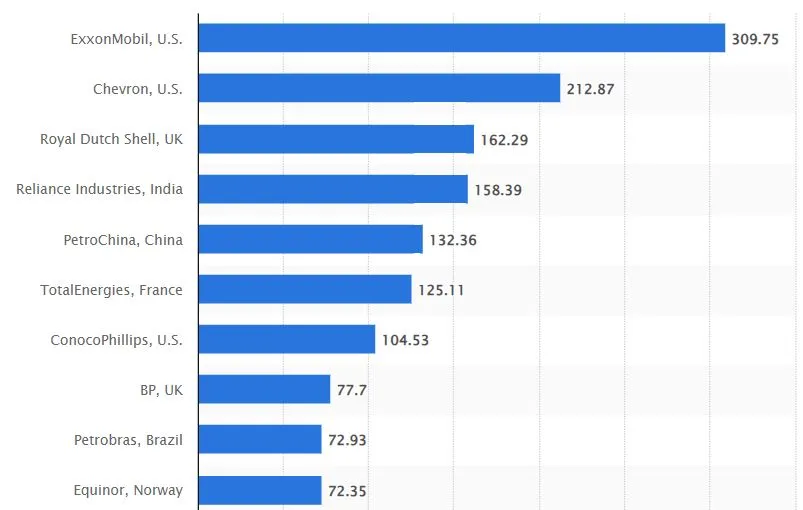
[Exxon Mobil, which ranked No. 1 in market capitalization among the world's oil and gas companies as of 2023 ©Statista]
How Is Governance Intervention Possible with Only a Small Investment?
Even small investors can sufficiently intervene in corporate management under the U.S. "Securities and Exchange Commission (SEC)" Rule 14a-8. That rule allows shareholders to submit items for a company's annual meeting. The qualification can be met if a shareholder holds at least $2,000 worth of stock, or 1% of the company's securities, for at least one year. In other words, Arjuna Capital and Follow This's agenda proposals are lawful. But Exxon Mobil argues that it is improper for investors to repeatedly submit proposals that do not consider the company's long-term value while holding only a minimal amount of stock.
The Two Investment Firms That Withdrew Their Agenda Requests
When Exxon Mobil filed the lawsuit, the two investment firms withdrew their agenda requests. It is highly likely they feared that the cost and duration of the lawsuit would grow astronomically. But Exxon Mobil stated that it would continue the lawsuit. This is because the lawsuit had the purpose not only of preventing the two firms' proposals from being placed on the shareholders' meeting agenda, but also of fundamentally blocking activist investors from influencing corporate governance with small investments. There is a view that Exxon Mobil is trying to use this opportunity to also influence the SEC's rules.
Exxon Mobil, Which Moved the Playing Field
The conflict moved from inside the company to the court. The court will review the intent and legality of the agenda the two firms attempted to place, and—more broadly—investors' rights regarding corporate governance, the interpretation of the SEC's rules, and so on. The investment firms have argued that their proposals lower the company's environmental impact and align with broad social values and sustainability goals, while Exxon Mobil sees such small investors' actions as not only running counter to shareholder value but also as a kind of abuse of rights. Whether it is Exxon Mobil or the investors that truly values the company's long-term interests will now be decided in court. And that outcome will cause a great reverberation in the changing role of shareholders regarding corporate governance.
by Editor N