

Major countries are successively postponing the mandatory implementation dates for ESG disclosures. First, South Korea delayed the mandatory disclosure deadline for listed large corporations, originally set for 2025, by one year. The EU will proceed with cross-industry common ESG disclosures as scheduled starting this January, but industry-specific ESG disclosure implementation has been postponed by two years from the originally planned June of this year to 2026. The U.S. Securities and Exchange Commission (SEC) has also delayed the release of its final climate disclosure rule multiple times, now scheduling it for April of this year. Of course, even this may be further delayed.
Why ESG Disclosure Keeps Getting Postponed
While there are various reasons, the biggest is widely considered to be the burden felt by companies. Unlike conventional disclosures that contain financial information such as income statements and financial statements, ESG disclosures must include fragmented non-financial information. It is not an easy task to quickly identify and organize information that previously had no legal disclosure obligation — such as greenhouse gas emissions and reduction plans.
According to a survey by the Korea Chamber of Commerce and Industry, over 90% of companies conducting voluntary ESG disclosures rely on external professional agencies. Only 14.0% of companies had their own in-house ESG IT systems. Due to these difficulties, the Korea Employers Federation requested relevant government bodies, including the Financial Services Commission, to postpone the mandatory ESG disclosure deadline by one year, and the government accepted. The EU's disclosure delay was also aimed at reducing the burden on businesses.
The Emergence of Disclosure Support Solutions
In the meantime, solutions to reduce the burden of ESG disclosure for companies have emerged. Accounting firms, which already serve as financial disclosure advisors to companies, and SI (System Integrator) firms with strengths in data management have taken the lead in launching platforms that support ESG disclosure. These platforms assist obligated companies with tasks such as identifying the data they need to collect, efficiently managing that data, and processing it in accordance with international reporting frameworks like the Sustainability Accounting Standards Board (SASB), the Task Force on Climate-related Financial Disclosures (TCFD), and the Global Reporting Initiative (GRI).
Accounting firms, in particular, emphasize their consulting expertise, going beyond ESG disclosure support to assist with overall ESG management. PwC Samil Accounting Corporation highlights that through its 'ESG Platform' service, it can help with 'redefining Vision for transitioning to an ESG management system,' 'establishing business strategies that integrate ESG value,' and 'building a monitoring system for strategy execution and performance.'
In the SI sector, IBM, a leading company, acquired the Australian sustainability data analytics company 'Envisi' and integrated it with its own AI software to complete the IBM Envizi ESG Suite (hereafter 'Envizi Suite'). The Envizi Suite automates the collection of ESG and greenhouse gas emission data and structures and standardizes the data to create the foundation for reports. IBM emphasizes that the Envizi Suite can reduce the time companies spend on ESG disclosure by 50% and highlights a case where it saved a company 20 million dollars in energy and water usage costs.
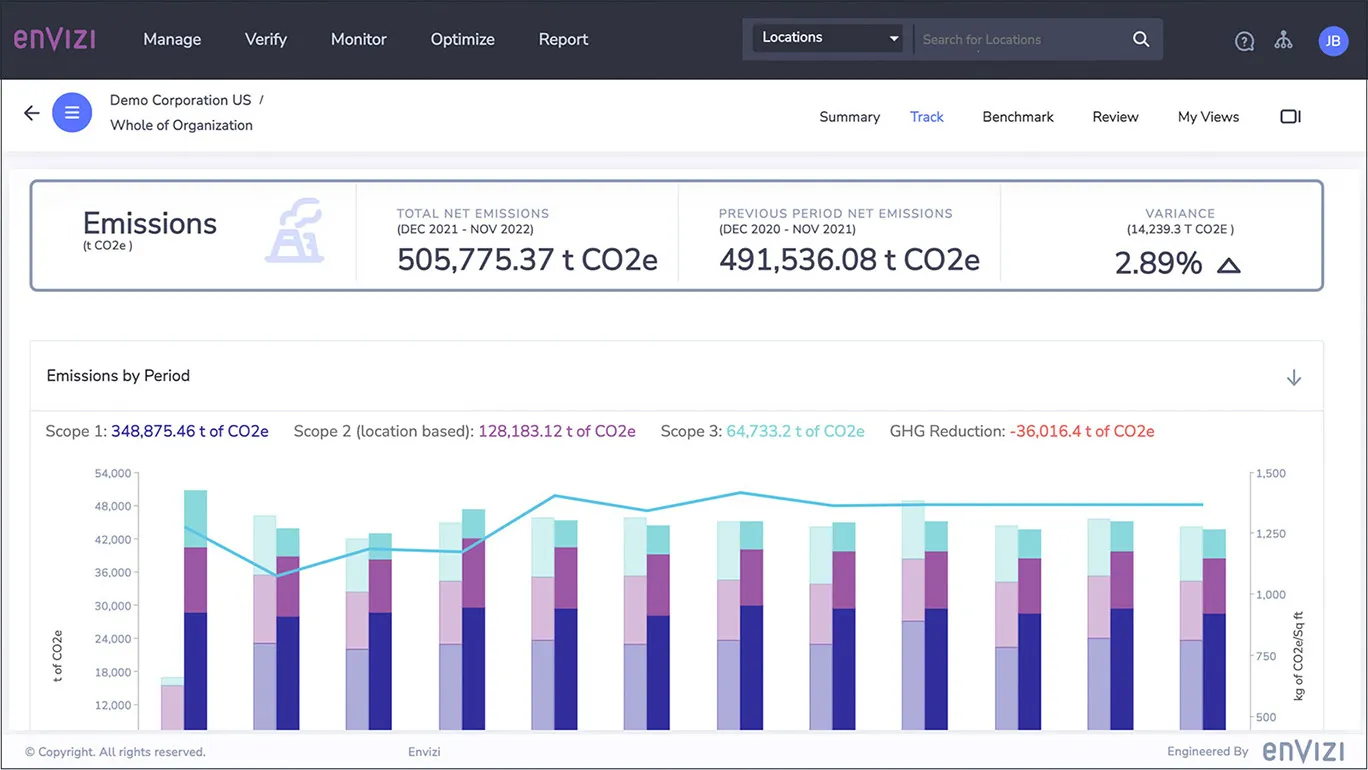
[Envizi Suite Carbon Emission Management Dashboard Demo ©IBM]
Will Platforms Solve the Disclosure Burden?
Of course, introducing a platform alone cannot eliminate the ESG disclosure burden in one stroke, because the absence of systems is not the only problem. According to a 2023 survey by the Federation of Korean Industries, 61.1% of domestic companies cited 'ambiguous disclosure concepts and lack of clear standards' as the biggest challenge in ESG disclosure. Export companies, moreover, struggle because disclosure standards differ from country to country. The disclosure standards of the International Sustainability Standards Board (ISSB), which will serve as the basis for South Korea's ESG disclosure, were also unveiled six months later than planned in June of last year after repeated coordination. The official Korean translation was only released just two weeks ago, in December.
Nevertheless, some argue that there is no real benefit in continuing to postpone ESG disclosure. Even if South Korea delays its disclosure timeline, export companies will still have to disclose anyway, and beginning disclosure will allow businesses to adapt to the system sooner and enhance their global competitiveness. Since some companies are already voluntarily making disclosures, it is not an impossible task. Professional disclosure support solutions from specialized firms are also beginning full-scale service operations. What matters most is the will of the obligated companies. Where there is a will, there is a way.
by Editor N