
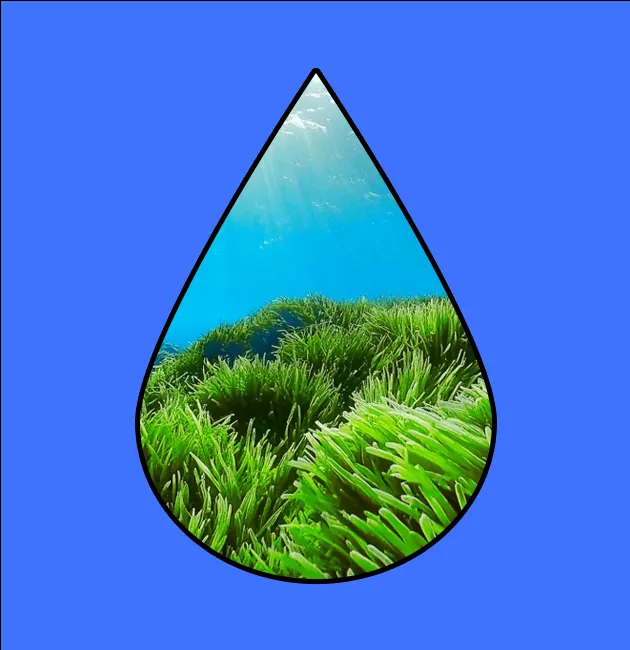
In this era of climate crisis, marine ecosystems are drawing attention as the last relief pitcher that will save the Earth. The sea's carbon sinks—called "blue carbon," such as seaweeds, mangrove forests, halophytes, eelgrass, salt marshes, and tidal flats—boast a carbon-absorption and storage capacity 50 times faster than that of land forests.
Jeju Island is rich in these blue-carbon resources. The "Knowledge Exchange on Blue Carbon" event, organized by the "World Bank," is held in Seoul and Jeju from March 31 to April 4. Jeju's resource-management activities have recently drawn attention in connection with responding to climate change, and during the event Jeju Island introduces on-site blue-carbon policy locations within Jeju—such as the marine-forest creation site off the coast of Jongdal-ri in Gujwa-eup, wind-power complexes, and the carbon-reduction facilities and solar facilities of Jeju Port. Kang Ae-suk, director-general of Jeju's Climate and Environment Bureau, said, "This event is a meaningful occasion in which the international value of Jeju Island's blue-carbon policy is recognized."

[The "Carbon-Eating" Sea — the Potential of Blue Carbon ⓒESG.ONL]
The environmental organization "Friends of Jeju's Nature" raised its voice, saying that along with Jeju's marine-forest creation and port carbon-reduction facilities, attention should also be paid to "measures to conserve existing halophytes." It also stressed that a policy to conserve "coastal dunes"—one of the important forms of blue carbon—is as important a strategy as growing halophytes, urging the importance of balanced ecological formation.
Currently, there are not many blue-carbon-related social enterprises active in Korea. But blue-carbon-related technology is evaluated as having great growth potential, and many companies are interested. In 2024, the Hyundai Motor Chung Mong-koo Foundation invested in a blue-carbon climate-tech startup. "Blue Carbon," an eco-friendly climate-tech company founded by Professor Hwang Dong-soo of Keimyung University and others, holds source technology for carbon capture. With Hyundai Motor's support, Blue Carbon received an innovation award last year at "CES (Consumer Electronics Show)," the world's largest IT expo. GS Caltex carries out blue-carbon creation activities at the Ramsar wetland in Buan-gun, North Jeolla Province, and Kia is also cooperating with the Ministry of Oceans and Fisheries to restore domestic tidal-flat vegetation. Companies such as Hyosung, POSCO, and KB Kookmin Bank are also lending strength to eelgrass-propagation projects—eelgrass being a plant effective for spreading marine forests.
In responding to global climate change, we should pay attention to the growth and contribution of Korea's blue-carbon-related climate-tech companies.
by Editor N