

There are university students seeking to examine the ‘environmental problems of a new dimension’ that the current generation faces. The ‘Unbridled Advertising Group,’ a gathering of advertising club students from Korea University, Dongguk University, Sejong University, and Ewha Womans University, is holding an advertising festival under the theme of <Rebirth (甦生): Be Green> from November 14 to 16. Why did the approximately 100 students, gathered under the name of the Unbridled Advertising Group and active as aspiring advertisers and marketers, come to talk about the environment and rebirth? Let us hear their vivid stories as they prepare for the advertising festival.

[<Rebirth (甦生): Be Green> held at Eulji Twin Tower from November 14 to 16 Ⓟ Unbridled Advertising Group]
We are curious why you chose the keyword ‘Rebirth (甦生)’ as your theme. Among numerous environment-related keywords, why did you focus on ‘coming back to life’?
// We thought ‘Rebirth (甦生),’ which means ‘coming back to life,’ conveys a message of hope and recovery for the environment through the word itself. Rather than simply shouting that we must protect the environment because the problems are severe, we wanted to convey a positive perspective that we fully believe in the possibility of living again even amid what we have already lost, and that we should act. Thus, Rebirth signifies not only the will to bring the environment back to life, but also our attitude of believing in the power of change even amid crisis, and our resolve toward a world in which all life and values breathe again.
As university students today, what is your perspective on environmental issues? We are curious about what concerns were exchanged when discussing the theme.
// We feel that interest in environmental problems and the environment has grown not just among ‘university students’ but across all generations. However, we think that a ‘contradiction’ still exists between the interest in the environment and students’ actions. As we produce advertising materials, waste such as paper and plastic is inevitably generated. But at an advertising festival themed around the environment, we felt a sense of awareness that it would be contradictory for us to harm the environment. So we held many discussions among members to operate in a direction that places as little burden on the environment as possible. For example, we directly contacted brands that use eco-friendly materials to request sponsorship, and we sought to reduce environmental pollution by minimizing printed materials and creating a system to collect pamphlets. These were attempts to make it not merely ‘an advertising festival that talks about the environment’ but ‘an advertising festival that practices it.’
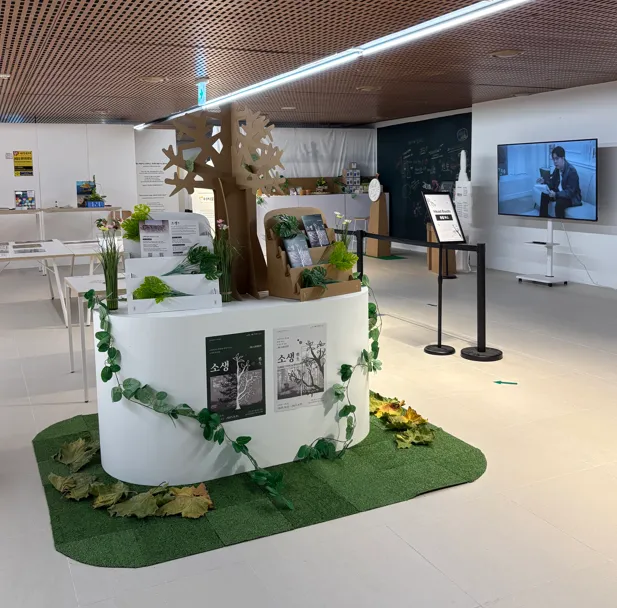
[<Rebirth (甦生): Be Green> Exhibition Site Ⓟ Unbridled Advertising Group]
There are many advertising festivals dealing with environmental issues. If there is a differentiated perspective or message unique to the ‘Unbridled Advertising Group,’ what would it be?
// We think the category of ‘environment’ is a fairly accessible concept, but precisely for that reason, we believe there are many stories that can be unpacked from it. The greatest differentiating point is that we did not view the concept of ‘environment’ solely through the lens of physical pollution. We did not stop at dealing with traditional environmental pollution issues such as waste, fine dust, and plastic, but addressed problems that have expanded into the realm of the ‘digital’ and ‘conscience’ — new forms of environment facing the current generation. Our Unbridled Advertising Group selected three themes within the broad category of environment — resources, digital, and the paradox in the name of eco-friendliness — to convey our message. Additionally, as mentioned earlier, in terms of DP and the like, if you also look at the exhibition hall — where minimal resources were used to create a feel that, while not grand, is clean and orderly — you will also experience a different kind of enjoyment.
The three axes of ‘rebirth of resources, rebirth of digital consciousness, and rebirth of conscience’ are intriguing.
// Through the three sections of this advertising festival, we sought to view environmental problems from a new dimension. Initially, we tried to structure the advertising festival around keywords that first come to mind when thinking of ‘environment,’ such as plastic, recycling, and waste sorting. But through repeated discussions, we came to think: what about awakening people to things they had unconsciously passed by and not been aware of? From that point, we came to realize that environmental problems are deeply hidden even within the things we use every day but take for granted (consumption, digital devices, our attitudes, etc.). In fact, we think it is not easy for people to reflect on their own unless someone awakens them. Therefore, the three themes — resources, digital consciousness, and conscience — lead to a flow that urges changes not only in the environment but in our perception and attitude toward the environment. The ‘Rebirth’ we speak of is not only the recovery of nature but also the process of our environmental consciousness awakening once more.
As a university student advertising club dealing with ESG and environmental issues, what would you say are your strengths compared to companies or professionals?
// We think our greatest strength as a university student advertising club is that we can present new perspectives based on diverse backgrounds and viewpoints. Our advertising festival is a project created together by approximately 100 university students from various departments across multiple schools, not just one. As a result, even when looking at topics like the environment or ESG, the perspectives rooted in different majors and experiences came together to reveal much broader and more multi-layered viewpoints. While companies and professionals generally approach issues with a focus on feasibility and marketability, we began from the free imagination and awareness of problems characteristic of university students. Starting from questions like “Is this truly sustainable?” and “What can we actually change?” we placed greater importance on the sincerity of the message and the meaning of practice than on realistic constraints. Ultimately, we believe our strength lies in ‘diverse attempts’ rather than ‘the right answer.’ Our strength seems to be the candid perspective of a generation looking at environmental issues and the potential to lead future changes.
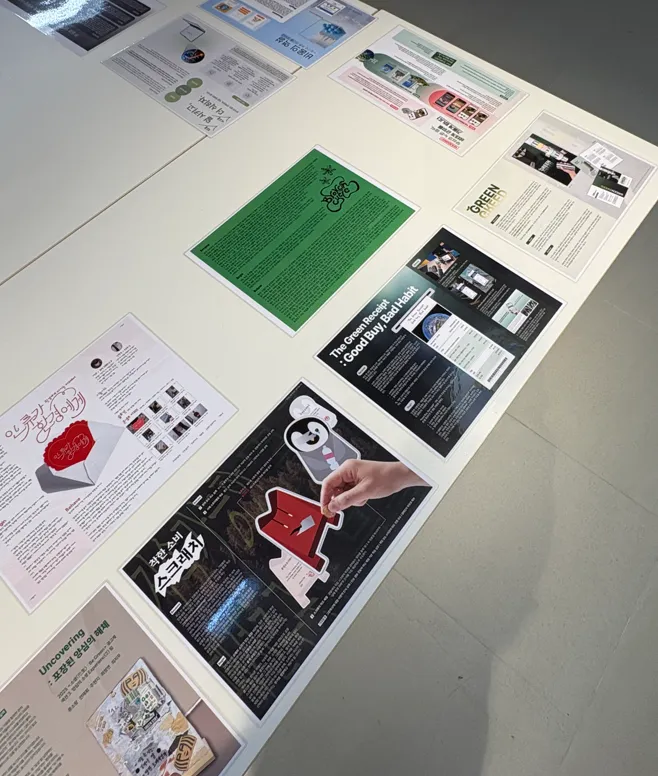
[A draft through which the experience provided by the Unbridled Advertising Group can be understood Ⓟ Unbridled Advertising Group]
What kind of experience do you want to provide to the audience through holding the advertising festival?
// In fact, the Unbridled Advertising Group has held its advertising festival in an ‘exhibition format’ every year, but this year’s festival was designed so that the viewing itself is an experience of the ‘process of rebirth,’ rather than a mere exhibition listing outcomes. As the audience walks through the exhibition hall, they follow a journey leading from ‘rebirth of resources → rebirth of digital consciousness → rebirth of conscience,’ and this circulation route is structured as a storytelling structure that allows one to directly feel how the environment and consciousness in which we live can come back to life.
And this advertising festival is being held simultaneously with an online exhibition, where the descriptions of the works created by each team are explained in a PT board format in the form of ‘Because-Begin-Behave.’ And by enabling people to view the environment from a multifaceted angle and think about rebirth through the organic connection of the three sections, we sought to induce behavioral action from the audience.

[‘Rebirth’ that can be experienced online Ⓟ Unbridled Advertising Group]
// We hope it will be an advertising festival where novelty remains in memory and influences the audience’s lives. We think it would be a successful advertising festival if people experience information they were not aware of before through actual experience, and this impact later affects their daily lives. For example, there is much new knowledge to be gained, such as the dual nature of merchandise and Black Friday events, and the fact that the overuse of digital resources is also environmental pollution. How this is applied to daily life will differ from person to person, but if possible, we would like even small behavioral changes to occur, such as ‘stopping in one’s tracks before downloading a meaningless file.’
by Editor N