

With 100 days left before the Paris Olympics, the flame was lit on the 16th (local time) at the Temple of Hera in Olympia, Greece. This past March, the posters of the Paris Olympics and Paralympics were unveiled, announcing that the 2024 Summer Olympics had drawn near to us. The posters were handled by Ugo Gattoni, well known as a scarf designer for Hermès, who visualized the slogan "Games Wide Open," carrying the meaning that the entire city turns into a stadium. From the very size of the posters—containing Paris's landmarks and all sorts of symbols—they showed a look differentiated from past Olympics and drew the world's attention.
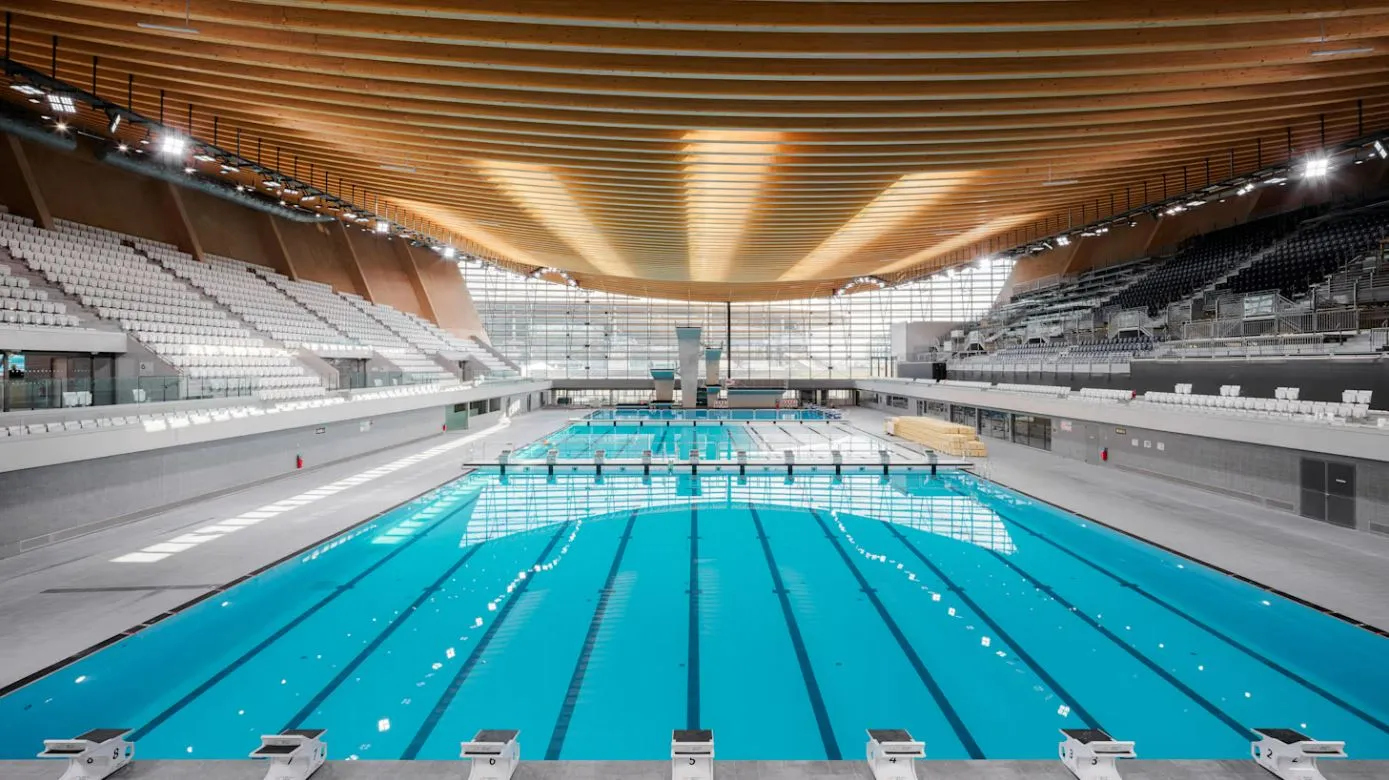
[The interior of the Aquatics Centre, built with wood and recycled materials ©Salem Mostefaoui/Olympics.com]
Before becoming a topic for its poster design, the Paris Olympics steadily emphasized "the sustainability of the Olympics." From the planning stage, it decided to minimize new construction for the Olympics and make maximum use of existing facilities. The newly built facilities are only the Olympic Village, the Aquatics Centre, the climbing facility, and the Adidas Arena, which correspond to about 5% of all facilities for hosting the Olympics. The Olympic Village is a facility where participating athletes will stay, and once the Olympics end, it is set to be used as ordinary residential facilities. Other facilities are likewise set to be converted into local infrastructure after the Olympics. It also took into account minimizing environmental impact from construction materials all the way to power supply.
The Olympics in the Sustainability Era
Entering the 2000s, the economic effectiveness of the Olympics was a subject of steady debate. Along the line of debate, the number of bidding cities that took up the challenge to host the Olympics also continued to decrease. At the time of the 2004 Athens Olympics there were eleven bidding cities, but they gradually decreased until, for the 2024 Paris Olympics, the final bidding cities were just two. Moreover, hard-prepared Olympics were often criticized by the international community for destroying the environment. Beijing, Sochi, and Rio—which hosted the 2008, 2014 Winter, and 2016 Olympics—were particularly so. Not only in persuading the international community but also local citizens, the justification and benefit of hosting the Olympics could no longer be explained without sustainability. Perhaps for that reason, the Paris Olympics has striven tirelessly, from immediately after its selection as host, to create and publicize a waste-free Olympics.
Partnership in the Sustainability Era
Olympic operation and promotion are aided not only by the host country but also by corporate partners. Partners that immediately come to mind at the words "Olympic partner" include Coca-Cola, Samsung, Visa, and Omega. They put their names on the partner list for this Olympics without fail. Besides such traditional partners, from the late 2010s, companies in the IT and digital categories, such as Intel and Airbnb, began to join as partners. But the most notable partner at this Paris Olympics is Deloitte. Deloitte participated in the 2012 London Olympics in a supporter role—a kind of advisory rather than a partner—but this Paris Olympics is the first time it has put its name up as a worldwide partner.
It's the First ESG Partner
The reason Deloitte became a worldwide partner is none other than ESG. Deloitte took on the role of supporting the Olympics' "2020+5" agenda by using its expertise in the ESG field. 2020+5 is an operational roadmap announced by the "International Olympic Committee (IOC)" in 2021, and includes the following content.
[1. Sustainability] Focus on environmental protection, use of reusable and recyclable solutions]
[2. Digital Innovation] Make the games accessible to more people, enhance fan participation and experience]
[3. Financial Soundness] Maintain financial sustainability and strengthen the Olympic financial model]
[4. Strengthening International Cooperation] Strengthen cooperation with various sports organizations and improve global governance]
[5. Promoting Diversity and Inclusion] Pursue social integration and diversity, and all forms of discrimination and confrontation]
Deloitte stated that, during the partnership period, it plans to carry out various activities related to climate neutrality, diversity, inclusion, and athlete support based on its ESG expertise. Exactly what help Deloitte is providing in this regard is not precisely known. Watching, from an ESG perspective, what role Deloitte—which has joined the Olympics—will play and how it performs is also one of the viewing points of this Olympics.
by Editor N