
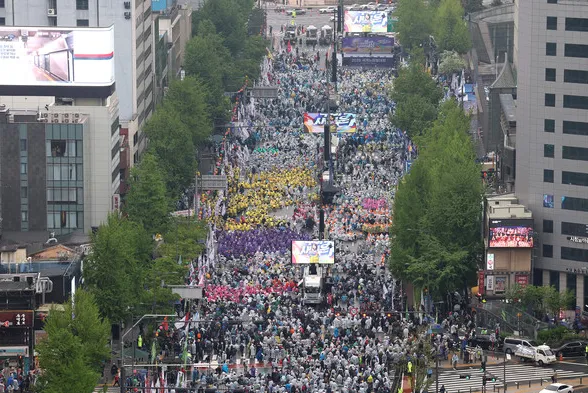
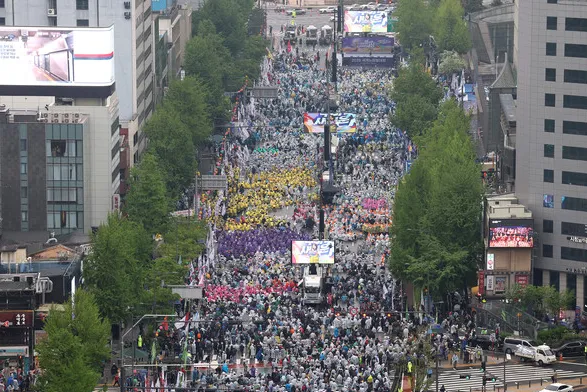
[The "2025 World May Day Rally" held near Sungnyemun © Yonhap News]
Workers' Basic Rights Viewed from an ESG Perspective
May Day is a day to remember sacrifice and struggle through the "Haymarket affair" — the large-scale general strike in which hundreds of thousands of workers in Chicago, USA, in 1886 demanded humane working hours, and the bloody incident that occurred in the process. Today, around May Day, workers, remembering this history, still raise their voices for a humane life and rights. Now that ESG management has established itself as an essential corporate value, in the "S (Social)" area, guaranteeing workers' human rights and basic rights becomes an indispensable evaluation criterion. The "International Labour Organization (ILO)" presented a guideline called "Just Transition," which holds that in the process of transitioning from a high-carbon economy to a low-carbon economy, the burden and harm on vulnerable groups must be minimized. Under this concept, companies must practice, for workers, improving the working environment, respecting human dignity, creating "Decent Work" in which productive labor takes place, and inclusive management in which no one is marginalized. But reality is not easy.
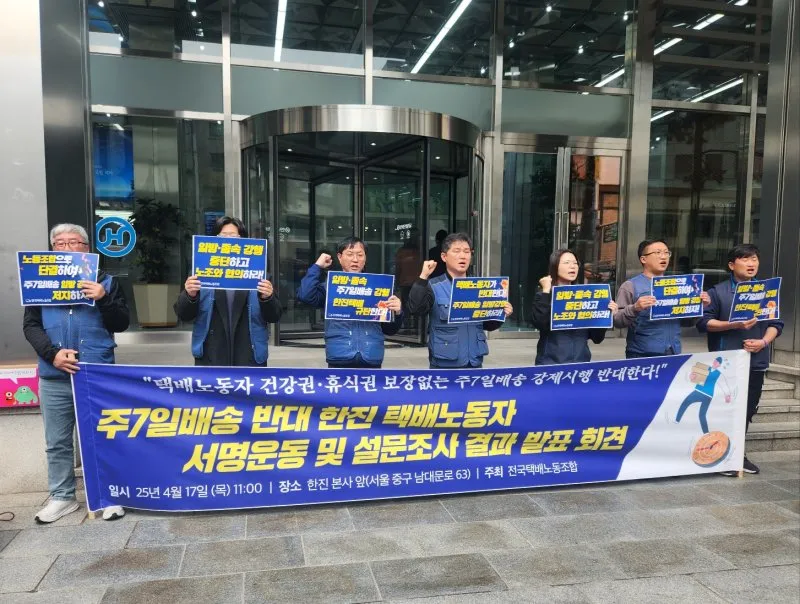
[Hanjin delivery workers opposing 7-day-a-week delivery © Newsis]
Delivery Workers, a Symbol of "Labor Without May Day"
Ahead of May Day, Hanjin delivery workers announced a position denouncing the forced implementation of 7-day-a-week delivery, which does not guarantee delivery workers' right to health and rest. The delivery workers opposed 7-day delivery, informing people of a labor reality in which — due to long working hours reaching 72 hours a week, cuts to delivery fees, and unstable forms of employment — even basic rights to health and rest are not guaranteed. Behind the convenient logistics service in which a package ordered the previous night arrives at the door when you wake up lies the ever-present reality of delivery workers who face excessive workloads and the risk of death from overwork due to the forced implementation of 7-day delivery without additional staffing.
To handle the delivery volume that surged after the COVID-19 pandemic and the shift to online commerce services, delivery workers have suffered hardship over the past several years. Over the eight years from 2017 to 2024, the number of delivery workers whose deaths from illness, including overwork, were recognized as industrial accidents totals 36. Including other causes such as accidents during this period, the total number of delivery-worker fatality accidents over the last five years rises to 51 (36 from illness, 15 from accidents). Including "hidden accidents" not captured in official statistics due to non-enrollment in industrial-accident insurance, the figure could rise further.
The solution presented by labor organizations including the KCTU to resolve delivery workers' burden is to induce appropriate working hours by preventing long, high-intensity labor — setting a maximum daily working time, restricting late-night delivery, and so on. These labor organizations are also strongly voicing the need for a five-day workweek and the guarantee of the right to rest, which is recognized as a natural right for workers in other occupations but is not observed for delivery workers alone. Labor organizations argue that overhauling the system so that workers are not disadvantaged even when delivery is delayed is also necessary.
Women, Youth, Migrant Workers... Why We Must Pay Attention to Vulnerable Labor Groups
A topic that has drawn attention for a long time in relation to labor issues is the problem of non-regular workers. The non-regular-worker problem refers to experiencing structural discrimination and inequality — not being paid the same wage for the same work, lower welfare and employment stability besides wages, and non-enrollment in essential social-security insurance. Korean law limits non-regular work to two years and regards fixed-term workers who exceed two years as indefinite-contract workers, but the reality of non-regular workers is one where employment insecurity is rampant — this is abused, for example, by restricting employment of more than two years itself.
The non-regular-worker problem is directed at vulnerable labor groups who have conditions that make it relatively hard to access quality jobs.

[The human-rights issue of women workers, still a task to be solved © Minjung-ui Sori]
Although it is said to have improved, society still views women workers with a double standard. Even amid declaring a national emergency over low birth rates and labor shortages, the gaze toward policies supporting women's work-family balance — women who stand before the burden of childcare and housework, conversion to non-regular status, and the threat of career interruption — is not always kind. Structural gender discrimination such as the gender wage gap also cannot be ignored. Korea has very few female leaders compared with other countries. The structure that limits women from becoming leaders is called the "glass ceiling index"; the average ratio of female corporate executives among OECD member countries is about 30%. That the ratio of female executives at domestic large corporations is about 6% — only one-fifth of that level — and has ranked last for 11 straight years alone shows our reality.
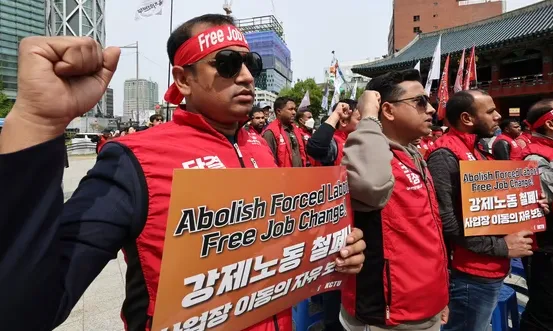
[Migrant workers demanding guaranteed freedom to change workplaces © News1]
Another vulnerable labor group is migrant workers. To put it in the extreme, Korea's dependence on migrant workers has now grown to the point that industrial sites cannot be operated without them. Migrant workers, placed in the most dangerous and poor working environments, currently number one million, but they suffer from low wages, high-intensity labor, unpaid wages, and violence and sexual assault. In particular, the current "Employment Permit System" places constraints on migrant workers freely choosing and changing their workplaces, a structure that makes it hard for migrant workers to actively escape poor working environments. Each labor organization, publicizing the migrant-worker issue on this May Day, argued the need for a minimum respect for human rights for the sake of Korean society's sustainability and the realization of justice.

[A protest for guaranteeing the human rights of youth workers © Newsis]
Youth workers, though few in number, also attended the May Day rally and raised their voices for youth workers' human rights. Youth workers, like adult workers, provide labor to our society, but due to the limitation of being newcomers to society, they frequently face unreasonable situations and suffer harm. There are also not a few cases where they suffer harm because they have not sufficiently learned about their rights as workers. For youth workers, whose numbers are increasing day by day, labor-human-rights education should be conducted starting from school, and it is necessary to strengthen the writing of employment contracts to protect them from excessive night and holiday work and unpaid wages when they provide labor. In addition, practical mechanisms are also needed so that young people can be protected from various rights violations and exploitation problems in the workplace — such as sexual harassment, which can also lead to serious crimes including crimes against children and youth.
The Korea Employment Information Service officially announced a prediction that from 2028, Korea's economically active population — that is, the working population — will decrease. Therefore, coexistence with the potential labor force that will support the insufficient workforce — women, foreigners, youth, and others classified as vulnerable labor groups — is essential for our government and companies.
A Call for a "Just Transition" for the Labor Market and Society
On this May Day, too, various worker groups gathered to publicize their respective pressing issues. The problems each worker group pointed out are not unfamiliar. We must undergo overall industrial-structure changes led by the climate crisis and the advance of AI technology, while carrying familiar problems long left unsolved. Of course, there are also new agendas. Discussion of introducing a four-day workweek has begun, and measures to improve the quality of life of older workers and resolve polarization as we enter a super-aged society have also become topics.
Considering the "Just Transition" — that support is needed so that no one is left behind in the process of transitioning toward a sustainable society — it is time to seek a transition to a society in which labor, welfare, and the environment achieve harmony, beyond simply preserving jobs. As satisfaction and joy in life through work are precious, let us all ponder together ways to guarantee the labor rights of various worker groups, replenish the insufficient workforce, and form better jobs.
By Editor L