
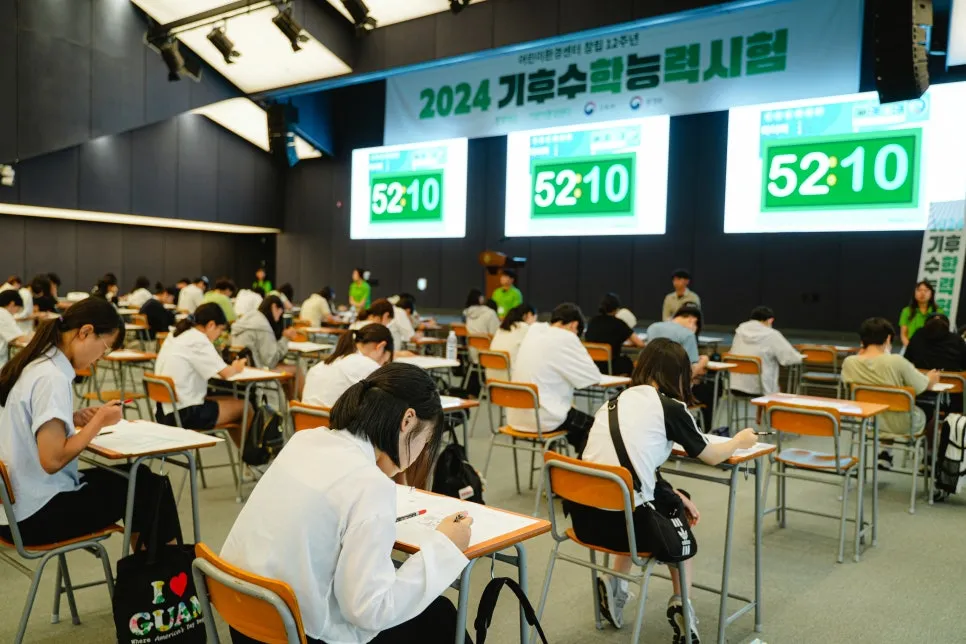
November 13 is the date of the 2026 College Scholastic Ability Test (CSAT). On this day of one of the nation’s major events, let us tell the story of another type of CSAT.
Seventy-five days before today, on August 30, 81 middle and high school students took a special CSAT. What these anxious-looking students received was the ‘2025 Climate CSAT Climate Section’ question paper, which closely resembled an actual CSAT paper. The students, holding the provided computer marker pens and mechanical pencils while pondering, looked no different from any other test-takers. After the exam ended, students checked their answers as with the CSAT and some even shed tears of regret.
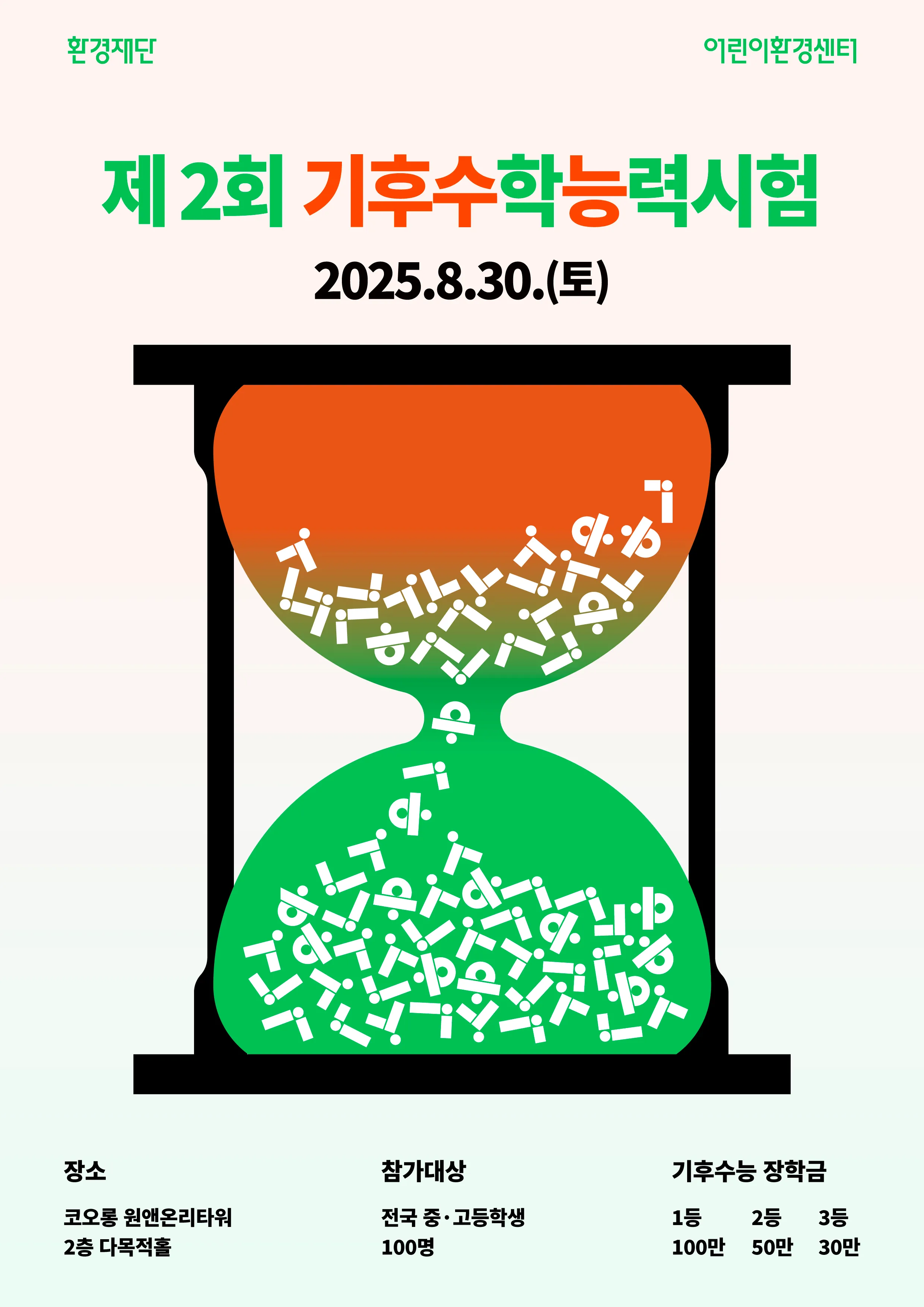
[2025 Climate CSAT Poster Ⓟ Korea Environmental Foundation]
Another CSAT: The ‘Climate CSAT’
The Climate CSAT hosted by the Korea Environmental Foundation marked its second edition this year. It is a project carried out by the Foundation’s Children’s Environment Center, now in its 13th year, together with the Ministry of Environment and the Ministry of Education, designed to help young people understand the climate crisis and build the capacity to respond proactively. Participants solve 38 multiple-choice questions and 2 short-answer questions in 60 minutes, drawn from the 2022 revised middle school environmental textbook and the latest climate and environmental issues.
This year’s Climate CSAT handwriting verification passage was a quote from Rachel Carson’s other book, <The Lost Woods>: “Wonder and humility are wholesome emotions, and they do not exist side by side with a lust for destruction.” It seemed to encapsulate the fundamental mindset we must hold in responding to the climate crisis. The average score was 69.8, up 6.8 points from last year, but the difficulty remained high. A number of concepts somewhat unfamiliar to adolescents appeared, such as RCP scenarios*, intergenerational equity**, and the EP100*** campaign, and the graph interpretation questions were reminiscent of the CSAT.
*RCP scenarios: One of the climate change scenarios that predicts how the climate will change by forecasting changes in the Earth’s greenhouse gas concentrations.
**Intergenerational equity: A concept often mentioned in environmental issues, meaning the fair sharing of resources, opportunities, and burdens between current and future generations.
***EP100: A campaign launched in 2014 that aims to double product energy efficiency and reduce greenhouse gas emissions.
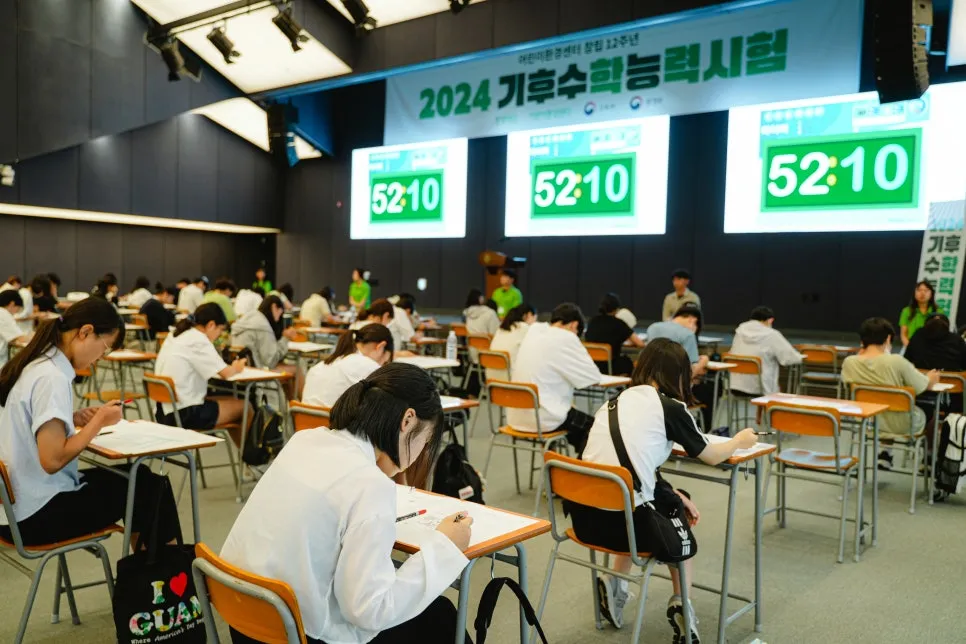
[2024 Climate CSAT Venue Ⓟ Korea Environmental Foundation]
Before the exam, the Korea Environmental Foundation provided a wealth of preparation materials on the Children’s Environment Center blog, as with the actual CSAT, helping both students and the general public study climate. It published environment textbook preview pages, core keywords for the exam, mini mock tests, and past exam questions. The 1st Climate CSAT questions and explanations can be downloaded from the Children’s Environment Center blog, and this year’s exam can be taken by anyone on the Climate CSAT website. Those scoring 60 or above can receive a ‘Climate Leader Certificate,’ and various events are held in connection with the actual CSAT.
The Foundation of the Climate CSAT: Climate Education Now
Prior to the exam, climate CSAT exam setter and Seoul’s only environmental teacher, Shin Kyung-jun, stated that “despite the increasingly severe climate crisis, domestic environmental education is in a very poor state.” While the 2022 revised national curriculum’s general guidelines include content reflecting ecological and environmental education responding to climate and environmental change across all subjects, and the revised environmental education explicitly states ‘climate crisis’ and ‘strengthening ecological transition,’ environmental education still remains a neglected subject compared to major ones. The proportion of schools offering environmental subjects among middle and high schools nationwide is only 7.9% for middle schools and 31.7% for high schools. The higher rate at high schools was sadly reported to be because environmental education hours can be used as ‘self-study time.’
Overseas, climate education is being made mandatory to respond to the climate crisis, actively encouraging student participation. The North of Tyne region in the UK decided in 2020 to place one climate and environment teacher in every public school, and Italy became the first in the world to adopt climate change as a mandatory subject, providing 33 hours of compulsory education annually to students aged 6–19. Finland, which has added climate and environmental education as a required credit, is even promoting participatory education in which students directly collect and interpret environmental data.
Do Other Countries Have a Climate CSAT?
Just as the CSAT is a uniquely Korean exam, the ‘Climate CSAT’ is rare overseas. However, there are a few noteworthy exams. The French Ministry of Education announced that it would introduce a ‘Green Knowledge Certification Exam’ for fourth-year middle school students starting in 2024. It covers desirable dietary habits and waste sorting and disposal, and can evaluate students’ climate change knowledge and response capabilities. In India, the ‘Green Olympiad’ is hosted by the non-profit research institute The Energy and Resources Institute (TERI). It began in 1999 in the form of an environmental quiz and is now held at approximately 2,000 schools in India and abroad. It targets grades 4–12 and covers diverse topics such as global warming, sustainable development, and eco-friendly technologies. The Hong Kong Observatory conducted an online exam related to climate change and gave souvenirs to the first 100 people with the most correct answers.
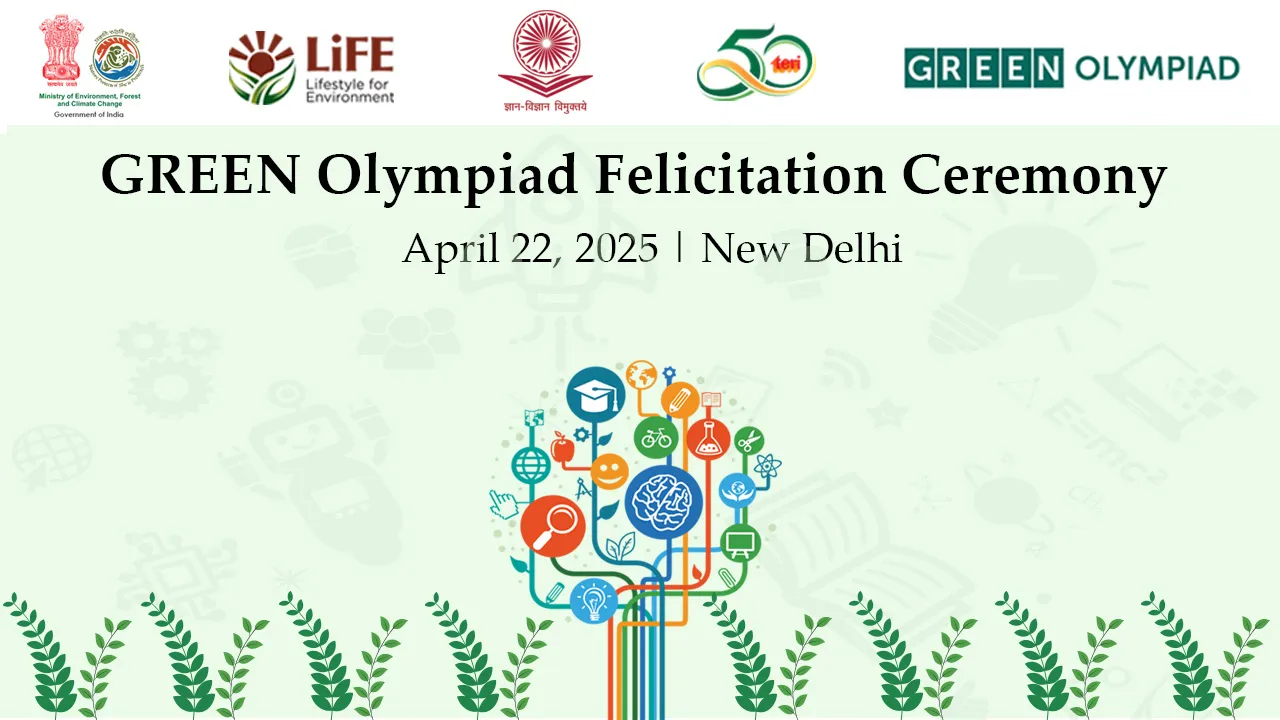
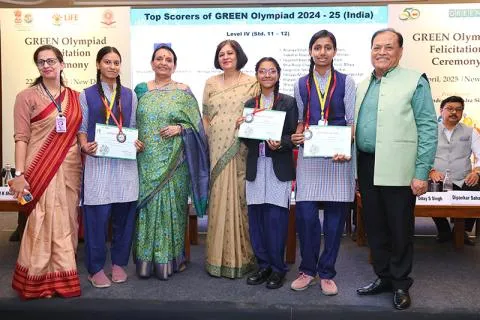
[India Green Olympiad Introduction and Awards Ceremony Ⓟ TERI]
The Climate Change IQ Test produced by the international body UN CC:Learn can be taken by anyone at any time. UN CC:Learn is an international learning platform created through the cooperation of 36 multilateral organizations to strengthen knowledge and capacity for responding to climate change. The Climate Change IQ Test takes the online format of solving 20 questions in 15 minutes. After taking the test, it provides learning content from UN CC:Learn and information on the status of climate crisis-related campaigns around the world.
Both domestically and internationally, there is consensus that ‘climate education’ is necessary for everyone’s future amid the climate crisis. How about taking the ‘Climate CSAT’ on this CSAT day? Regardless of the score, testing how much we know and do not know about climate will be a great help for future learning and small actions.
by Editor L