

With the arrival of December, companies’ ESG report cards are being released one after another. Companies with excellent ESG performance publicized this year’s ESG achievements, while the reasons for the relatively low ratings of other companies are being analyzed by the media and the market. ESG stands for the three core elements for achieving sustainability in corporate management. So what is ESG evaluation, and what kinds of evaluation agencies exist? Let us also learn about what ESG evaluation is, the differences between domestic and international ESG evaluators and their respective evaluation criteria, and the comprehensive ESG evaluation elements through the K-ESG Guidelines.

[2025 Korea ESG Standards Institute (KCGS) Excellent Company Awards Ⓟ KCGS]
What Is ESG Evaluation?
Now, both investors and consumers are utilizing ESG to evaluate companies. According to a 2021 survey, over 60% of consumers responded that they consider ESG activities in their consumption, and several global credit rating agencies including Moody’s also reflect ESG in their credit ratings. While it is important to receive good ESG evaluations, there is no single common evaluation standard. Currently, more than 600 evaluators worldwide assess companies using differing ESG definitions and processes. This is precisely why ESG evaluation grades differ significantly from one evaluator to another, regardless of whether they are domestic or international. ESG disclosure is scheduled to become mandatory in South Korea from 2026 onward, and if evaluations can be conducted with a common standard in this way, it appears that somewhat more accurate evaluation and comparative analysis will be possible going forward. The ESG evaluation grades of representative companies can be grasped at a glance on the ESG Portal jointly created by the Korea Exchange and the Financial Services Commission.

[ESG Portal Site Mobile Screen Ⓟ ESG Portal]
Where Should ESG Evaluations Be Received?
ESG evaluation institutions each set the definition of evaluation items, measurement methods, and the weighting of each item differently. For example, for the same electric vehicle company, Evaluation Agency A focuses on the emission of pollutants during the operation of the electric vehicle, while Agency B focuses on the emission of pollutants during the production process of the electric vehicle. This is how evaluation scores diverge.
If a domestic company is evaluated by a domestic evaluator, a qualitative ESG evaluation based on non-financial information is possible compared to an overseas evaluator. A major advantage is that even companies without an English-language sustainability report can receive an evaluation. In addition, the ability to encompass domestic-specific ESG risks such as chaebol owner risk within the evaluation scope can also be seen as a strength. The broad framework for evaluation by institutions providing scores on the ESG Portal, such as KCGS, Sustinvest, and the Korea ESG Research Institute, is similar. They use corporate disclosures, business reports, sustainability reports, and publicly available materials on company websites as evaluation data, and may also utilize media such as news articles. Each of the E, S, and G domains are divided into detailed items to assign scores, points are deducted where risk factors exist, and weightings are applied to each item score reflecting industry-specific characteristics. Evaluation results are expressed in 7 grades; for Sustinvest, AA is the highest grade, while for the other two institutions, S is the highest grade.

[Ⓟ Sustinvest]
Examining the characteristics of each evaluator more closely, KCGS is a non-profit incorporated foundation in which capital market-related institutions including the Korea Exchange participate. Its evaluation purpose is to help companies examine and improve their current level of sustainable management. Among ESG, it evaluates the G domain by dividing it into ‘general listed company governance’ and ‘financial company governance,’ and also awards companies with excellent evaluations. Sustinvest’s evaluation purpose lies in investment. It helps investors make investment decisions that consider ESG factors as well. It also verifies information that companies have not disclosed, which is reflected in the ‘controversy assessment,’ where points are deducted by monitoring issues that may be controversial from an ESG perspective, and the ‘large corporate group assessment,’ where points are deducted from the G domain score for risks arising when the owner family influences the corporate group with a minority stake. Meanwhile, the Korea ESG Research Institute is a relatively new institution launched in 2021 from the Daishin Economic Research Institute. It is carrying out improvement work to refine industry-specific weightings on an annual basis and calculates evaluation grades by applying relative evaluation.
[Ⓟ KCGS]
There are also advantages to being evaluated by overseas evaluators. Cross-comparison of scores with global companies becomes possible. The most widely used evaluation standard, MSCI, evaluates based on publicly available information, selecting and weighting issues of high financial materiality by industry. It is also designed to measure a company’s resilience to ESG risks. S&P reflects global corporate sustainability assessment scores in publicly available materials such as corporate disclosures. This sustainability assessment includes industry-specific questionnaires that companies can directly answer. S&P produces results by scoring from 0 to 100 points instead of grades. Beyond these, Sustainalytics and Refinitiv are representative overseas evaluation institutions.

[Ⓟ MSCI]
ESG Evaluation Items: Based on the K-ESG Guidelines
Since ESG evaluation methods differ so much, companies may be confused about which indicators to use as the basis for establishing their ESG response direction. The Sustainable Management Support Center provides the ‘K-ESG Guidelines,’ which are materials analyzing the key points of major domestic and international ESG evaluation indicators and disclosure standards, and can be considered suitable for understanding common evaluation criteria across evaluators.
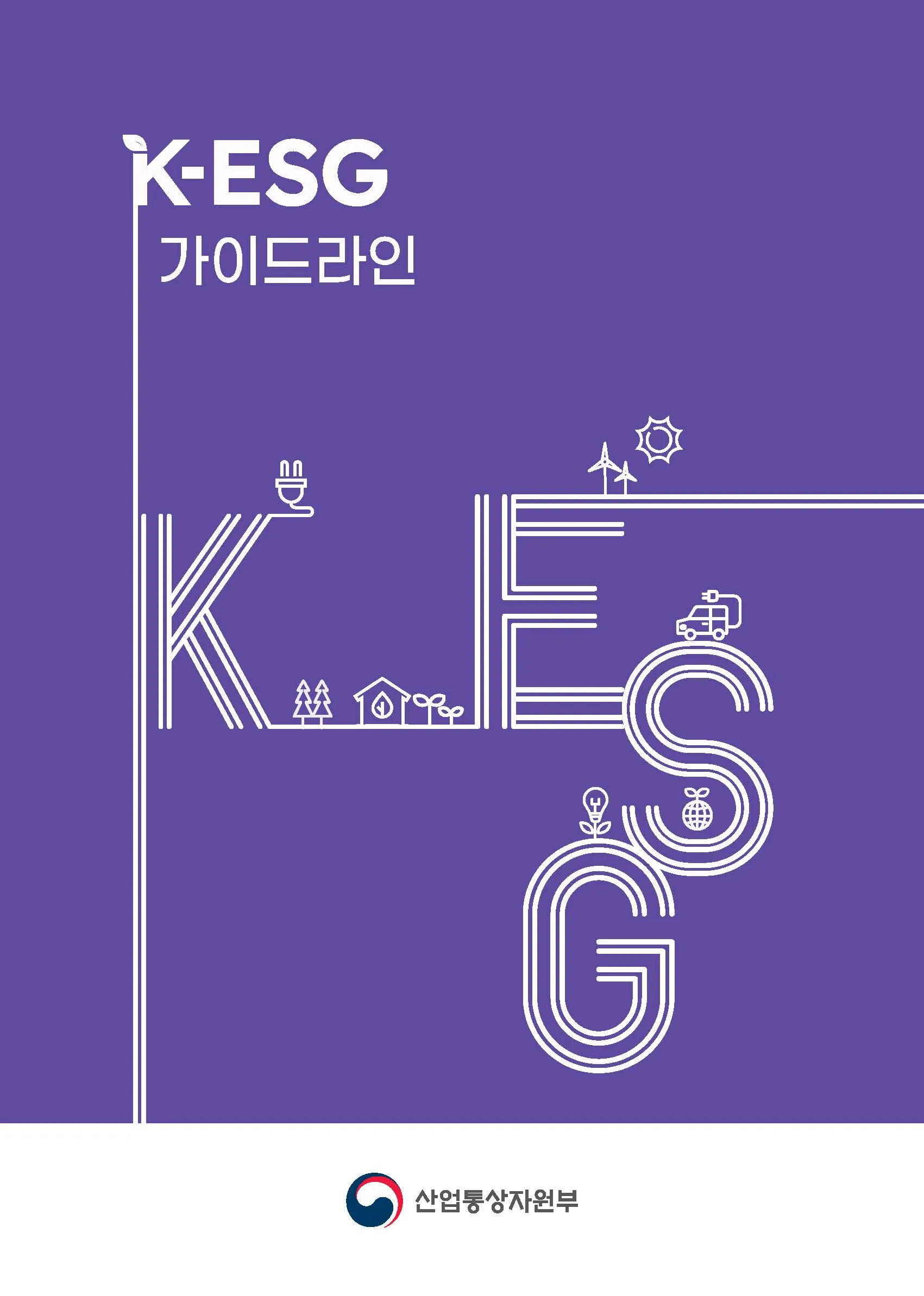
[K-ESG Guidelines v2.0 Cover Ⓟ Sustainable Management Support Center]
The Guidelines add a P (disclosure) domain to E, S, and G. First, Environmental (E) is composed of a total of 25 items. It checks whether environmental management objectives have been established, how resources (energy, water) are being managed, and the volume of greenhouse gases, waste, and pollutants being emitted. Whether there are any violations of environmental laws and regulations, and how many eco-friendly certified products exist also have an impact. It includes climate change response methods including climate change governance, as well as biodiversity conservation activities.
Social (S) is composed of a total of 22 items. These include the labor domain, which checks new recruitment, the proportion of regular employees, and the guarantee of freedom of association, as well as the diversity and gender equality domain, which evaluates the proportion of female members and the employment rate of persons with disabilities. Governance (G) has a total of 17 items. It evaluates board composition and activities, shareholder rights, and so forth. Additionally, ESG Information Disclosure (P) refers to the act of publicly informing about environmental, social, and governance-related information that influences the decision-making of investors and diverse stakeholders. The disclosure domain checks the method, frequency, and scope of information disclosure.
Since ESG does not yet have a long history, its evaluation standards are diverse as described. With both South Korea and the world set to begin ESG regulations in earnest from 2026, the importance of ESG evaluation is expected to grow even further. Next year, checking ESG evaluation methods and inferring the ESG level of our companies will also be an interesting activity.
by Editor L