

The European Union (EU) is significantly simplifying corporate sustainability reporting standards. The key measure is to reduce the total number of data points requiring disclosure by more than 70%, thereby lowering companies’ reporting burden.
What has been revised is the European Sustainability Reporting Standards (ESRS),which set the rules for how companies must disclose sustainability information on climate change, environmental pollution, labor, human rights, corporate governance, and other matters. The revised standards will enter into force on November 10, 2026. They will become mandatory for financial years beginning on or after January 1, 2027. The revision is part of the EU’s broader policy to simplify corporate regulations. Its aim is to reduce the cost of collecting data and preparing reports while maintaining the comparability of disclosed information.
The reporting burden under the existing ESRS
The ESRS were developed under the EU’s Corporate Sustainability Reporting Directive (CSRD).While the CSRD determines which companies must report on sustainability, the ESRS specifies what and how those companies must report. The existing ESRS covered a broad range of issues, including climate change, biodiversity, and resource use, as well as employees, supply-chain workers, consumers, and business ethics. Companies had to assess both the impact of these issues on their businesses and the impact of their activities on society and the environment, and disclose material information.

The problem was that companies had to collect and review large amounts of information when preparing their disclosures, while some requirements were complex or duplicated. The burden was particularly significant when obtaining supply-chain information unavailable within the company or determining whether to disclose items of relatively low materiality. The European Commission therefore pursued the ESRS revision as part of its efforts to strengthen corporate competitiveness and reduce administrative burdens. The basic purpose of disclosing sustainability information remains intact, but the standards are being adjusted so companies can focus on information that is genuinely important.
More than 70% reduction in disclosure data points
The most notable change in the revision is the reduction in disclosure data points. According to the European Commission, the revised ESRS reduces the total number of data points by more than 70% compared with the existing standards, while mandatory data points are reduced by more than 60%. These two figures should be viewed separately. The total number of data points includes not only mandatory items but also items reported under certain conditions. Therefore, a reduction of more than 70% in total data points does not mean that mandatory disclosures for every company will fall by the same proportion.
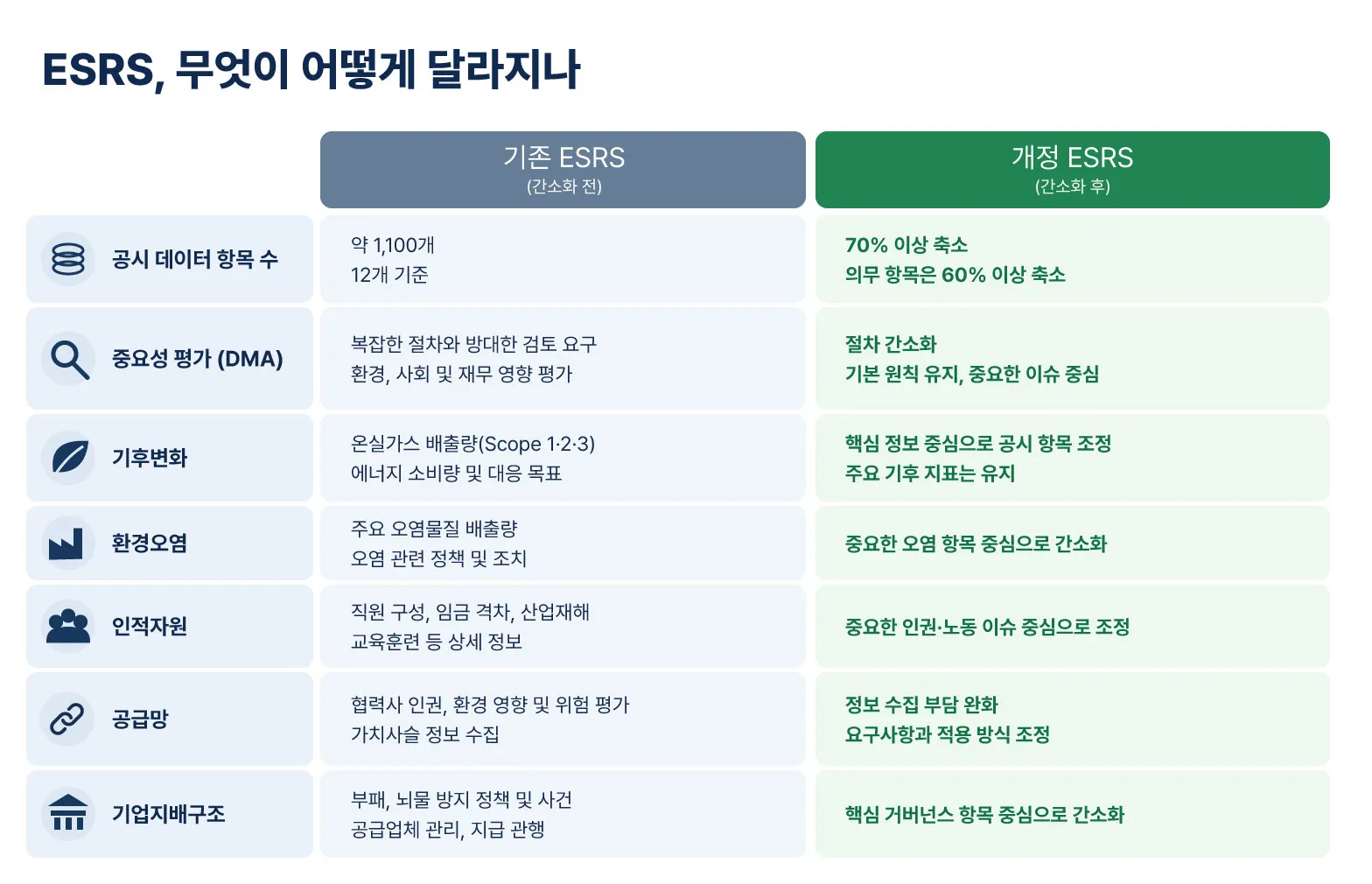
The Double Materiality Assessment (DMA), the starting point for reporting, is also being simplified. DMA examines both the impact of a company’s activities on the environment and society and the impact of climate change and environmental regulations on the company’s operations and finances. While maintaining the basic principles of this assessment, the revised standards focus on simplifying the process by which companies determine materiality and disclose related information.
The burden of collecting supply-chain information will also be eased. The requirements and their application have been adjusted to reflect the difficulties involved in obtaining data from partners and business counterparties that companies do not directly manage. The European Commission expects the simplification to reduce disclosure costs by more than 30% per company. However, this is an anticipated effect of the revised standards, and the actual level of savings may vary depending on each company’s business structure and existing level of reporting preparedness.
Impact on Korean companies
The simplification of the ESRS is not a change limited to European companies. Korean companies operating in the EU and domestic suppliers doing business with European companies should also review the revised standards. However, the ESRS does not directly apply to all Korean companies.
Companies subject to sustainability reporting obligations in the EU may first adjust their reporting systems according to the revised standards. This means they can identify data they previously collected that has been removed or simplified and reorganize their reporting procedures to align with the new standards. Changes are also expected for Korean suppliers providing products or components to EU companies. Previously, even when suppliers were not directly subject to reporting obligations, their European customers could request information on greenhouse gas emissions or labor-related matters. To reduce this indirect information-submission burden, the EU has also established voluntary sustainability reporting standards for small companies.
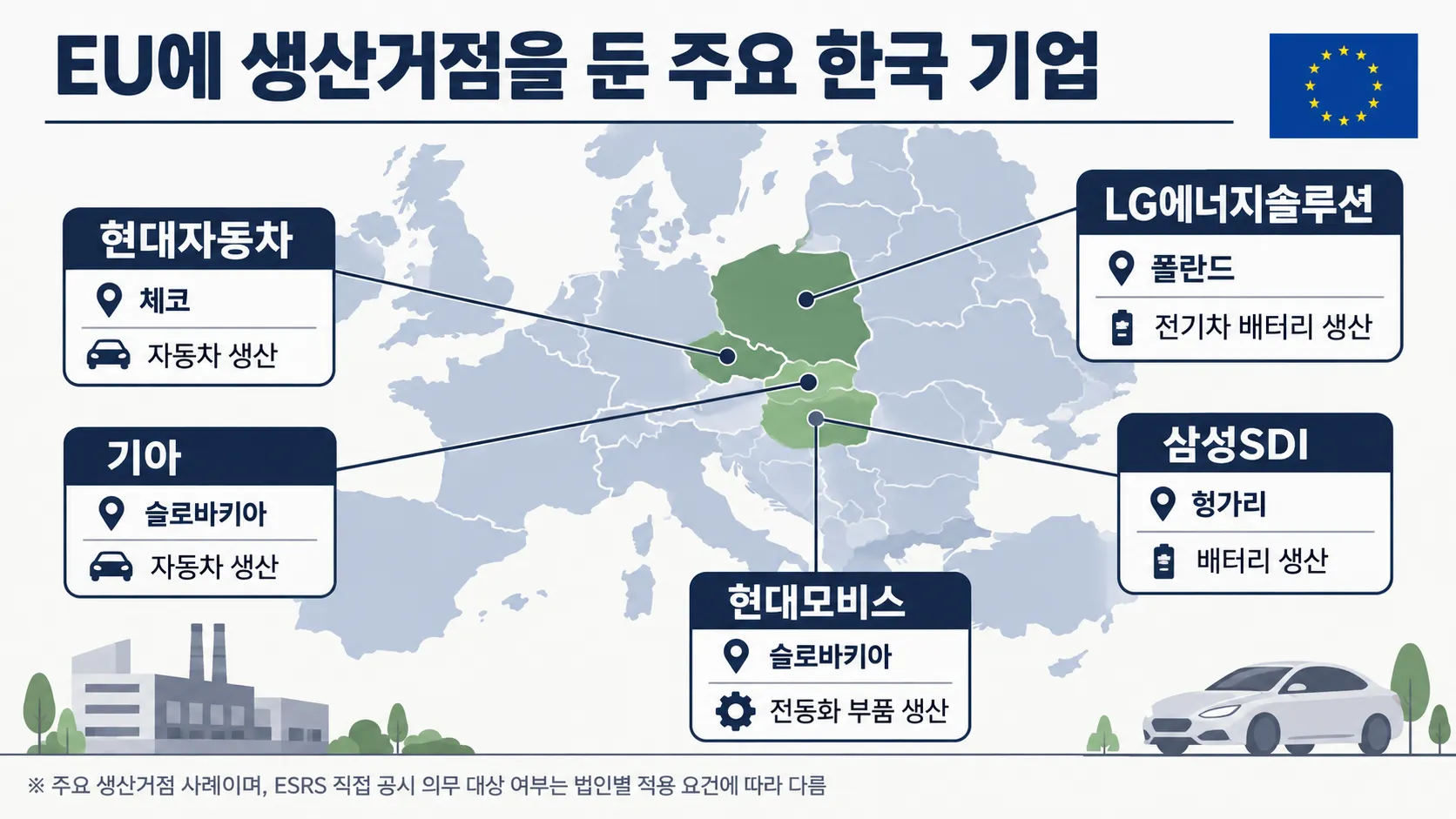
The standards announced by the European Commission include measures limiting the scope of sustainability information that companies subject to reporting obligations may request from businesses in their supply chains. However, determining which information requests are permitted in individual business relationships requires reviewing both the entities covered and the relevant regulations.
The simplification of reporting standards should be distinguished from a reduction in the scope of companies subject to reporting obligations. The ESRS revision adjusts the information companies must report and how they prepare their reports, while the EU’s separately pursued Omnibus revision reduces the range of companies required to report under the CSRD. The two changes are connected, but they are not the same system.
Reducing the reporting burden while maintaining information quality
The simplification of the ESRS shows that Europe’s sustainability reporting policy is being adjusted to consider not only the quantity of information but also its usability and the burden of preparing it.
A greater number of disclosure items does not necessarily produce more useful information. If companies focus on completing numerous items, important information that investors and stakeholders need for their decisions may be buried in lengthy reports. Conversely, if the number of disclosure items is reduced too drastically, there may not be enough information for comparisons among companies.
Through this revision, the European Commission has set out the goal of reducing companies’ administrative burden while maintaining the quality of sustainability information needed by investors and stakeholders.
The revision should therefore be viewed not as a measure eliminating companies’ environmental and social responsibilities, but as a change in the standards governing what information is used to explain and disclose those responsibilities. As the number of disclosure items declines, whether the revised ESRS can adequately capture genuinely important information will become a new benchmark for assessment.