
The pace at which the world is changing is incomparably faster than in the past. Some decisions are swiftly automated, and some judgments become the domain of algorithms instead of people. The more technology evolves, the more organizations must respond quickly and flexibly. Amid such changes, companies face the most fundamental question: ‘With whom, and based on what values, are we working right now?’ This is not simply a matter of organizational culture. It is a question that asks whether a company can earn the long-term trust of the market, and by what data such sustainability can be evaluated.
Confirming Organizational Health Through Objective Data
Many companies speak of sustainable management and hold up ‘respect’ and ‘inclusion’ as core values. However, whether such abstract words are actually reflected in the systems of the real organization, or whether they merely remain as declarative phrases, cannot be known until one becomes a member of the organization and experiences it.
Until now, diversity and inclusion within organizations were areas difficult to measure, closer to variable factors that changed depending on the personal inclinations of good colleagues or leaders. Thus, proving the health of an organization to external stakeholders was a vague task. It is precisely here that DEI (Diversity, Equity, and Inclusion policy) reports gain their significance. Key data points — such as who enters and exits the organization, whether caregiving responsibilities lead to career interruptions for certain members, and whether formal governance that manages discomfort is functioning — are not mere personnel statistics. Through DEI reports, one can confirm that the concepts of ‘respect’ and ‘inclusion’ have been transposed into data in the form of figures and structures. Such data serves as a key indicator that objectively diagnoses the previously vague state of an organization’s health and gauges its resilience.
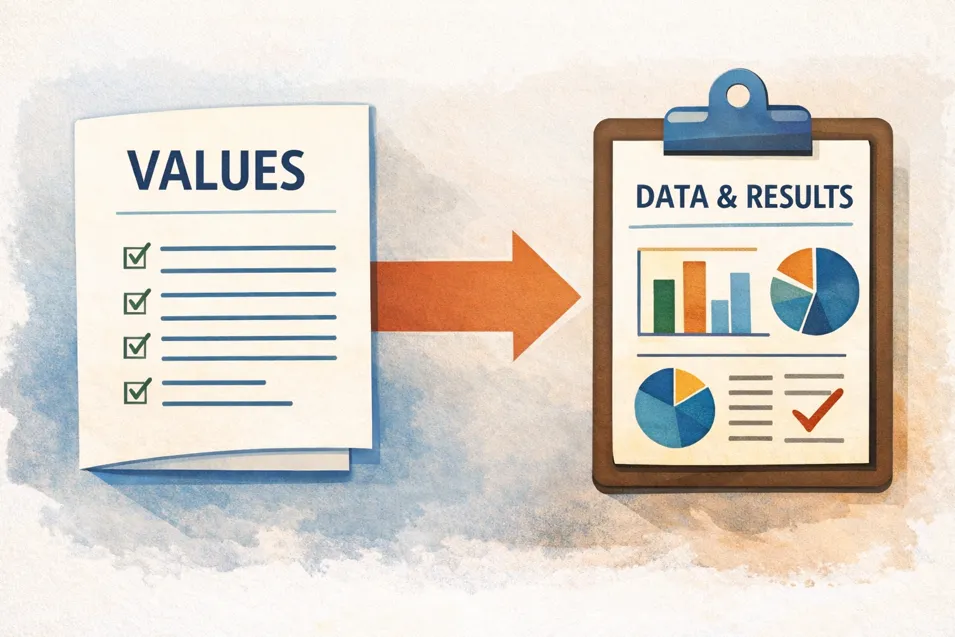
[Image of the datafication of value concepts © ChatGPT]
Our Own Benchmark, Not Answers for the Sake of Evaluation
Of course, indicators are always a double-edged sword. Quantified data can serve as powerful evidence proving corporate performance, but at times, it also starkly reveals gaps that need to be addressed. In this context, defining a company’s DEI report merely as promotional material showing that the company is fulfilling its ‘social responsibility’ is a one-dimensional approach. The essential value of a DEI report lies in examining ‘by what criteria the organization was designed’ and in reading the meaning of the data. Since each company differs in size and industry, there is no single correct answer, but it is important for companies to approach the data not by filling their DEI reports with answers aimed merely at showing off, but with criteria unique to the organization.
In this context, the case of the ‘2026 Lush Korea DEI Report’ is intriguing. Lush Korea did not list short-term campaigns or token systems in its DEI report. Instead, it chose the approach of transparently disclosing the default values that drive the organization and showing them in figures and language. From the forms of address and work modes of its members to the customized job design for the employment of persons with disabilities and the governance through which childcare and caregiving are viewed — all these elements are designed not as temporary benefits for specific groups but upon a reality that acknowledges diverse ways of living.
[Lush Korea DEI Report © Lush Korea]
Particularly impressive is the fact that the ‘feedback culture that embraces mistakes’ is being measured as a quantified indicator of the psychological safety net. The figure showing that 76.8% of all members responded that they ‘exchange improvement-oriented feedback rather than blame when mistakes happen’ demonstrates that the value of inclusion is functioning as the organization’s substantive operating system, going beyond mere declaration. The ‘2026 Lush Korea DEI Report’ is, in effect, the outcome of calmly recording the intangible values that Lush Korea has been pursuing and proving them through data.
An Essential Foundation for Sustainable Management
Companies in this era must transparently show not only what they count as performance but also their attitude toward their members. For this, not mere words but ‘structures’ and ‘data’ must back it up. The DEI report is not merely a means to pass external evaluation, but an essential foundation for companies to continue sustainable management without wavering in a rapidly changing environment. Through DEI reports, we can confirm not the completion of an organization but the image of an organization responsibly moving forward toward a better future. In the end, a company’s true sustainability is proven not by grand declarations but by the concrete systems that support those promises in places unseen.
by Editor L