
Global credit rating agency S&P Global introduced a new evaluation system in 2025 for the first time targeting solar and wind ESS (Energy Storage System) manufacturers worldwide. Outstanding companies were selected by comprehensively analyzing various factors including market position, market share, scale, financials, and sustainability. After passing through such rigorous criteria, the Q Cells division of the domestic company Hanwha Solutions was selected as Tier 1 Clean Tech. Let us examine the ESG strategy of a company leading the materials and energy sector, recognized for its value in the global market, through Hanwha Solutions’ sustainability report.
[Hanwha Solutions 2025 Sustainability Report Cover Ⓟ Hanwha Solutions]
Together, Further: Hanwha Solutions’ Portfolio
Hanwha Solutions is a global energy and materials-based solution company operating businesses in a total of five fields. Its representative business areas include the Chemical division, which produces petrochemical products and recycled raw material rPE (recycled polyethylene) certified by global certification bodies under international recycling standards, and the Q Cells division, which is building a solar power value chain from solar panels to energy storage devices. The Insight division, which emphasizes sustainability, researches sustainable urban development solutions that consider industrial and lifestyle domains such as new and renewable energy and premium lifestyles. As for business areas that target overseas markets without having domestic business sites, there are the Q Energy division, which is dedicated to introducing eco-friendly energy within Europe, and the W&C division, which constructs grids that distribute power produced through new and renewable energy methods.
These five business divisions are researching and developing sustainable energy and material solutions by domain. Hanwha Solutions, whose business portfolio alone reveals its orientation toward a sustainable future — so what methods is Hanwha Solutions employing to realize ESG?
The Sustainable Future Created by Hanwha Solutions
First, it is necessary to examine the way Hanwha Solutions makes its products and the results. Hanwha Solutions analyzed the business risks and opportunities arising from climate change. The petrochemical-based Chemical division carries the risks of policy regulation, changes in consumer awareness, and the emergence of low-carbon substitutes. Meanwhile, the expansion of the hydrogen industry, the increase in the share of new and renewable energy, and the growth in demand for bio and recycled plastics will provide positive opportunities for the Chemical, Q Cells, and W&C divisions.
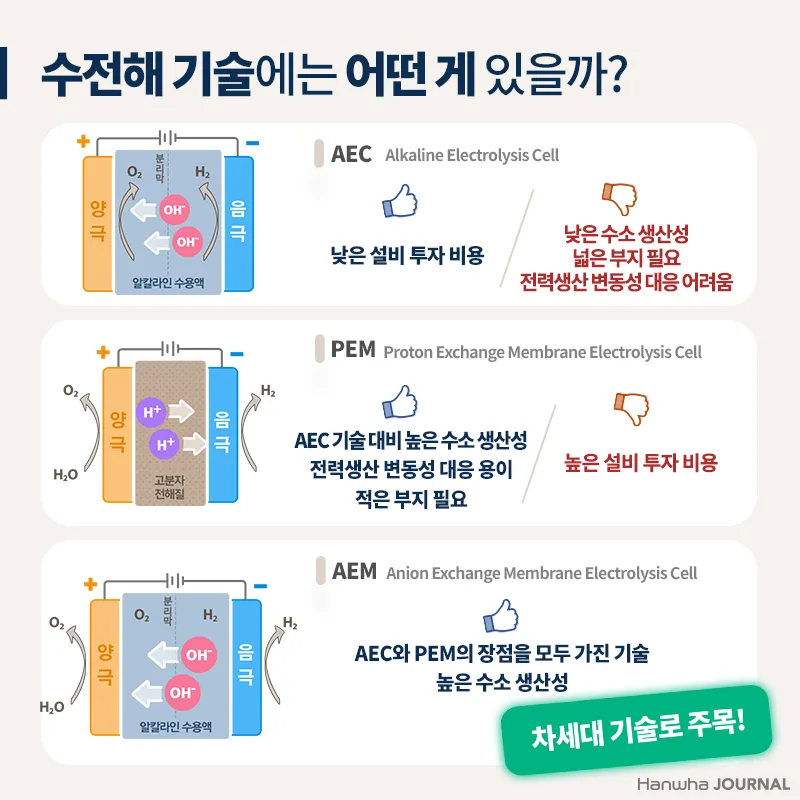
[Representative Types of Water Electrolysis Technologies Ⓟ Hanwha Journal]
Based on this analysis, Hanwha Solutions is adopting a strategy of expanding eco-friendly businesses, developing new and renewable energy infrastructure, and taking the lead in total energy solutions. First, the Chemical division is researching and developing Anion Exchange Membrane Electrolysis (AEMEC) technology to activate the hydrogen industry. Currently commercialized water electrolysis methods include Alkaline Water Electrolysis (AWE) and Proton Exchange Membrane Water Electrolysis (PEMEC), but both technologies have respective limitations in terms of initial investment cost or productivity. The AEMEC being developed by Hanwha Solutions is a method that complements the limitations of AWE and PEMEC, and is expected to be capable of producing large volumes of hydrogen even with low investment costs and low electricity consumption.
Additionally, the Hanwha Solutions Insight division is planning the construction of solar power and fuel cell facilities at H-Techno Valley in Hwaseong, Gyeonggi Province, for the development of new and renewable energy infrastructure. H-Techno Valley is a semiconductor and automotive specialized industrial complex, and producing products using new and renewable energy in an industrial sector where demand will remain high going forward is significant. Beyond this, reflecting the geographical characteristics of South Korea with its many mountainous areas, the Insight division also acquired a patent for a solar power facility structure that can be arranged in an east-west direction. The structure, which compensated for the limitations of existing facilities that could only be arranged facing due south, now secures advantages such as shortened construction periods, improved economic viability, and reduced wind resistance, thus ensuring the efficiency and economic viability of the solar power facilities that will grow in the future.

[Perovskite Campaign Image Ⓟ Hanwha]
Finally, the Hanwha Solutions Q Cells division is strengthening its leadership in solar technology to take the lead in total energy solutions. Most solar silicon modules have a power generation efficiency of around 23–24%. In other words, only 23–24% of the solar light energy received by the module can be converted into electricity. The M10-standard perovskite-crystalline silicon tandem cell, independently developed and manufactured by the Q Cells division, can absorb solar light of wavelengths different from existing silicon cells and produce approximately 15% additional power. The Q Cells division is also constructing a ‘Solar Hub,’ an integrated solar production complex, to build a renewable energy value chain within the United States. Through this, it provides total energy solutions encompassing product sales, project development and operation, and power intermediation and sales. As a result, it was selected as the engineering, procurement, and construction partner for TransGrid Energy, which operates a significant-scale Battery Energy Storage System (BESS) complex within the United States, and construction is underway. Sustained technology research and energy capability development have borne substantive results.
Making ‘Eco-Friendly Products’ in an ‘Eco-Friendly’ Way
Hanwha Solutions does not stop at developing eco-friendly technologies and producing products, but applies processes that ensure the process does not have a negative impact on the environment. Hanwha Solutions declared its 2050 Net Zero commitment in 2021.
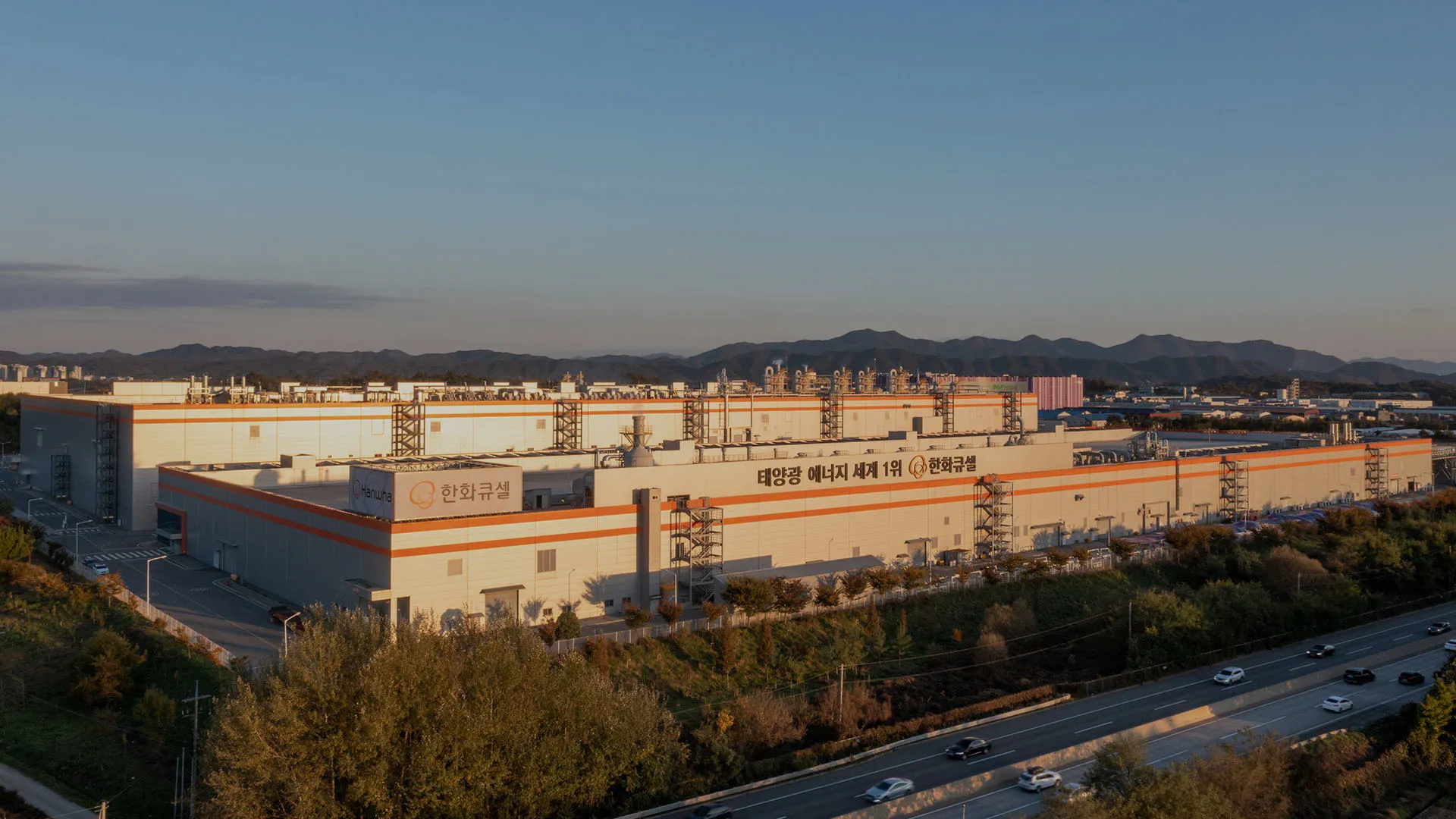
[View of the Jincheon Plant of Hanwha Solutions Q Cells Division Ⓟ Hanwha Q Cells]
The most important aspect of greenhouse gas reduction is to reduce absolute energy consumption. The Q Cells division promoted an LED lighting replacement project at the Jincheon and Eumseong plants. Unlike fluorescent lamps, LEDs do not use mercury, thus producing no carbon dioxide, and are superior to incandescent bulbs in terms of energy efficiency and power consumption. In addition, the Jincheon plant, which produces solar cells and modules, introduced cooling system optimization facilities to reduce its energy usage, investing in the HVAC system that uses the most power to save energy.
The Chemical division is realizing sustainability through air pollutant management. It has set its air pollutant emission allowance standards at 30% of the legal standard and is conducting self-measurement of abatement facilities. It systematically manages air pollutant emissions by strengthening close monitoring of the operation of air pollution-related facilities. It is also managing nitrogen oxide emissions by introducing reduction facilities suited to the characteristics of each business site.
Hanwha Solutions is an affiliate of the Hanwha Group, launched through the integration of Hanwha Q Cells & Advanced Materials and Hanwha Chemical. In particular, the Chemical division, one of the domestic petrochemical Big Four, traces its origins to the state-owned enterprise Hanyang Chemical and shares the history and lineage of the Korean petrochemical industry. The petrochemical industry produces materials indispensable to our lives such as plastics, nylon, polyester, and acrylic, yet it faces a crisis in which the very reason for the industry’s existence must be proven, due to global oversupply and the trend toward defossilization. Hanwha Solutions is securing its future competitiveness through a strategy of diversifying its portfolio with various energy supply solutions including petrochemicals, while simultaneously pursuing sustainability in both process and outcome. Hanwha Solutions’ ESG strategy and Scope 3 emissions strategy, which could not be covered in this article, can be found in the 2025 Hanwha Solutions Sustainability Report.
by Editor L