
27.3 people per 100,000 population. It is the figure for the number of people who took their own lives over the single year of 2023. Although it has been on a downward trend since 2010, it is about twice the OECD average. Statistics that the proportion of self-harm/suicide patients visiting emergency rooms recently increased 3.6-fold over ten years — and surged especially among people in their teens and twenties — became known, adding to the shock.
September 10, 2025, marks the 22nd year since World Suicide Prevention Day was established, but Korea's suicide rate is still high and does not show a meaningful decline. However, over the past 20-odd years, many points have certainly changed. Our society has begun to accept suicide and self-harm not as an individual problem but as something that the state, local communities, and private institutions must cooperate to solve. Also, suicide-prevention safety nets and campaigns tailored to the individual characteristics of women, adolescents, and sexual minorities are being carried out. Let us look at cases in 2025 of people reaching out to one another.
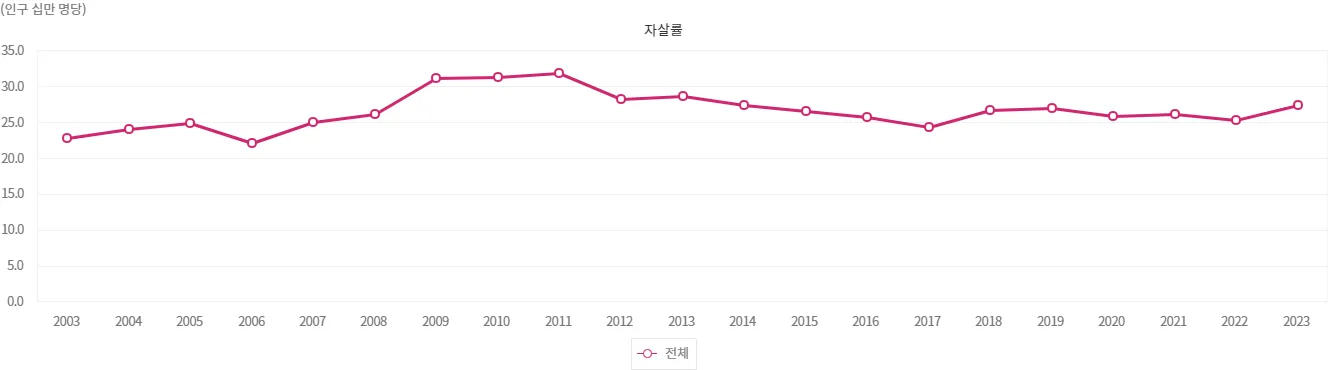
[Graph of Koreans' suicide rate from 2003 to 2023 © Statistics Korea (Index Nuri)]
A Neighbor's Life, Protected by the Local Community
For a helping hand to properly reach the high-risk group for suicide, neighbors' attention is essential. The "Life-Respecting Safe Village" project, run jointly by the Ministry of Health and Welfare and the Korea Foundation for Suicide Prevention, actively draws out local-community cooperation. Various institutions — neighborhood clinics, cram schools, supermarkets, police boxes, and more — detect people showing warning signs of suicide early and connect them to specialized institutions. As of 2024, this project is being implemented in 56 cities, counties, and districts nationwide, and the number is increasing.
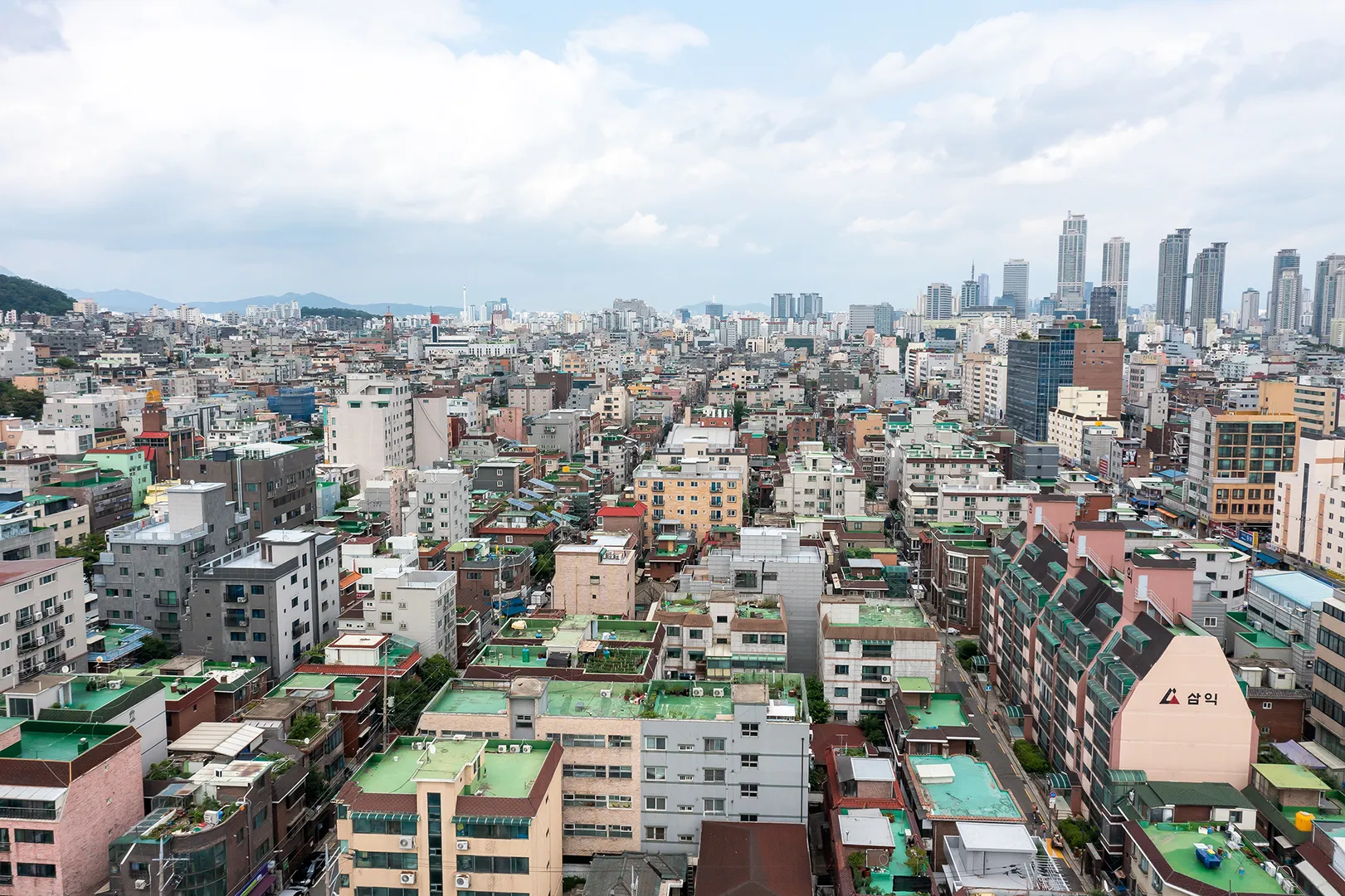
Gangseo-gu in Seoul designated Hwagok 1-dong and Hwagok 8-dong as "Life-Respecting Safe Villages" this past April. Both have a high proportion of single-person households and are representative densely housed areas within the district. Strengthening patrols of frequent suicide locations, monitoring the sale of dangerous drugs at pharmacies within the area, and carrying out respect-for-life campaigns and education in parallel were key to the selection. In particular, Gangseo-gu previously led a suicide-prevention project successfully by designating "Gayang Complex 4 Apartment," which had a high proportion of single-person households aged 60 and over, as a "Life-Love Safe Apartment" back in 2021, adding to the expectations.
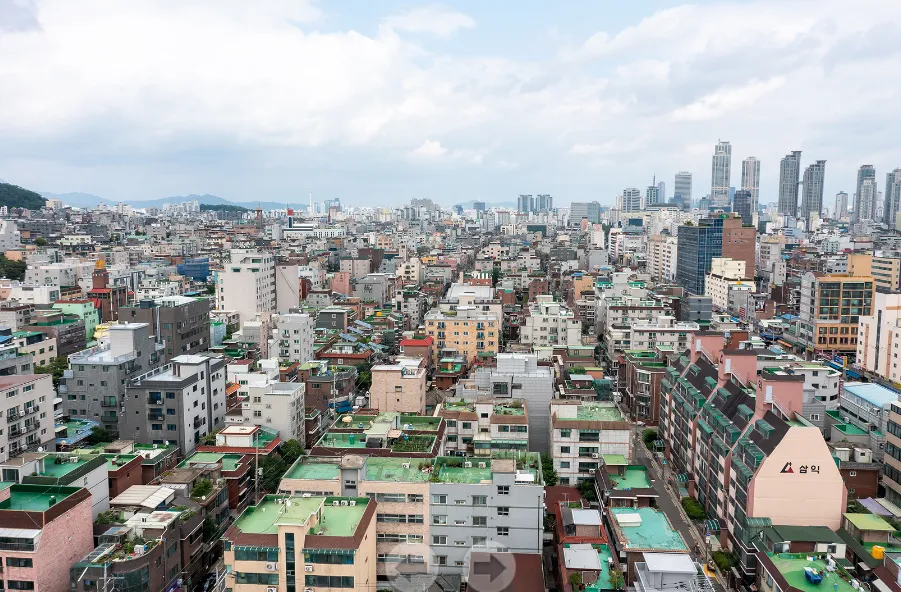
[Hwagok 8-dong and others, designated as "Life-Respecting Safe Villages" © Gangseo-gu Office]
Incheon Metropolitan City is also implementing a similar "life guardian (gatekeeper)" project. In Incheon, selected as an "excellent local government for suicide prevention" for three consecutive years since 2022, 2,632 "field-specific life guardians" are active. The drivers of the "Life-Love Taxi," operated for the first time in the country in 2017, played a big role in suicide prevention by listening to passengers' hearts and, when there was a problem, connecting them to specialized institutions. Starting with this, Incheon expanded the "field-specific life guardian" project by connecting various occupations and spaces — "Life-Love Pharmacy," "Life-Love Hospital," "Life-Love Cram School," "Life-Love Lodging," and more. Many cases continue — a cram-school director discovering signs of a student's self-harm and helping with treatment together with the parents, or a pharmacist listening to a customer's complaints of depression and insomnia, offering comfort, and connecting them to psychiatric treatment. The city is focusing in particular on continuous education for life guardians and on operating a system that links them to specialized support.
The mental-health support project of the Korea Land and Housing Corporation (LH), which received a Minister of Health and Welfare commendation at the "2024 Mental Health Day Ceremony," also has the institution act as a neighbor to residents, saving the lives of residents in crisis. The "Mind Health Committees" of 1,160 rental-housing complexes nationwide — composed of management-office heads, welfare officials, mental-welfare centers, public-health centers, and other public and outside experts — identify and support residents at mental-health risk. Over one year, they helped 1,128 residents suffering from depression and hoarding disorder. In one example, a rental apartment in Jeungpyeong-gun visited a household that was behind on maintenance fees and out of contact, discovered a resident in crisis due to hoarding disorder, and provided support. Twenty local-community volunteers cleared the trash together, and the institution added financial support, so that neighbors in various forms are helping toward a hopeful life for a resident in crisis.
Distinctive Companies and Institutions Spread the Message of Respect for Life
The MOU signed in 2022 by the Ministry of Health and Welfare, TikTok, and the social-welfare corporation Lifeline Korea is a good example of public-private cooperation for suicide prevention. Lifeline Korea, the country's first telephone-counseling institution, and TikTok, the global video platform most used by teens, developed a "respect-for-life education program for teens" with the solid support of the Ministry of Health and Welfare. Contrary to worries that it might be an MOU merely for a "suicide-prevention TikTok challenge," the three institutions joined forces to create a substantive program over five months. "Life-Love, Care for Me" is an 8-hour program for late adolescents, in which young people strengthened their psychological and emotional functioning by creating outcomes themselves. By September 2023, more than 9,000 students had participated in "LaLa," a group education program for middle-school students. Even after the project, TikTok and Lifeline Korea continue their partnership. TikTok participated as a sponsor in the "Life-Love Night Walk" campaign co-hosted by Lifeline Korea and KBS. Lifeline Korea participated in the "TikTok Korea Creator Summit 2025," presenting to TikTok creators the mental-health problems within digital media and directions for solutions, and guiding them to a list of resources usable in crisis situations.
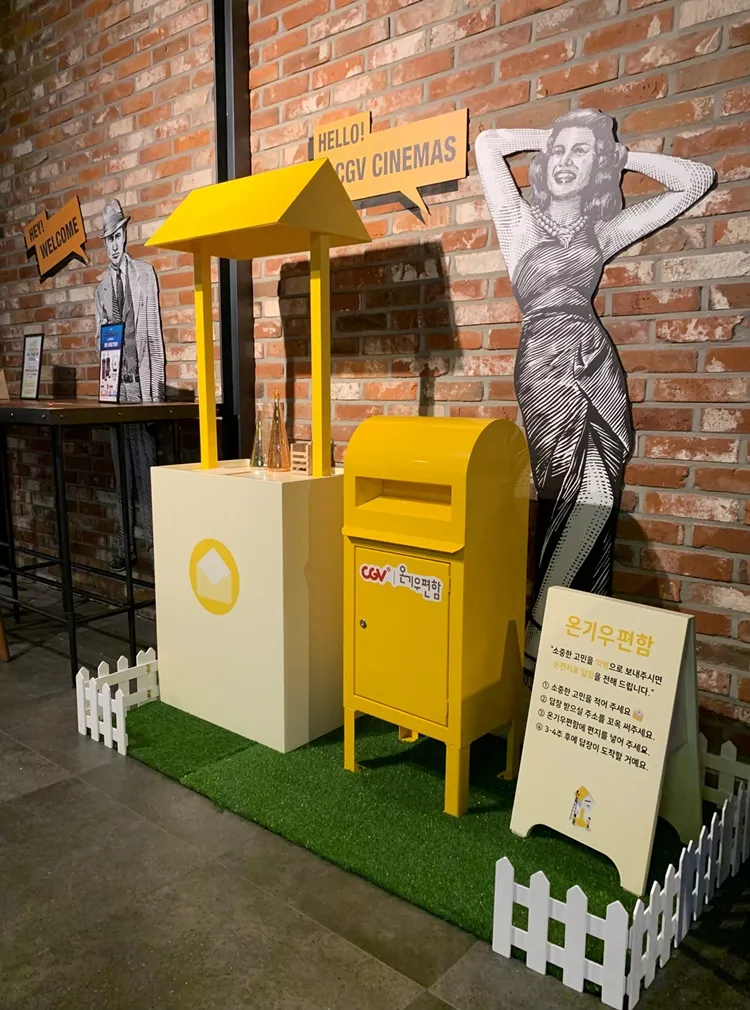
[The "Ongi Mailbox" installed at CGV © CJ Newsroom]
The incorporated association "Ongi," which runs the nonprofit "Ongi Mailbox" project — in which, if you put in a letter about your worries, a volunteer "Ongi postman" replies with a handwritten letter — has had a business agreement with CGV since 2021. Located at 21 CGV theaters, it seeks to build a psychological safety net for society and helps people ease feelings of depression in an everyday space to recover their mental health. The worry-letters delivered in this way numbered more than 6,000 over the single year of 2023. The incorporated association Ongi cooperates continuously not only with companies but also with public institutions. The mailbox at a memorial park operated by the Seoul Facilities Corporation is greatly meaningful in comforting those with the pain of loss. When a letter arrives expressing extreme depression, psychological-counseling volunteers write a first reply and connect the person to a mental-health center in their area. Companies, institutions, and the incorporated association cooperate to go beyond the act of exchanging comfort of the heart, building even concrete suicide-prevention measures.
Beyond simply crying out that "life is precious," the voices heard on Suicide Prevention Day in 2025 are more concrete and warmer. Local communities look out for one another, provide suicide-prevention education tailored precisely to those concerned, and naturally spread the preciousness of life through various campaigns. In order to live together, it is time for everyone to join hands.
by Editor L