
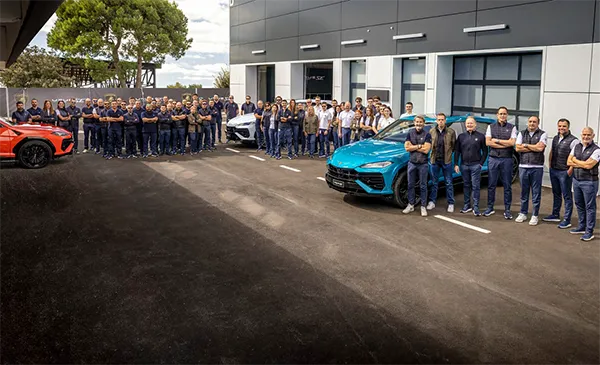
"F1: The Movie," directed by Joseph Kosinski, director of "Top Gun: Maverick," and starring Brad Pitt, set a new box-office record by surpassing 60 million dollars (about 810 billion won) at the worldwide box office. Prompted by this film, made to commemorate the 75th anniversary of F1, the world's fastest car race, much interest is gathering around F1 and motorsports in general.

[A scene from F1: The Movie © f1themovie.com]
Meanwhile, according to the International Energy Agency (IEA)'s "World Energy Outlook 2024" report, energy demand in the transport sector will increase by about 10% by the end of the 2020s, and the main factor is road transport. However, while the number of vehicles corresponding to road transport increases by about 10%, the growth rate of road-transport energy use is expected to stay at around 5%. The spread of electric vehicles offset the energy use of existing internal-combustion-engine cars that use fossil fuels.
The Fédération Internationale de l'Automobile (FIA), which governs many motorsports, is responding to this change by holding Formula E, electric-powered open-wheel racing, since 2014. So then, in what way is a mobility company that makes the fastest cars on the road raising its speed toward ESG?
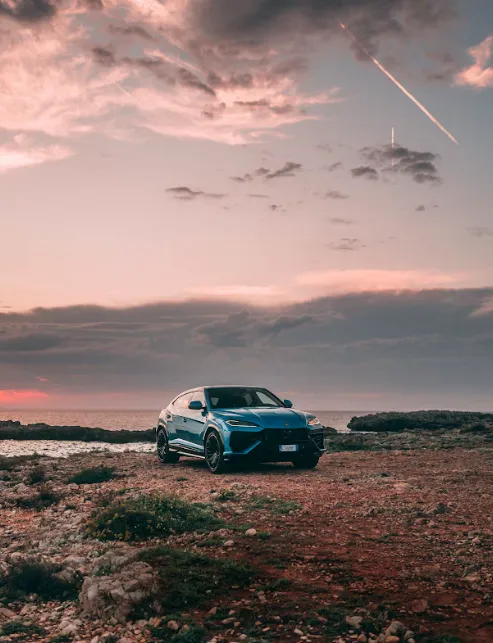
[Cover of Lamborghini's sustainability report © Lamborghini]
Toward Taurus (Direzione Cor Tauri)
Ferrari, Aston Martin, McLaren, and Lamborghini — the brands that represent supercars — each practice sustainability in their own way. Ferrari has steadily published sustainability reports since 2018, Aston Martin since 2019, and McLaren since 2021. Lamborghini published its sustainability report for the first time this year, beginning to officially share the brand's ESG moves.
Under the slogan "Driving Human Beyond," Lamborghini aims for the goal of newly creating not only what is visible but even the experience. The strategic direction "Direzione Cor Tauri" — that is, "Toward Taurus" — launched in 2021, was to the extent of electrifying all of Lamborghini's models, but in 2024 it expanded its goal and scope to the decarbonization of the company's entire value chain. This means achieving decarbonization in the true sense not only in Lamborghini's cars but in all processes encompassing the brand, such as production and transport.
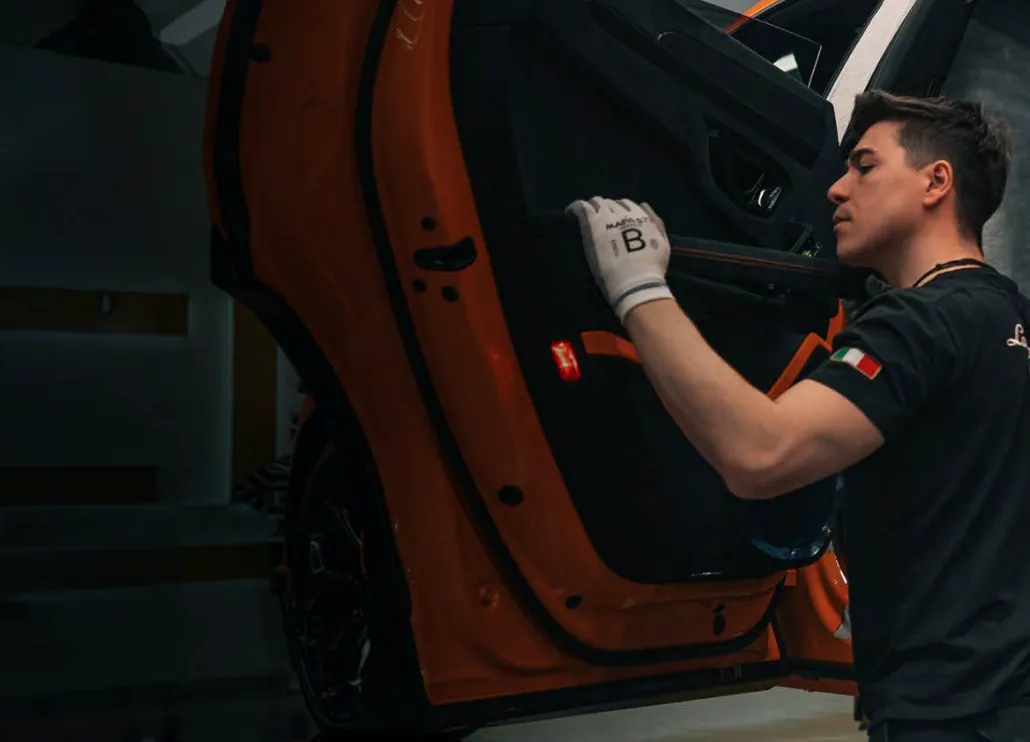
[Lamborghini's production process © Lamborghini]
Lamborghini's Sustainable Value Chain
Lamborghini continues to collaborate, through ongoing communication, with partners who pursue common values in social, environmental, and quality terms. Through this, it consistently maintains a high level in the basic quality of products and in the experience the products deliver to consumers. Since joining the Audi Group in 1998, Lamborghini has been innovating its supply chain, collaborating with related departments to create synergy with Volkswagen Group brands.
Lamborghini's headquarters and manufacturing plant are in Italy, and it reduces transport-related greenhouse-gas emissions by sourcing parts from suppliers in the Europe, Middle East, and Africa region. In addition, as part of a project to employ the socially disadvantaged, it signs supply contracts with local cooperatives. This can be called a mutually beneficial value chain that solves the problem of excessive greenhouse-gas emissions arising from long-distance transport while at the same time realizing local development.
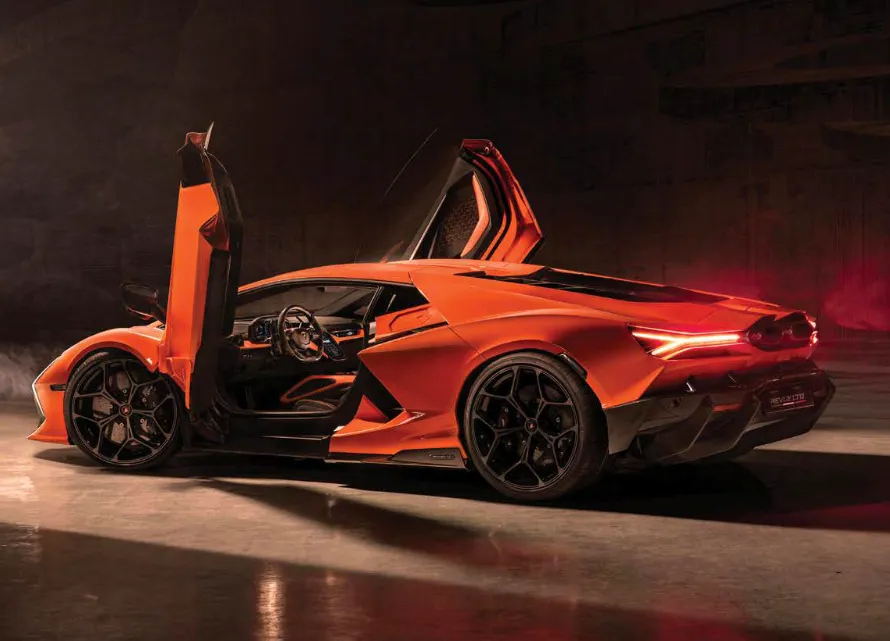
[Lamborghini's high-performance electric car "Revuelto" © Lamborghini]
An Upright Promise for Future Generations
In line with Lamborghini's Direzione Cor Tauri strategy, the "Revuelto" model, unveiled in 2023, is the brand's first hybrid HPEV (High Performance Electrified Vehicle) supercar, a model combining a 12-cylinder engine with three electric motors. The following year, Lamborghini also unveiled the Urus SE, a hybrid version of its super SUV, and the Temerario, its second HPEV. At the 2024 Asia-Pacific unveiling event for the Temerario, Lamborghini CEO Stephan Winkelmann stated, "We will convert our entire lineup to hybrid in sequence, and we are waiting for the right time to apply electrification technology that maintains the driving experience Lamborghini pursues." A pure electric car inheriting Lamborghini's performance and driving pleasure is scheduled for release in 2030.
Besides making its existing internal-combustion supercar lineup all hybrid and electrified, Lamborghini operates various policies for environmental protection: saving energy and resources, reducing greenhouse-gas emissions to minimize environmental impact, and protecting biodiversity. Paying particular attention to water-resource management, Lamborghini uses water supplied through the waterworks network as domestic water for the cafeteria, cleaning, and the like, and supplies the water needed for the production process from its own wells. Lamborghini covered 82% of its total water use from 2023 to 2024 with well water, also using water treated in its own purification facilities as a major supply source. Going forward, Lamborghini aims for a zero-discharge plant that completely reuses, until depletion, the intake resources of process wastewater, domestic sewage, industrial wastewater, and rainwater generated in the process. By reducing unnecessary waste of water resources and recycling used water, it is expected to contribute to environmental protection and resource circulation.
Like the speed approaching 300 km/h and the tremendous performance, many of the elements that represent the sentiment of a supercar originate from the internal-combustion engine. Supercar brands are preparing for changes in future mobility by exploring various methods such as e-fuel, hybrids, and high-performance motors. If you are curious about what the future of mobility that Lamborghini is preparing — and further, its future as a sustainable carmaker — will look like, how about reading Lamborghini's sustainability report, whose meaning is all the greater for being its first?
by Editor L