
As various technologies such as AI and virtual currencies emerge and develop, the financial sector — most closely connected to daily life — is also being influenced. ‘Fintech’ is a term combining finance and technology, referring to financial services led by ICT companies. Fintech, which has taken the lead in the digital innovation of finance by combining financial services and technology, has shown a high market growth trend alongside technological advancement. According to the National IT Industry Promotion Agency’s global ICT market survey, the global fintech market size is projected to grow from USD 79.38 billion in 2023 to USD 141.18 billion in 2028.
[KakaoPay 2024 ESG Report Cover © KakaoPay]
KakaoPay is a simple payment service used by two out of three South Koreans, and under its mission of creating beneficial flows in daily life, it carries out diverse business and social contribution activities. What content is contained in KakaoPay’s sustainability report, now in its third year of publication?
The Digital Industry Is Also Under the Influence of the Physical Environment
How does KakaoPay, where most work and services take place in a digital environment, interact with the physical climate? KakaoPay’s ESG Committee, which regularly discusses climate issues, conducted a climate-related materiality assessment in 2024 and identified 15 risk factors. The most significant risk factors among these are: ①Market — Electricity price increases, ②Policy and Legal — Strengthening of emissions reporting obligations, ③Policy and Legal — Increases in greenhouse gas emission allowance prices, ④Reputation — Increases in negative stakeholder feedback, ⑤Technology — Costs of transitioning to low-carbon technologies, and ⑥Market — Changes in customer behavior. These risks are factors that could lead to increased input costs and decreased revenue in the medium-to-long term.
In particular, data centers — essential for operating digital platforms — emit massive amounts of greenhouse gases as they consume large volumes of electricity. Even if climate change cannot be said to immediately and significantly affect the working environment or efficiency of workers, it can be anticipated that it will gradually become a burden on corporate operations.
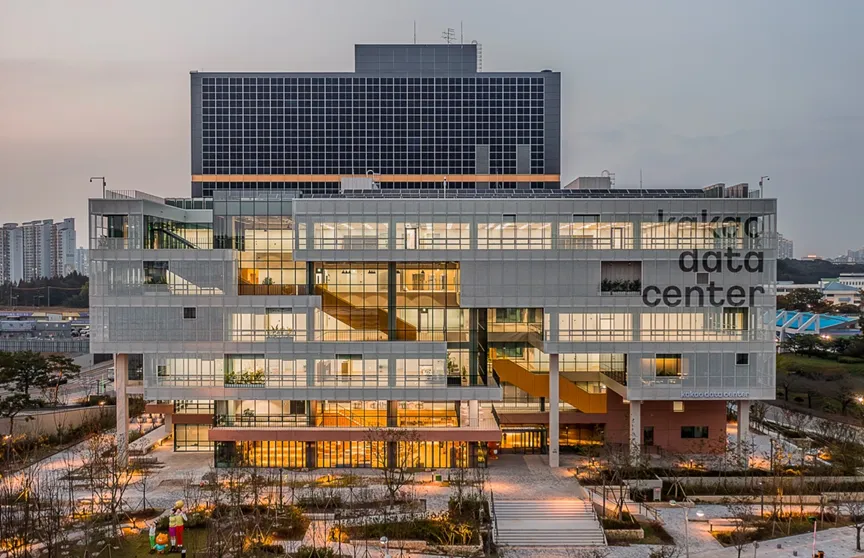
[View of Kakao Data Center © Kakao]
Data centers are infrastructure vulnerable to rising temperatures. To provide users with fast payment and financial services without delay, data centers must be operated in an optimal state, and to do so, they must be maintained at an appropriate temperature. While operating data centers consumes a great deal of power, cooling the heat generated by data centers also consumes power — a major issue. In fact, the power consumption required for data center cooling is said to reach 40–50% of the data center’s total power consumption. An efficient and effective solution is needed.
Accordingly, KakaoPay is gradually introducing eco-friendly and high-efficiency servers. When constructing new data centers, it is joining the movement to fulfill environmental and social responsibility by purchasing servers that have received the highest rating (Platinum) from the U.S. Electronic Product Environmental Assessment Tool (EPEAT). It is also making efforts to reduce power consumption by optimizing the data center cooling system. During the shoulder and winter seasons, it reduces cooling power usage, and through a DCIM (Data Center Infrastructure Management) solution, it systematically manages power consumption and energy efficiency. During the summer, when thermal management requires particular care, it installs sunshades atop chillers and has introduced an ‘Adiabatic System’ to increase thermal management efficiency.
The Adiabatic System is a method in which water is sprayed onto the hot air flowing into the chiller during summer to cool the air. By utilizing the principle of water evaporating together with heat, it removes heat from the air and lowers the temperature of the air entering the chiller, increasing the efficiency of data center cooling.
In a Direction Beneficial to the Community
More than 90% of the greenhouse gases emitted by KakaoPay originate from electricity consumption. For this reason, KakaoPay is making efforts to transition the power consumption occurring at its business sites to eco-friendly sources, beyond just data centers. KakaoPay has established a RE100 goal of converting 100% of the power used at its Pangyo office to renewable energy by 2027, and further converting 100% of the power used at all business sites to renewable energy by 2040. In 2024, it drew closer to achieving its interim target by using 1,000 MWh of renewable energy, equivalent to 12% of its total power consumption. Beyond this, it aims to reduce the greenhouse gas emissions generated by its business activities by converting 100% of its company-owned and leased vehicles to eco-friendly vehicles by 2030.
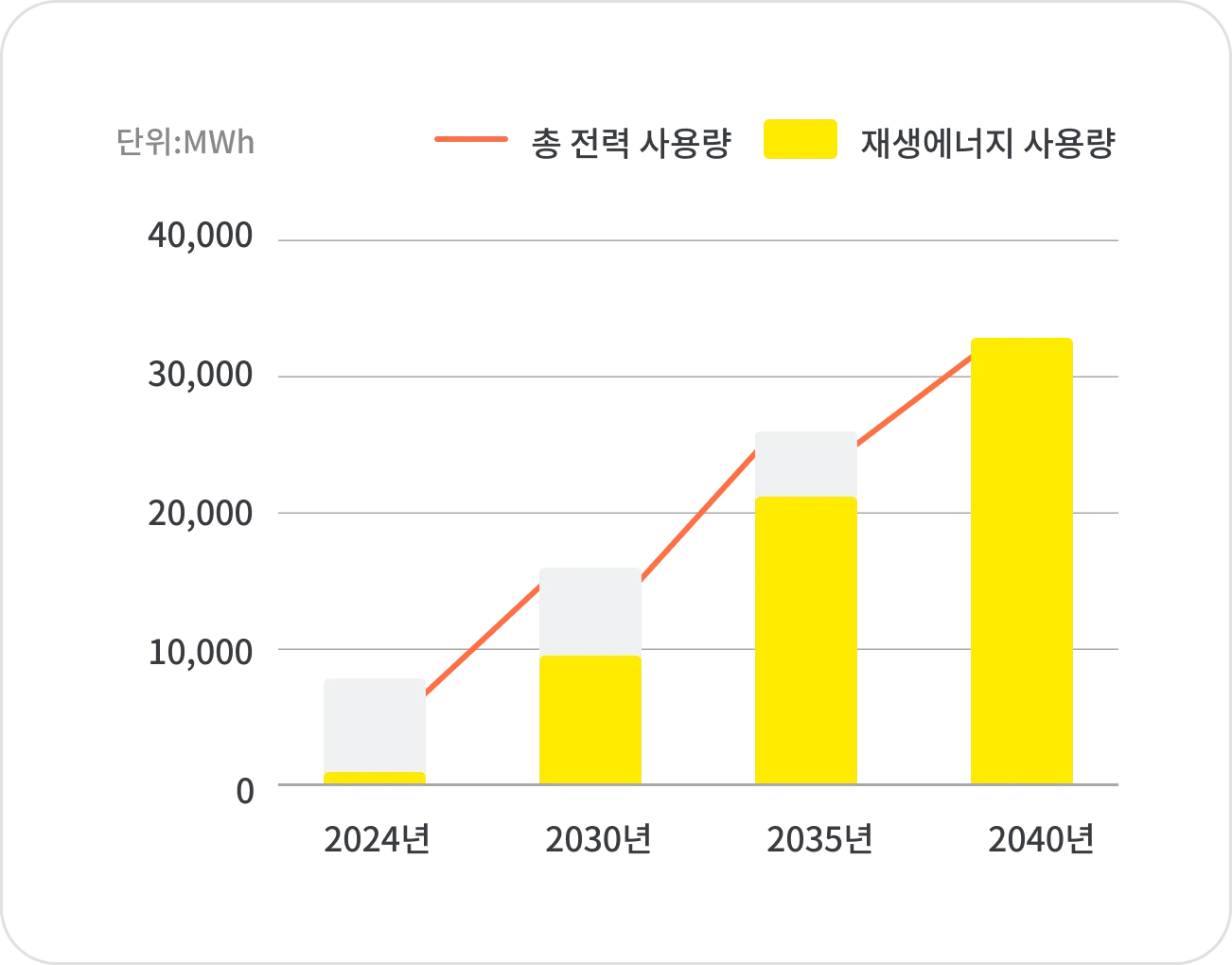
[KakaoPay 2040 RE100 Implementation Roadmap © KakaoPay]
If greenhouse gas emissions are reduced through such efforts and climate change is mitigated, this will consequently help prevent physical risks to KakaoPay’s key assets. This is because the torrential rains, heavy snow, and droughts intensified by recent climate change could inflict physical damage on KakaoPay’s assets or generate additional costs for management and recovery.
Beyond this, KakaoPay is attempting various other improvements in its business site operations beyond power consumption, such as using paper bags and shopping bags within the company that are certified by the Forest Stewardship Council (FSC) and replacing the cups used at the in-house café with reusable cups.
Even a business based on outstanding technology and infrastructure can only realize its value when there is an environment to operate it and people to use it. KakaoPay is striving for the sustainable development of fintech finance by pursuing benefit toward the Earth, toward people, and toward growth.