
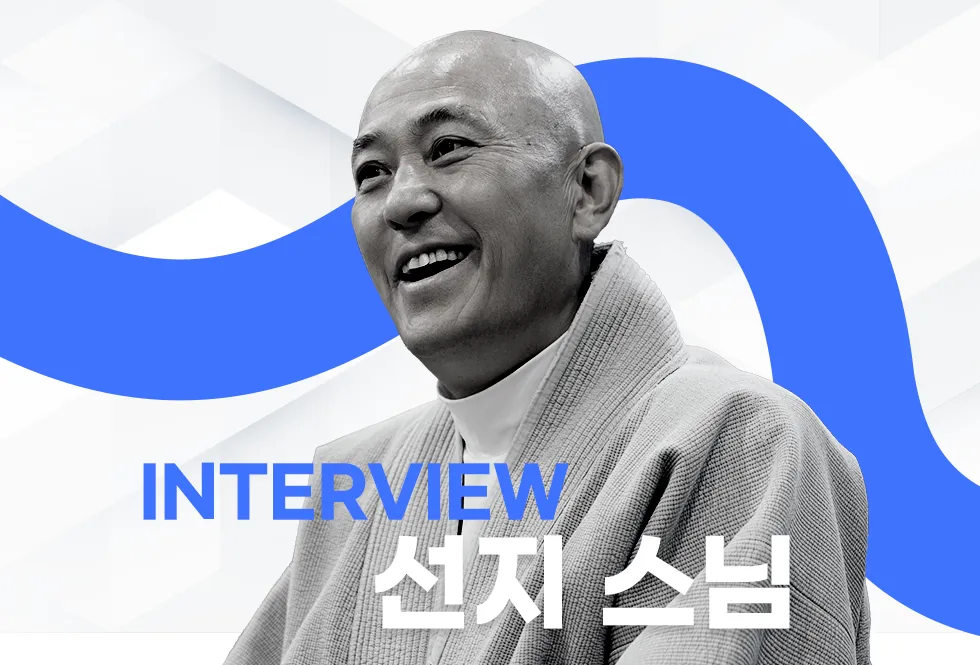
How can ESG management be interpreted from a religious perspective? Buddhism has long valued the concept of "symbiosis (coexistence)." To learn what the future of a sustainable world looks like through the eyes of the Buddhist community, we met Ven. Seonji, author of "Buddha Management," which conveys "symbiotic ESG management," and heard the wisdom of ESG management needed in this era.
At the threshold of spring, I headed to Mapo to meet Ven. Seonji, author of "Buddha Management" and abbot of Jungnimsa Temple in Yeongcheon. Much interest has concentrated on this book, which views ESG through the eyes of religion. We arranged to meet the Venerable — who had come up to Seoul for a broadcast appearance — at a coffee shop near the broadcasting station. The editor, arriving an hour earlier than the interview time, spotted from afar the Venerable absorbed with a pen in hand in one corner of the café. Worried that an early visit might disturb him, I carefully slipped away.

At the café I visited again at the appointed time, the Venerable welcomed ESG.ONL with a bright, childlike smile. From the Venerable's appearance, the spirit of a pure and frugal ascetic could be felt. His clean but frayed-fronted quilted jacket seemed to represent the Venerable's simple life, stirring in the heart of this worldly person, worn out living in the city, a ripple as clear as the sound of a dawn temple bell. How did the Venerable meet ESG and weave that thought into a book?
["Buddha Management," which explains "sustainable symbiotic ESG" © ESG.ONL]
The Meeting of Buddhism and ESG Management

Ven. Seonji began to think he should view ESG from a Buddhist perspective while preparing for his doctoral degree at Dongguk University. Existing works of Buddhist studies include various books by scholarly monks in academia. Ven. Seonji thought, "Do I really need to major in that field too?" There was another point of concern. The Venerable pondered whether there might be a way to apply the Buddha's teachings to modern society and convey them easily. Thus the Venerable met ESG. At first, he sought to shed light on the changing state of temple environments and surrounding ecosystems.
The global trend emphasizing the themes of ESG management — environment, society, transparent governance — is spreading into the political, social, and cultural spheres. Thinking, "Can Buddhism alone be free within this social current?", Ven. Seonji put into this book the wish that the Buddhist community should at least know what ESG is and take an interest in why it should be practiced. He wrote it feeling the awareness that today's sangha, having inherited a brilliant culture, must preserve the ground we must live on together with future generations.
The Modern Practice of the "Bodhisattva Way": Symbiotic ESG Management
When it comes to Buddhism, many people will first think of Ven. Beopjeong's "Non-Possession." Starting one's thinking this way, the link between ESG and Buddhism does not readily come to mind. In fact, non-possession applies to ascetics; it was not saying that ordinary sentient beings too should practice non-possession. There were many merchants and industrialists near the Buddha. They came seeking the Buddha's teachings. Ven. Seonji said that what the Buddha told them at that time was "do not possess more than what you have."
Viewing the world according to the principle of the law of dependent origination that the Buddha preached, one can see that "all beings do not exist alone but depend on and form relationships with one another." At this point, one can find a hint of symbiotic ESG management. Symbiotic ESG management means that, based on this simple yet certain truth, we should pursue the coexistence and prosperity of humanity and sustainable development. One more thing: Buddhism has "Bodhisattva thought." Bodhisattva thought is the thought of the salvation of all beings. The core of that bodhisattva way — that is, the path for a bodhisattva to attain enlightenment — is "giving back to society." Buddhism is based on the practice of Bodhisattva thought in that it pursues transparency in temple operation through temples' environmental movements, the formation of relationships with society at large, and the principles of galma-beop (the sangha's decision-making method) and daejung gongsa (all-attending decision-making based on reason and fairness). This also touches on symbiotic ESG management. Ven. Seonji emphasized, "Symbiotic ESG management is about overcoming our society's contradictions, excluding egoism, and sharing one's own with others to realize an equal society."

[Ven. Seonji, who emphasized the value of symbiotic ESG © ESG.ONL]
The "Karma Community" That Inherits Traditional Buddhist Governance
In Ven. Seonji's view, what does our Buddhist community's ESG look like? Ven. Seonji says that, considering the Buddhist community's environmental and internal factors, top-down change is inevitable. The same goes for ESG. Change begins only when the head of the administrative headquarters and the heads of central monastic institutions open discussion of symbiotic ESG management as an agenda.
If a "Symbiotic ESG Management Declaration" is announced at the level of the Jogye Order, which has public credibility, its ripple effect could spread as the administrative headquarters and central monastic institutions hold declaration ceremonies at the 24 diocesan head temples and their subordinate temples. In particular, in the governance field, one could create a good case by supplementing the "karma community," which can be called a traditional Buddhist-style governance. The karma community is the Buddhist community's method of discussion, passed down for thousands of years. Sangha members all attend and discuss a topic, and the discussion is completed when there is unanimous agreement. As a democratic and peaceful discussion method that the Buddhist community can inherit, it can also discover follow-up ESG-related agendas.
The Symbiotic ESG Management Value Only Buddhism Can Create
Buddhism has an especially solid foundation in the fields of the natural environment and social responsibility. There is also the earlier case in which the Buddhist community took the lead in resolving the crisis when the World Scout Jamboree went awry. As he also emphasized in his book, Ven. Seonji says that for Korean Buddhism to cooperate with companies and public institutions to pursue projects of domestic and international scale, it is first important to declare symbiotic ESG management at the order level. If Buddhism creates long-term symbiotic ESG-management exchanges with companies for responsible social activity, it will be of great help in realizing environmental and social value.
Buddhism has a heaven-blessed natural environment and beautiful temples all over the country. Projects that can utilize these places are also continuing. "Hwaeomsa," widely known as a Temple Stay destination, is a good case fitting the ESG environmental-management trend. Collaborating with an eco-friendly lifestyle brand, it made "Hwaeomsa goods," which are very popular among young people too. A particularly popular Hwaeomsa item is a bag on which, through a handcrafted process, the red plum blossom symbolizing Hwaeomsa is drawn onto a "coffee sack" that could have been discarded as industrial waste. Ven. Seonji added, "It is a shame that such novel eco-friendly planning and product development do not spread and are limited to that region," saying he hopes such young ideas blowing through the Buddhist community will be shared more widely.
[The "Hwaeomsa red-plum-blossom bag," which gained popularity as an eco-friendly item © Hwaeomsa]
Realizing new ideas is good, but Ven. Seonji said there is an ESG practice measure our Buddhist community can most easily start with first: saving unnecessarily used energy and achieving zero waste. On the smallest scale, it is necessary to first turn off lights used unnecessarily at temples in the evening, save electricity, and remove visitors' trash cans and guide people to take their trash back. "Because temples are, after all, in nature, Buddhism especially emphasizes environmental aspects such as climate change, preserving the temple practice environment, and protecting the ecological environment," he said, also revealing the expectation that if even small actions start with the monks at temples, they will gradually spread to society.

Beyond the Boundaries of Buddhism, for the Sustainable Development of the Global Village
The easiest yet most important thing Ven. Seonji proposed is "repenting of one's faults and stopping." We are now using too many things. Consumption to follow short-lived fads and trends only increases. As the Venerable proposes, let us once bring forth the mind to reduce, starting with oneself. And if there are volunteer activities organized in the local community, let us actively take part. The spirit of volunteering and participation that I start will surely spread to those around me. If such activity affects neighbors and organizations and can spread and become known to a wider world, it will create great change. To emphasize again: "Let us start with ourselves first!"
by Editor L