
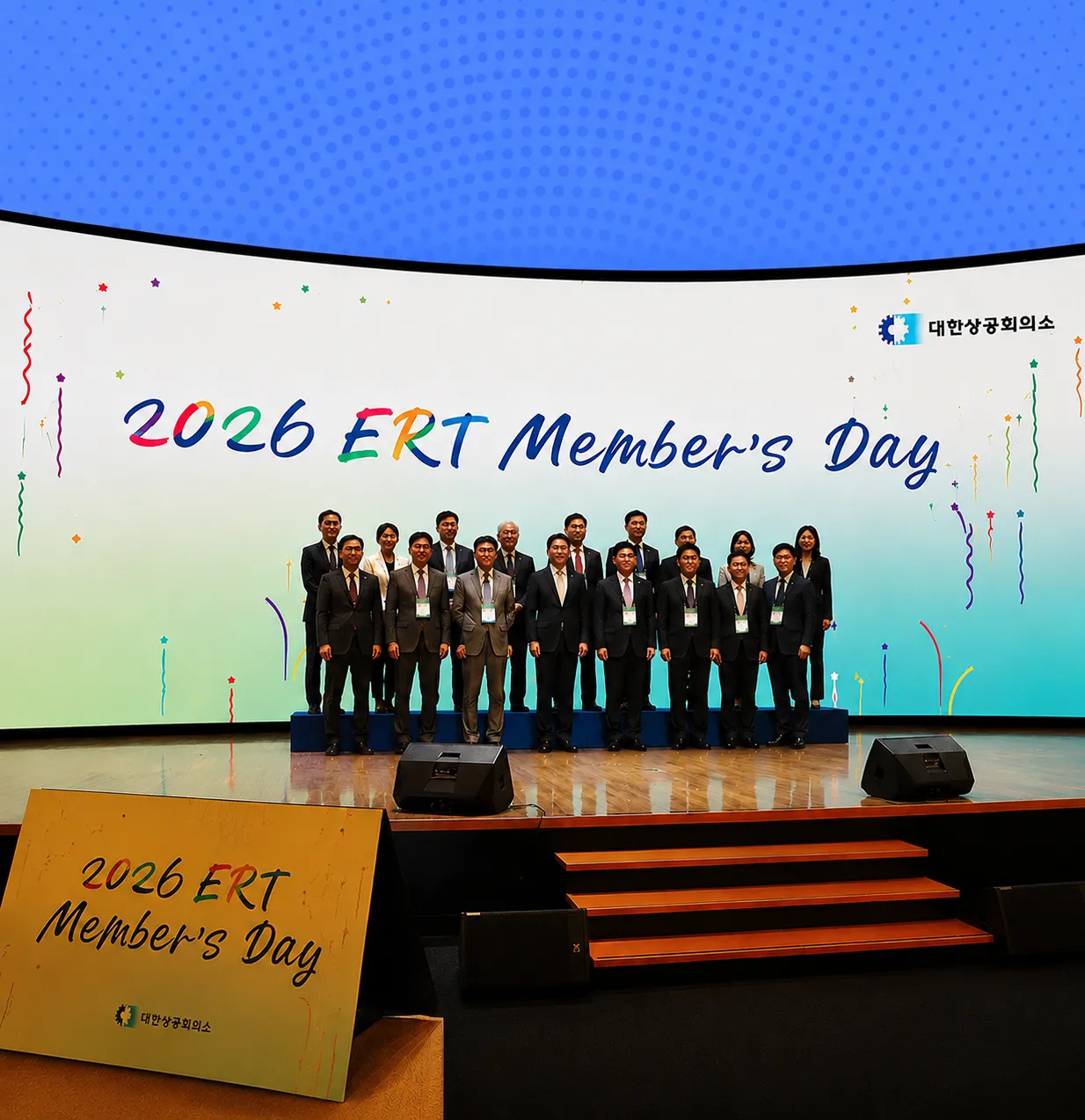
At 1:00 PM on May 20, the International Conference Hall of the Korea Chamber of Commerce and Industry in Jung-gu, Seoul, was filled with a diverse range of stakeholders — from government, regional, and social enterprise officials to citizens interested in ESG and solving social issues. They had gathered to attend ‘ERT Members Day 2026,’ hosted by the Entrepreneurship Round Table (ERT). ERT is a voluntary council of companies that leverage technology and capabilities to contribute to solving social issues, currently joined by some 1,900 companies and 72 regional chambers of commerce and industry. Now in its third year, Members Day is an annual event where ESG and social contribution managers from ERT member companies share examples of each company’s activities, experience hands-on programs, and expand inter-company exchange.
This year’s event theme was ‘The AI Era: Connection and Collaboration.’ It started from the awareness that it is not that technology will solve social issues on its own, but rather that the more we enter the AI era, the more sophisticated the structures of collaboration among businesses, government, regions, and consumers must become. The event did not treat this theme as a single lecture, but concretized it through a flow that began with a keynote address presenting the concept, followed by member company collaboration case presentations and an experiential exhibition zone. The targets of collaboration were also distributed across sessions by level — government, platform, local community, and consumers — helping attendees understand the concept.
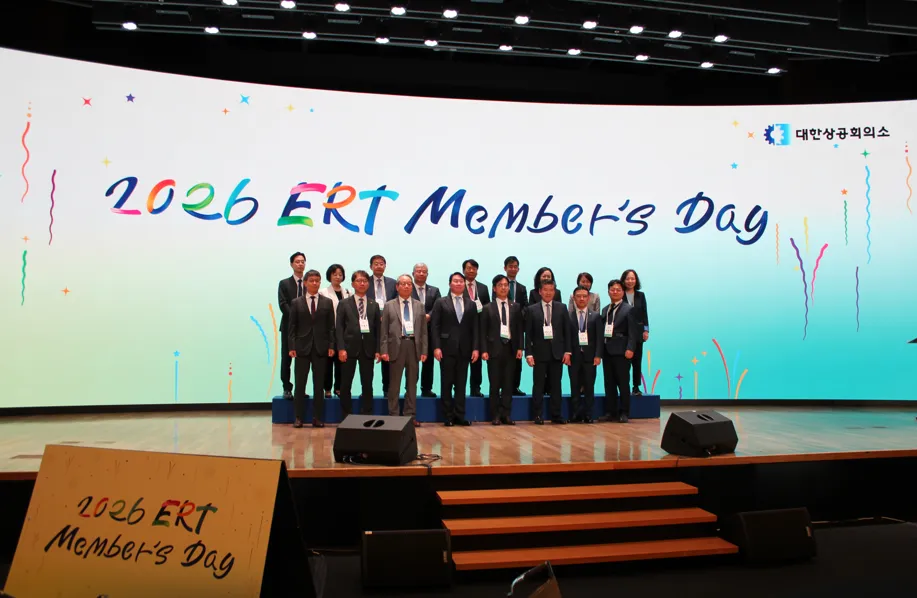
[Group photo of key figures attending ERT Members Day 2026 © ESG.ONL]
Before the full-fledged panel session programs began, the importance of collaboration among diverse actors for solving social issues was emphasized in the keynote speech and congratulatory remarks. In his keynote address, Korea Chamber of Commerce and Industry Chairman Chey Tae-won stated, “As social issues have become more complex than before, they are difficult to resolve through the efforts of a single company or government alone,” adding that “companies, government, social enterprises, and consumers must organically connect their respective capabilities to solve structured social issues.” Vice Minister of the Interior and Safety Kim Min-jae also shared in his congratulatory remarks, “Regional issues cannot be solved by institutions alone. When local governments, field expertise, and public-private ideas are combined, practical solutions can be found.”
Government·Platform·Regional Collaboration Creating Sustainable Structures
In the panel sessions that followed the keynote, examples of collaboration between regions, companies, and government were presented, along with specific cases of company-platform collaboration. The ‘Solvathon’ case — a regional problem-solving idea competition in which LG HelloVision collaborated with the Ministry of the Interior and Safety last year — and McDonald’s Korea’s ‘Taste of Korea’ campaign that incorporated regional specialty products demonstrated new possibilities for mutual prosperity that spreads regional distinctiveness while enhancing brand value. Naver Happy Bean introduced the ‘Drunk Driving Prevention’ Good Action campaign, a consumer-participatory social contribution activity carried out with OB Beer, showcasing ‘the power of a platform that connects companies and society.’
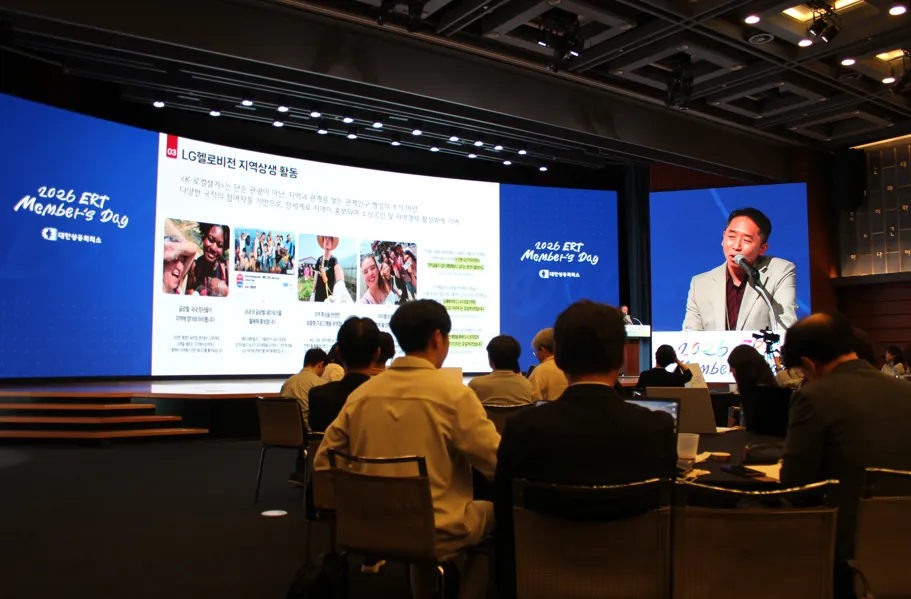
[LG HelloVision ESG Director Noh Sung-rae presenting on ‘Local Impact Created by Connection’ at ERT Members Day 2026]
The ways in which companies measure social value and spread it together with consumers were also a major pillar of this year’s ERT Members Day. SK introduced its Social Progress Credit (SPC) model for measuring and rewarding social value. SPC is a policy experiment that measures the social performance created by social enterprises and provides incentives proportional to that performance. Over the past 10 years, SK has accumulated experience in measuring performance through collaboration with 468 social enterprises. Through the SPC case, SK presented the possibility that social value can lead to a structure of sustainable corporate growth.
Hyundai Department Store added further depth to the session by sharing its ‘365 Recycle Campaign,’ part of its ESG program, in which customers’ unworn clothing is reborn as upcycled padding vests.
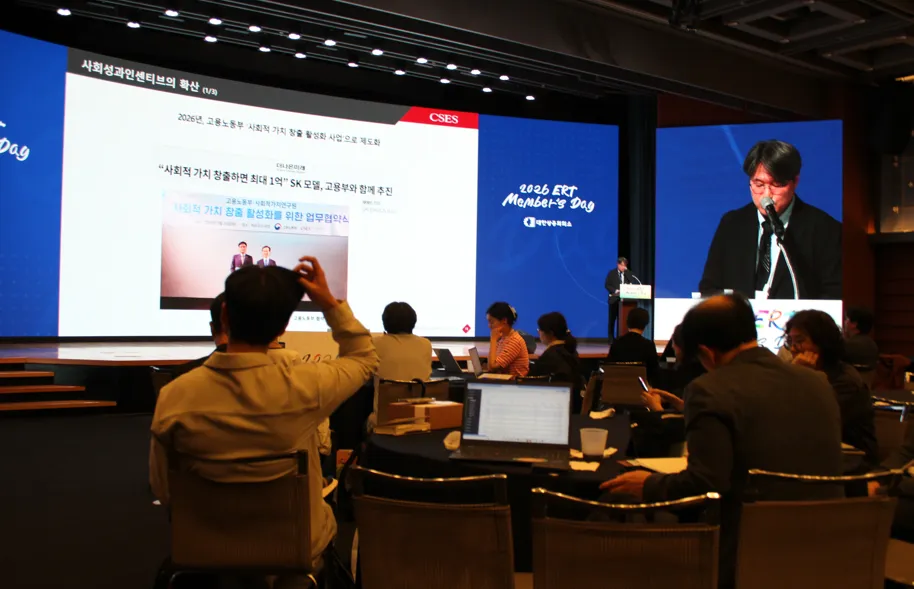
[SK Social Value Institute Planning Director Park Sung-hoon presenting on ‘Social Progress Credit (SPC) Cases’ at ERT Members Day 2026 ]
Where Technology Meets People
In addition to the speaker presentation sessions and workshop networking, the ERT Members Day venue featured a workation exhibition zone addressing regional tourism and local extinction. The exhibition zone offered regional workation information for Jeju, Gangneung, Busan and other locations, as well as a test to find the workation type best suited to oneself and activities to discover desired workation destinations, drawing crowds of participants eager to experience regional value alongside entertainment.
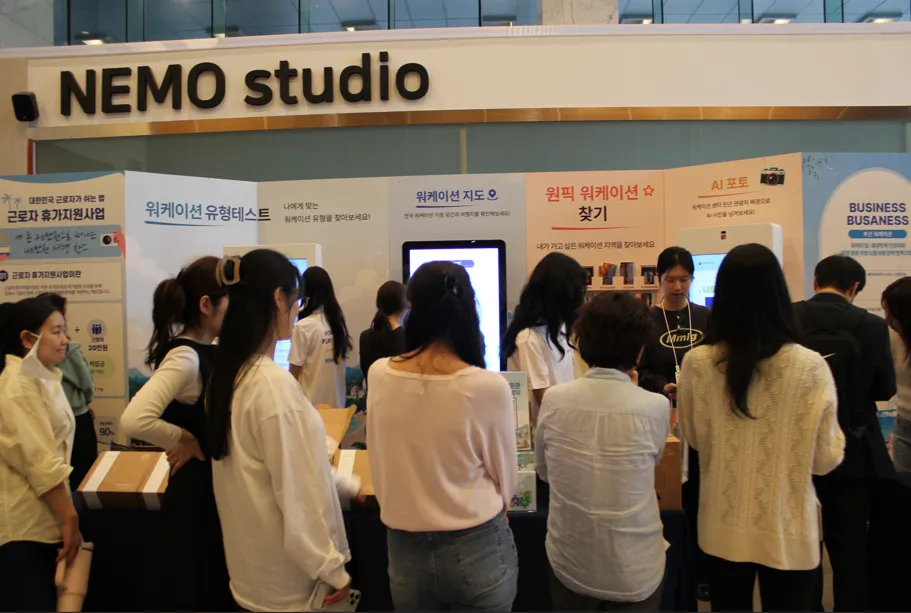
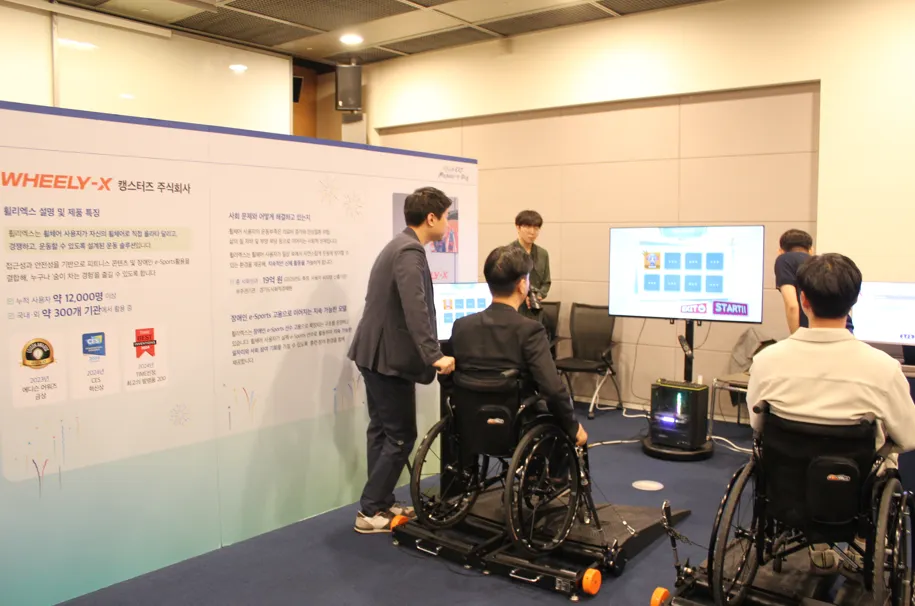
[The ‘Workation Exhibition Zone’ and ‘Helpful AI Experience Zone’ set up at the ERT Members Day 2026 venue]
In another experiential space, the ‘Helpful AI Experience Zone,’ various companies showcased their latest technologies: ‘Dot,’ which supports information access for the visually impaired through proprietary braille cell technology; ‘WHEELY-X,’ which provides exercise solutions enabling wheelchair users to mount the wheelchair themselves; and ‘Local Universe,’ which demonstrated map-based AR (augmented reality) local content.
A defining feature of this year’s ERT Members Day was that it did not leave the theme ‘The AI Era: Connection and Collaboration’ as a mere slogan but embedded it in the very structure of the event. Government, companies, local communities, and consumers each took the stage in their respective roles, and even the methods of measuring social value and spreading it together with consumers were addressed in a single venue. That said, the distance between the language of collaboration filling the event hall and its translation into substantive change remains. As ERT Members Day marks its third edition, we can look forward to next year’s event to see what record of collaboration it will accumulate beyond being an annual forum for sharing.
by Editor N