

The Stewardship Code, a self-regulatory code requiring institutional investors to responsibly engage in the management of their investee companies, is undergoing a full-scale overhaul after ten years since its introduction. Since its domestic adoption in December 2016, a total of 249 institutional investors have joined, including the four major pension funds — National Pension Service, Government Employees Pension Service, Teachers’ Pension, and Korea Post — as well as asset management firms, insurers, and venture capital firms. While the scale has grown compared to the early days of adoption, its effectiveness remains in question. According to a December 2025 report by the Korea Capital Market Institute, among 72 participating institutions including pension funds, asset managers, insurers, securities firms, and banks, only 10 had published a Stewardship Code implementation report. Even those that did publish were limited to pension funds and asset managers, with no confirmed cases among insurers, banks, or securities firms.
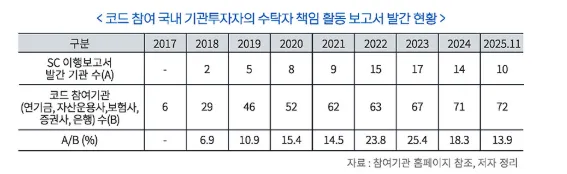
[Stewardship Code Implementation Report Publication Status © Korea Capital Market Institute]
Measures to Substantiate the Stewardship Code
The UK has revised its Stewardship Code three times since its introduction in 2010, and Japan has also been steadily refining it, yet South Korea has not had a single revision since enacting its Stewardship Code in 2016. Change began in December 2025. The Stewardship Code Development Committee and the Korea ESG Standards Institute, together with relevant ministries and agencies including the Financial Services Commission and the Ministry of Health and Welfare, announced measures to substantiate the Stewardship Code. The core of the substantiation effort has three pillars.
First, the formalization of implementation review procedures. Participating institutions must submit self-reports on 12 items including fiduciary duty policies, conflict of interest management, and voting rights exercise, and the ESG Standards Institute will practically review these self-reports through the implementation review process.
Second, the integration of the disclosure system. Implementation reports that were previously scattered across each institution’s website will be collectively posted on a dedicated Stewardship Code website, and a comprehensive report enabling inter-institutional comparison of item-by-item implementation levels will also be published.
Third, the revision of the Stewardship Code content itself. The scope of fiduciary responsibility, which was previously centered on governance (G) within ESG such as board composition and governance transparency, will be expanded to include environmental (E) and social (S) considerations, and the application of stewardship principles at the investment selection stage is also under review. The Stewardship Code Development Committee plans to prepare amendments to the code and detailed guidelines within the first half of 2026.
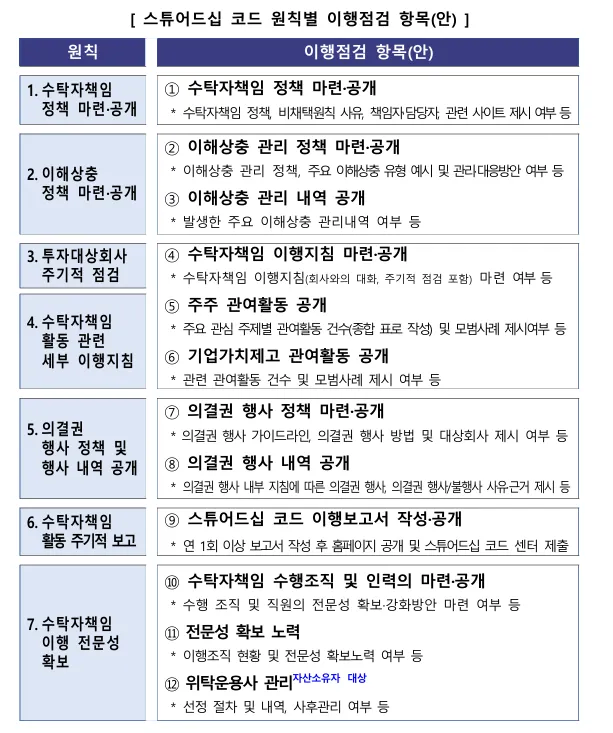
[Stewardship Code Implementation Review Items by Principle © Korea ESG Standards Institute]
From Pro Forma Participation to Subject of Real Scrutiny
In tandem with the institutional overhaul, the National Pension Service, the largest institutional investor, has also picked up pace. President Lee Jae-myung directly ordered the strengthening of the Stewardship Code at a work report session with the Ministry of Health and Welfare and its affiliated institutions, stating that “the National Pension Service must actively exercise its voting rights in companies with backward management practices.” The National Pension Service is pursuing plans to establish separate fiduciary responsibility activity standards for outsourced managers and to reflect inspection and evaluation results in fund allocation and redemption. Concrete examples have already emerged: the National Pension Service voted against SK Hynix’s proposal to dispose of treasury shares for employee compensation purposes at its shareholders’ meeting.
Starting this year, the Financial Supervisory Service will inspect asset management firms’ Stewardship Code implementation status and disclose the evaluation results. The scope of inspection will begin with 68 asset management firms and pension funds in 2026, and expand in phases to private equity fund managers and insurers in 2027, securities firms, banks, and investment advisory firms in 2028, and to venture capital by 2029. Internal controls and compensation systems for private equity fund managers will also be reformed. The Financial Supervisory Service indicated that corporate leaders need to personally inspect performance-based compensation structures and internal organizations.
After Japan introduced its Stewardship Code in 2014, institutional investors actively demanded shareholder returns from undervalued companies with low Price to Book Ratios (PBR). Companies responded with share buybacks and expanded dividends, and as a result, the Nikkei index, Japan’s benchmark stock index, more than tripled over the course of a decade. This is a case where the Stewardship Code went beyond mere normative dimensions to transform the fundamental character of the entire capital market. Once the Stewardship Code amendments are finalized in the first half of this year, those standards will immediately set the bar for investors. This is precisely why companies should now review their internal ESG management systems and disclosure readiness.
by Editor N