
Early voting for the June 3 local elections begins in three days. What choice should we make? If you have not yet decided, it may be worth consulting the ‘2026 Local Election 10-Domain Climate Policy Proposal (hereinafter the Proposal).’ Jointly announced on May 21, the first day of the official election campaign period, by Climate Politics Baram, Cultural Solidarity, and Citizens’ Coalition for Walkable Cities, the Proposal is a policy proposal presented by civil society as a framework for vetting candidates. Under the banner of ‘Reduce Carbon, Increase Welfare,’ it contains a total of 30 policies across 10 domains. Civil society has taken the initiative in providing criteria, from Environmental (E), Social (S), and Governance (G) perspectives, for evaluating the pledges of metropolitan and local government heads.

[2026 Local Election 10-Domain Climate Policy Proposal © Green Transition Institute]
The 10 domains covered by the Proposal are: ▲Region-Led Carbon Neutrality Policy ▲Energy Transition ▲Mobility Rights ▲Housing Rights ▲Education ▲Green Jobs ▲Climate Care ▲Agriculture & Food ▲Ecology ▲Resource Circulation. As the slogan suggests, the policy focus is oriented toward reducing the burden on citizens. The common goal across the 30 policies is to create regional circular structures for transportation costs, heating and cooling costs, food costs, energy, jobs, food, and care. In this way, the Proposal places weight on articulating concrete items through which citizens can experience and verify climate pledges. In the publication statement, civic groups argued that “voters must directly seek out and scrutinize the climate pledges that local election candidates have not put forward,” and that “they must demand that candidates strengthen their climate pledges and policies by election day.”
Analysis Also Shines Light on Governance Blind Spots
Among the quantitative data presented in the Proposal, there are figures worth noting from the ESG Governance perspective. A comprehensive analysis by the Green Transition Institute of the 1st Carbon Neutrality Master Plans of all 226 local governments revealed that the average 2030 carbon emission reduction rate was 25.3%, falling short of the Nationally Determined Contribution target of approximately 40% reduction from 2018 levels. A total of 87 local governments (38.5%) received a D grade, requiring a full-scale redesign.
The state of governance operations is even more deficient. Among the 226 local governments, only 147 (65.0%) have actually constituted and are operating a Carbon Neutrality and Green Growth Commission, and even those that are constituted have been limited to holding just 1–2 meetings per year on average. Only 7 (3.1%) operate subcommittees dealing with more detailed agendas. The fact that 28.5% of appointed members are concentrated in academia and research, while labor and farmers account for only 2.0% and youth and students for just 1.3%, is also disappointing from a diversity perspective. Among the 147 operating commissions, 51 (34.7%) were found to be male-dominated in violation of statutory gender balance provisions. This is the backdrop for the Proposal’s first domain — ‘Region-Led Carbon Neutrality Policy’ — calling for a citizen-participatory plan redesign and the establishment of a climate deliberation body.
The disparity in the energy domain is also clear. As of 2024, South Korea’s renewable energy generation share stands at approximately 9%, just one-third of the OECD average (31.0%). While Germany installed an additional 430,000 balcony solar units in 2024 alone, South Korea remains at the initial stage for both institutional frameworks and deployment infrastructure. Energy-poor households are estimated at 1.58 million, and homes aged 30 years or older total 5,563,000, accounting for roughly 28% of all housing. The Proposal’s ‘One Household, One Solar’ deployment system and ‘Grand Housing Renovation’ are policy cards directly targeting these disparities.
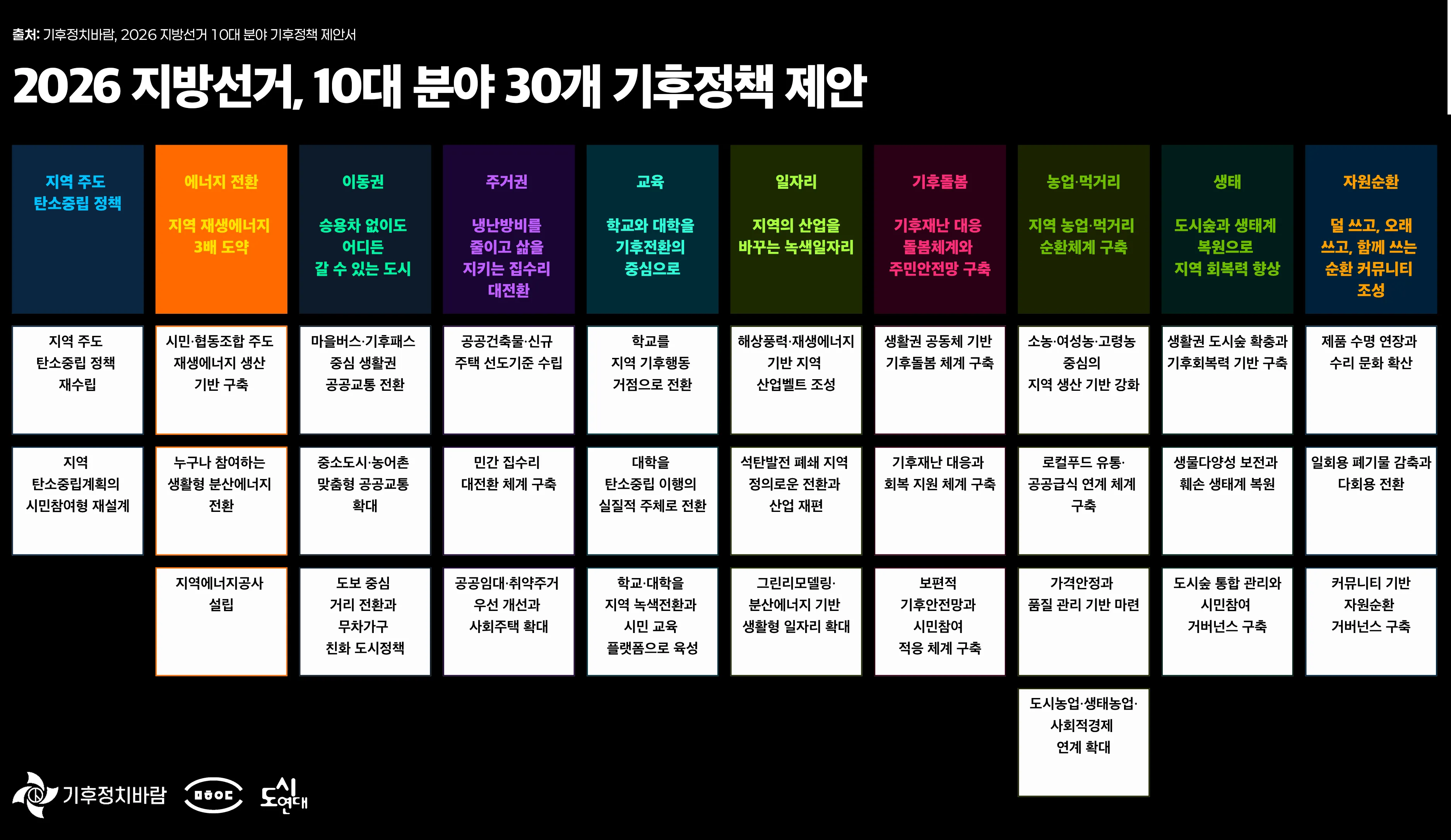
[2026 Local Election 10-Domain 30 Climate Policy Proposals © Green Transition Institute]
Partial Alignment Between Proposal and Candidate Pledges
Examining metropolitan government head candidates’ pledges against the 30 policy items presented by civil society reveals variation in the degree of alignment by domain. In the mobility sector, Democratic Party Seoul mayoral candidate Jeong Won-o’s pledge for ‘full expansion of the Climate Companion Card across the metropolitan area’ points in the same direction as the Proposal’s call for expanding flat-rate climate passes. Data showing 20 million cumulative Climate Companion Card top-ups and 800,000 monthly users were even cited in the Proposal itself as evidence of policy effectiveness. In the green jobs sector, Democratic Party candidate Kim Young-rok’s pledge for 2 million pyeong of RE100 industrial complexes as Governor of the integrated Jeonnam-Gwangju Special City partially aligns with the Proposal’s call for offshore wind and renewable energy industrial belt creation.
Conversely, some domains are key items in the Proposal yet rarely appear in candidate pledges. The ‘Grand Housing Renovation’ policy in the housing rights domain barely features in core metropolitan government head pledges, despite the building sector accounting for 22.2% of domestic greenhouse gas emissions. The protection of climate-vulnerable groups, mandated by the amended Framework Act on Carbon Neutrality that took effect on April 7, is only mentioned at the party level — the Democratic Party’s ‘Climate Insurance’ and the Rebuilding Korea Party’s ‘Climate Allowance’ — while implementation plans at the metropolitan government head level remain rare.
Another signal of party-level interest was evident at the debate hosted by Climate Politics Baram on May 7. While officials from the Democratic Party, Rebuilding Korea Party, Progressive Party, and Justice Party attended the mayoral and gubernatorial debate, the People Power Party and New Reform Party did not respond to the organizer’s invitation.
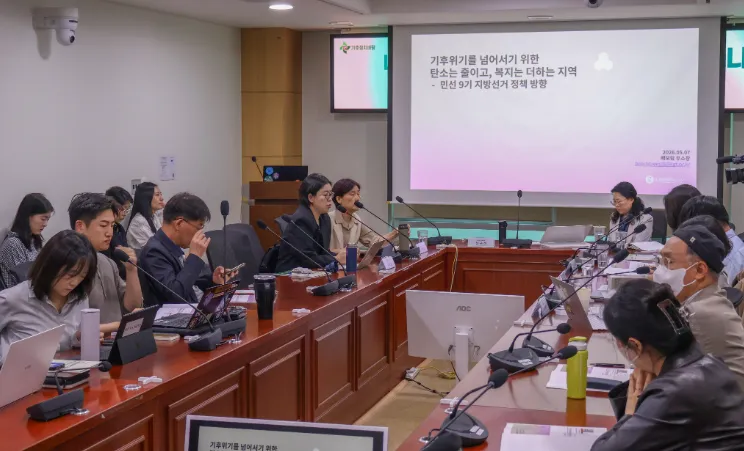
[‘Climate Pledges That Change My Life: Are Mayors and Governors Ready?’ Debate Venue © Green Transition Institute]
By-Elections as a Legislative Variable
The 14 National Assembly by-elections being held on the same day are also a variable. This is because the legislative momentum for bills pending in the 22nd National Assembly — such as the ESG Adoption and Promotion Support Act, the SME Carbon Neutrality Support Act, and the RE100 Industrial Complex Special Act — will be influenced by the election results. While metropolitan and local government heads will steer policies for the next four years, the composition of the National Assembly that will provide the legal basis for those policies is being decided on the same day. The Proposal also addresses the division of roles between local and central governments. In the publication statement, the civic groups noted that “while the central government can secure funding and introduce institutions for carbon neutrality, the actual realization of climate response requires local governments, regional communities, and citizens to act,” and that “the success or failure of the Nationally Determined Contribution ultimately rests with local governments.”
Ko Yi-ji-sun, Regional Transition Team Lead at the Green Transition Institute who oversaw the drafting of the Proposal, explained in the press release that “the emphasis was on restructuring climate policy not as a mere environmental agenda but as a civic livelihood agenda,” and that “both candidates and voters must recognize that policies that substantively reduce transportation, heating, cooling, and food costs are the very policies that reduce carbon.” In particular, the ‘Region-Led Carbon Neutrality Policy’ — which the Proposal placed as the first domain — calls for establishing carbon neutrality targets before 2050, installing dedicated carbon neutrality organizations, creating regional climate funds, and redesigning citizen-participatory plans, all of which must be initiated in the first year of the elected official’s term. The extent to which the 30 items flagged by the Proposal take root in local administration within the four-year term will also provide a rough outline of the ESG report cards of South Korean local governments in 2030.
by Editor N