

Companies issue sustainability reports spanning hundreds of pages each year. These reports organize environmental data under Global Reporting Initiative (GRI) standards and describe climate risks according to the International Sustainability Standards Board (ISSB) framework. As of 2025, 51% of the top 50 companies by market capitalization in South Korea applied the ISSB framework in preparing their sustainability reports, and from 2028, KOSPI-listed companies with total assets of KRW 30 trillion or more will be required to file sustainability reports. Viewed solely by the ratio of companies producing sustainability reports, South Korea’s ESG information disclosure system seems to have entered a mature stage.
Are AI Systems Reading Sustainability Reports?
However, the way investors and consumers review corporate sustainability has already changed. Corporate stakeholders no longer meticulously read 200-plus-page PDF attachments. They ask generative AI such as ChatGPT, Perplexity, Claude, or Google Gemini questions like “What is this company’s carbon reduction performance?” or “What is its supply chain human rights policy?” and make decisions based on the AI’s answers. The problem is that the sources AI uses to compose its answers are not necessarily the official sustainability report. AI synthesizes news articles scattered across the web, social media mentions, and third-party evaluation data to create a ‘summarized corporate image.’ No matter how thoroughly the content is detailed in a sustainability report, if it lies buried in a form that AI cannot read, the situation that emerges is no different from it not existing online at all.

[Google AI Overview, where generative AI synthesizes answers from multiple web sources © Google]
The strategy that has emerged to solve this problem is Generative Engine Optimization (GEO). Originally developed in the marketing field as a technique for optimizing information structures so that brand content is cited in AI answers, GEO differs from conventional Search Engine Optimization (SEO), which aimed at achieving high keyword-based search result rankings, in that it is designed to make AI trust and cite specific sources when generating answers. The key is ‘structures that AI can easily understand.’ Trustworthy sources, clear sentences, logically connected paragraphs, and fact-based descriptions with specified figures and sources all increase the likelihood of AI citation. Conversely, if descriptions are vague or data are scattered without structure, AI will skip that information.
The Format of Sustainability Reports Determines Corporate Reputation
Applying a GEO perspective to ESG information disclosure makes the problem of AI struggling to use sustainability reports as information sources even more apparent. The vast majority of sustainability reports are in PDF file format and consist of lengthy narrative text and images — a structure that makes it difficult for AI to collect and cite data in real time. Even if a company diligently discloses its Scope 1·2·3 emissions, if those figures are entered within table images that AI finds difficult to analyze, they will not be reflected in AI search results. If the climate target achievement roadmap lies buried in paragraph form in the middle of a 50-page report, AI will not recognize it as key information.
As a result, AI ends up evaluating a company’s ESG level based not on its sustainability report, but on content reported by external media. Because of this, greenwashing controversies surrounding companies can easily spread, while companies that have actually achieved substantive results may be undervalued.

[Corporate sustainability report published in PDF file format © Lotte Engineering & Construction Official Website]
Leading companies are already responding to this change. Comprehensive shipping and logistics company HMM has publicly released a supply chain carbon calculator on a web-based platform, enabling external stakeholders to query and cite data in real time. Amazon discloses climate targets and partner company data in structured form through its ‘Sustainability Exchange’ platform.
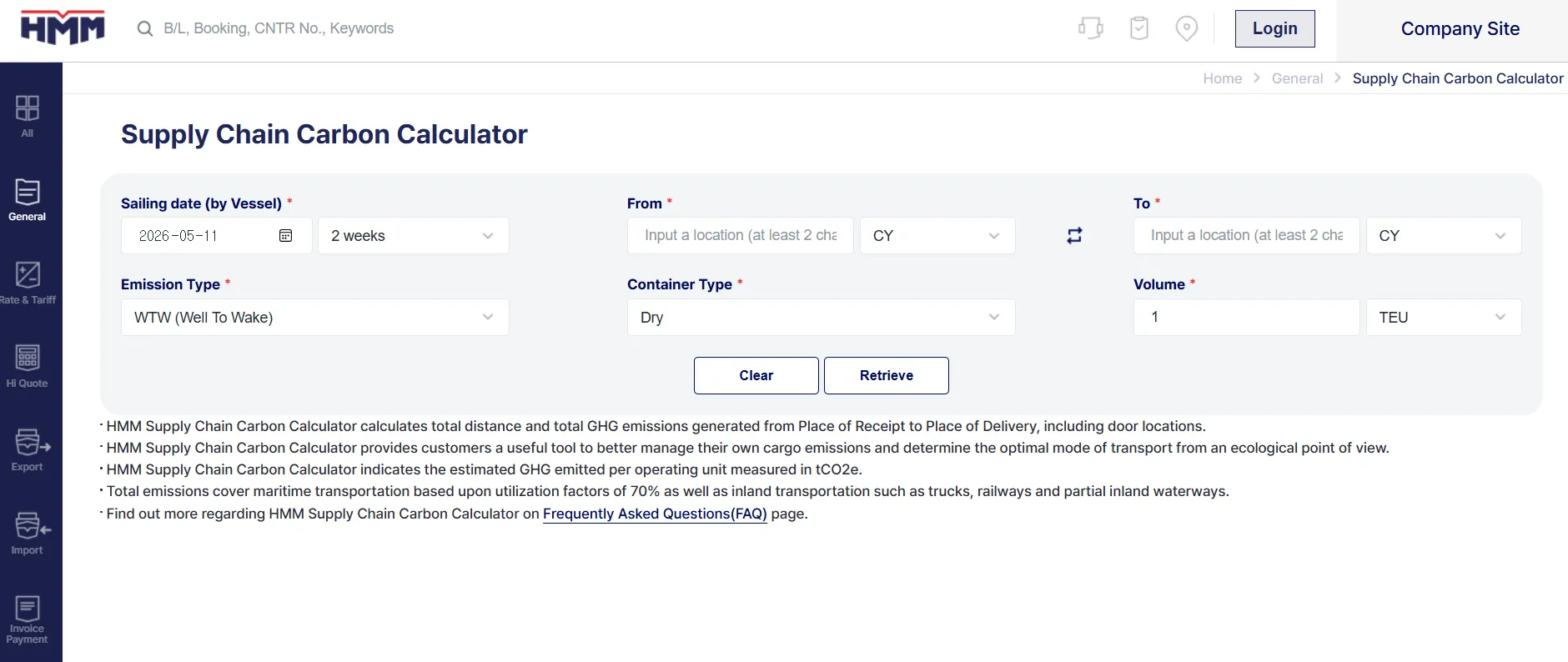
[HMM Supply Chain Carbon Calculator screen © HMM Official Website]
In this way, a trend is forming in which companies are moving beyond the closed format of the sustainability report and transitioning their ESG information into open data structures that AI can read and cite. Now, as mandatory ESG disclosure expands, the question companies must answer is shifting from ‘what to disclose’ to ‘how to disclose.’ Reports that AI cannot read are reports that will no longer be read.
by Editor N