
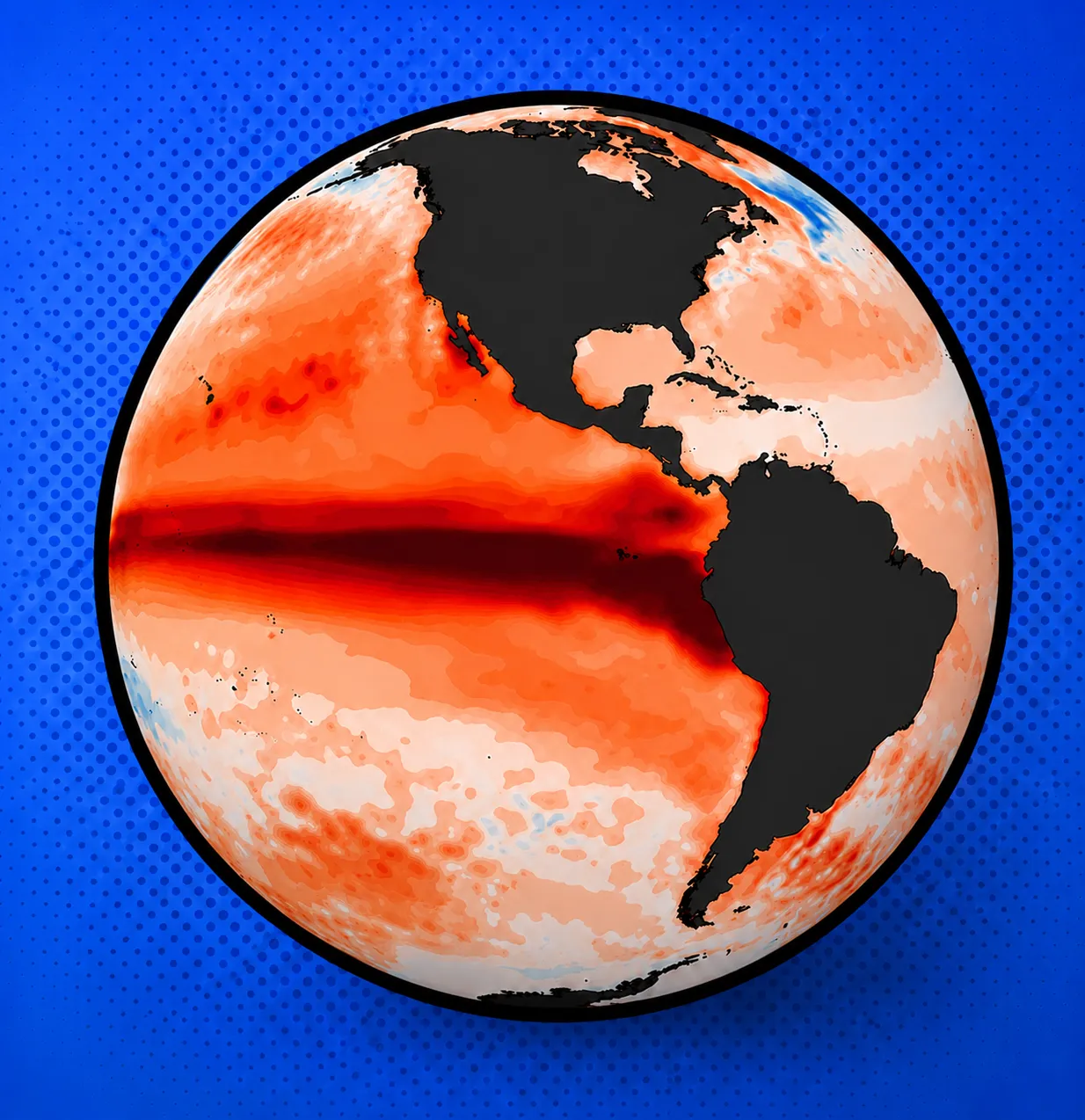
This spring brought unpredictable extreme weather, with temperatures soaring up to 31°C creating midsummer-like conditions, followed the next day by torrential downpours. El Nino is pointed to as the primary cause of such abnormal weather patterns. Concerns are mounting in particular as the possibility of a more powerful ‘Super El Nino’ has been raised for this summer, putting the entire world on high alert regarding climate risk.
Not Just El Nino, But a ‘Super El Nino’
El Nino refers to a phenomenon in which sea surface temperatures in the eastern equatorial Pacific Ocean rise above normal levels. Typically, trade winds blow strongly from east to west in the equatorial region, pushing warm water toward the western Pacific. However, when the trade winds weaken, warm water shifts toward the eastern Pacific, causing changes in the oceanic and atmospheric circulation system. El Nino is generally defined as a sustained period where eastern Pacific sea surface temperatures remain 0.5°C or more above normal, while a ‘Super El Nino’ is classified when temperatures rise by 2°C or more.
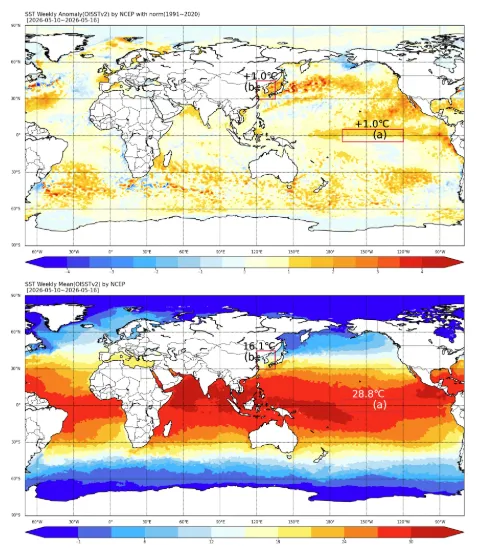
[Sea Surface Temperature Status, May 10–16, 2026 © Korea Meteorological Administration ‘El Nino White Paper’]
According to data from the Korea Meteorological Administration, sea surface temperatures in the Pacific El Nino-La Nina monitoring region currently stand at 28.8°C, 1°C above normal, indicating an increased likelihood of El Nino development. Recently, the U.S. National Oceanic and Atmospheric Administration (NOAA) forecasted an 82% probability of El Nino occurring between June and August of this year. NOAA also analyzed that the probability of El Nino developing into a stronger Super El Nino between this year and 2027 reaches as high as 67%.
Damage Caused by Super El Nino
So what will happen if a Super El Nino occurs? With temperatures continuing to rise due to global warming, a Super El Nino could lead to more frequent extreme weather events such as torrential rains, record-breaking heatwaves, and droughts. This could result in reduced agricultural output and a sharp increase in agricultural product prices, a phenomenon known as ‘heatflation.’ Furthermore, socio-economic damages such as water shortages and heightened wildfire risk are expected to intensify significantly.
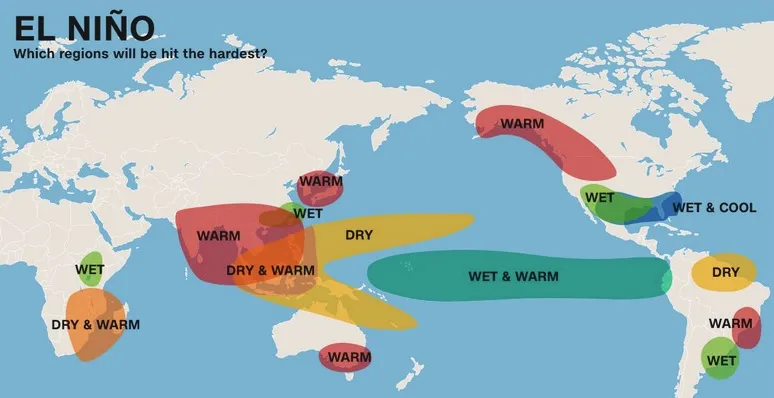
[KMA Teleconnection Schematic Diagram © Korea Meteorological Administration ‘El Nino White Paper’]
Since the establishment of the World Meteorological Organization (WMO) in 1950, Super El Nino events have occurred a total of four times. They occurred as recently as 2023 and 2024, with 2024 recorded as the hottest year since observations began in 1950. The 2024 Super El Nino also triggered a series of weather anomalies. Droughts struck parts of South America and Africa, while prolonged high temperatures and drought in the Mediterranean region caused cocoa and olive oil prices to surge dramatically. South Korea also recorded its longest-ever streak of tropical nights, with some regions enduring heatwaves exceeding 35°C.
Can We Prepare for a Super El Nino?
Super El Nino is not merely a weather phenomenon. Beyond heatwaves, droughts, and torrential rains, it is a compound risk factor affecting food supply, prices, and public safety. Particularly in the context of ongoing global warming, the ripple effects of a Super El Nino could be even more severe, making heightened awareness essential.
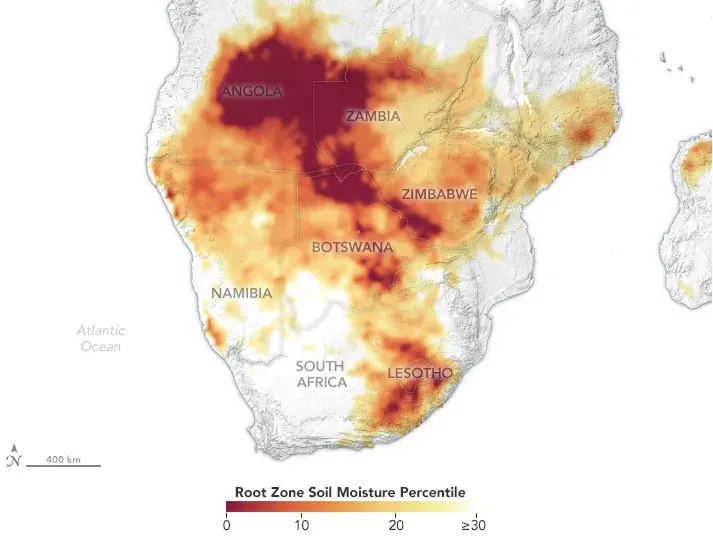
[Severe Drought in Southern Africa Due to the 2024 El Nino © NASA Earth Observatory ]
Experts emphasize that fundamentally mitigating the extreme weather caused by Super El Nino requires ‘greenhouse gas reduction’ and ‘achieving carbon neutrality.’ At the same time, building response systems to prepare for climate disasters is also critical. This includes advancing weather prediction systems, establishing agricultural and water resource management measures, and strengthening social safety nets to protect populations vulnerable to disasters.
The increasing likelihood of a Super El Nino signals that the climate crisis is already an ongoing risk. The extreme weather we are experiencing now may be merely the beginning of the climate disasters we will face ahead. We are now in an era where not only structural societal transitions for energy conservation but also everyday practices are no longer optional.
by Editor N