

July 3 is the International Plastic Bag Free Day, commemorated by the international community. This day was proposed in 2008 by GAIA, an international environmental organization based in Spain, with the aim of limiting plastic bag use for at least one day a year, and was established with the participation of environmental organizations from countries including the United States and France. Let us explore the birth of the plastic bag, regulations across different countries, and the efforts to make a plastic-bag-free day a part of everyday life.
The Irony of the Plastic Bag Invented for the Environment
In modern consumer society, the plastic bag — a symbol of cheap, lightweight convenience — was originally developed with the purpose of protecting nature. In 1959, Swedish engineer Sten Gustaf Thulin devised a reusable, high-density polyethylene bag — what we now know as the plastic bag — to address the deforestation problem caused by excessive use of paper bags. However, ironically, as mass production technology advanced and manufacturing costs plummeted, the plastic bag, in complete opposition to Thulin’s original intention, became a single-use, throwaway item.
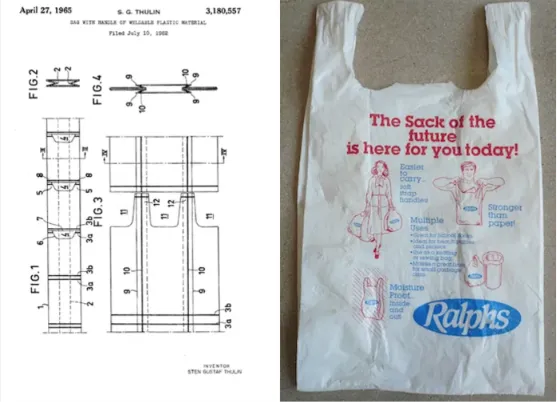
[The first plastic bag, devised by Sten Gustaf Thulin in 1959 © Medium]
Easily discarded plastic bags emit enormous amounts of carbon during the production process. Moreover, their durability — taking hundreds of years to decompose after disposal — disrupts both soil and marine ecosystems. In other words, the disposable plastic bag created to protect the environment has instead become a threat to it.
The Choices Made to Reduce Plastic Bags
To address the environmental problems caused by plastic bags, countries around the world have established legal regulatory measures. In South Korea, since April 2019, as part of the Ministry of Climate, Energy and Environment’s ‘Enhanced Recycling Waste Management Measures,’ the use of disposable plastic bags has been completely banned in large discount stores and supermarkets above a certain size. According to the Ministry, plastic bag usage in large retailers stood at 1,596 tons in 2017 before the policy was implemented, but decreased to 466 tons by 2021, four years later. Reusable standard garbage bags, shopping baskets, and paper bags are replacing disposable plastic bags.
While South Korea’s regulations focus on specific disposable plastic bag items, overseas efforts are moving toward broadening the regulatory scope. According to the EU’s ‘Single-Use Plastics Directive’ announced in 2019, by 2030, all plastic bottles placed on the EU market must contain at least 30% recycled plastic in their manufacture. New Zealand, beginning with a ban on single-use bags and disposable plastic shopping bags in 2019, has been progressively tightening single-use plastic regulations. Since October 1, 2022, the manufacture and sale of six categories of items — including single-use plastic cotton buds, drink stirrers, and polyvinyl chloride (PVC) containers — have been banned.
Plastic Bag Free Day: From One Day to Daily Life
For International Plastic Bag Free Day to become part of daily life, a shift in consumer culture is necessary. Governments must set long-term reduction targets that go beyond individual product regulations, backed by concrete implementation plans. Corporate responsibility is equally important. Companies must join the path toward sustainable development — by developing reusable packaging materials and investing in the adoption of circular economy models. Policy sets the direction; business provides the means.

[International Plastic Bag Free Day poster © Korea Environment Institute Official Instagram]
Ultimately, however, the agent of change is the individual who uses these disposable items. In honor of International Plastic Bag Free Day, let us carry a reusable bag instead of a plastic one. That small choice can be the first step toward a sustainable future.
by Editor N