
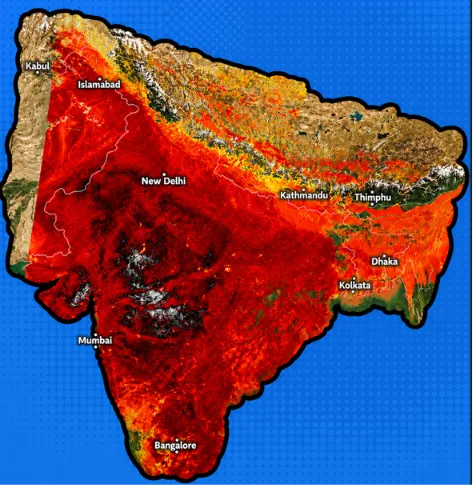
Even faster than South Korea, where recent summer heat feels unlike past years, India has been trapped in extreme warmth since April. In India, the period from May to June is typically considered the severe hot season, with intense heat persisting. This year, however, an early heatwave with maximum temperatures exceeding 45°C struck India as early as April, before the full onset of summer. In Rajasthan state, temperatures soared to 48.3°C, and major cities including Delhi and Lucknow have been enduring relentless heat day and night. Recently, even nighttime temperatures have risen sharply, prompting talk that there is effectively no time to escape the heat anymore.
As of April 27 of this year, the fact that the top 50 cities worldwide recording the highest temperatures were all located in India’s interior is an event with few statistical precedents.
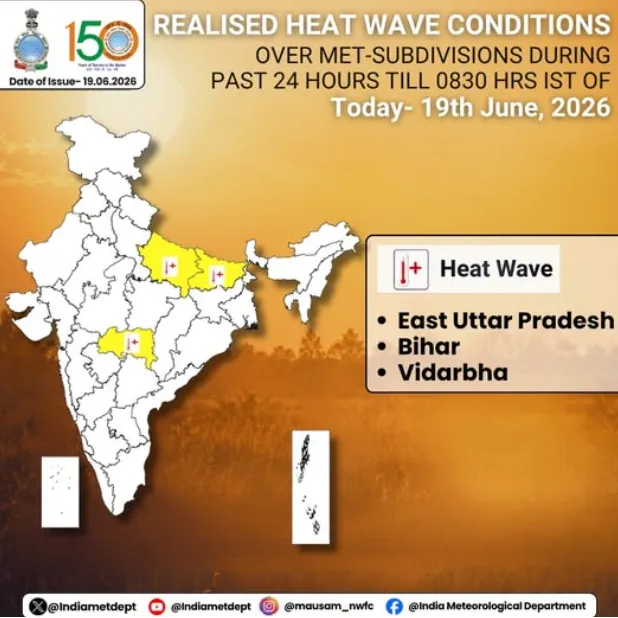
[Heatwave in India, June 2026 © India Meteorological Department Official Facebook]
Why Is India So Hot?
This heatwave is not the result of a single factor but a complex combination of multiple meteorological phenomena and environmental factors. Western Disturbances — storms originating in the Mediterranean region that move eastward and bring rain to India — have weakened this year, with reduced frequency. Over the Gangetic Plain and eastern Indian region, a Heat Dome has formed, with hot air trapped by a stationary high-pressure system.
In addition, abnormal climate patterns are a cause of India’s long-term climate change. According to the India Meteorological Department, since 1961, the frequency of heatwaves in India has increased by 0.1 days per decade, and average nighttime temperatures have also risen by approximately 0.21°C per decade. Cities retain heat longer due to densely packed buildings, limited green spaces, and high vehicle emissions, further accelerating nighttime temperature increases.
Nighttime heat is more dangerous than daytime heat because it deprives the body of recovery time. Moreover, this year has added the potential for a Super El Niño, where tropical Pacific sea surface temperatures rise 2°C or more above normal. A Super El Niño can weaken the seasonal monsoon, which accounts for about 70% of India’s precipitation, potentially delivering compound blows to agriculture and the economy through reduced harvests, intensified water rationing, and power outages.
Heat That Threatens Survival
The danger of heatwaves cannot be fully explained by temperature figures alone. The 2026 heatwave in India is even more lethal because it is accompanied by a sharp rise in humidity. India’s average relative humidity rose from 67.1% in 2015–2019 to 71.2% in 2020–2024, and among cities, Delhi showed the largest increase at 8 percentage points.
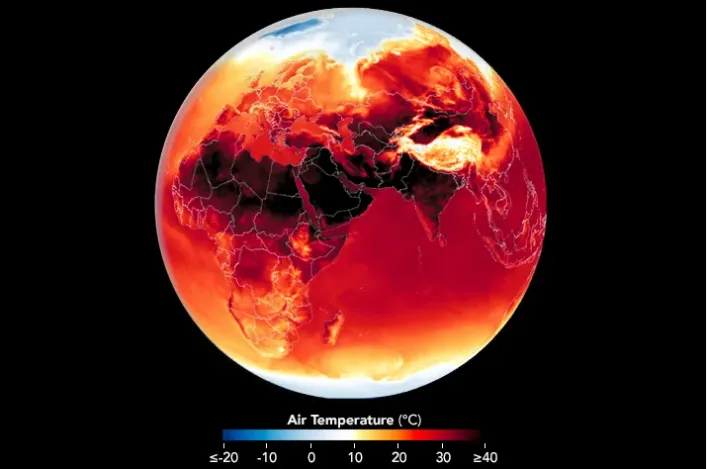
[Atmospheric temperatures during the 2024 heatwave in Europe and Southeast Asia © NASA]
When the wet-bulb temperature — an index that simultaneously reflects temperature and humidity — approaches 35°C, the human body loses its ability to regulate temperature through sweat evaporation, threatening life itself. Climate analyst Bruno Bresinski stated, “In some regions of India, the heat index is approaching 55°C, and the wet-bulb temperature is reaching levels close to the limit of human survival,” conveying the severity of the heatwave. While only air conditioning can remove both heat and moisture simultaneously, the reality is that most Indian households lack air conditioning.

[ Medical facilities provided as heatwave shelters in India © Children’s Environment Health Collaborative]
The Vicious Cycle of Climate and Economy Triggered by Heatwaves
Also notable is the structure in which efforts to overcome the heat — such as using fans or air conditioners — actually intensify the heatwave. Over 70% of India’s electricity is still generated by coal-fired power, and according to S&P Global Energy data, India’s coal-fired power generation averaged 164.9 GW in April 2026, an increase from the same period last year. Ultimately, the heatwave drives up electricity demand, which raises the utilization rate of coal power plants, leading to additional greenhouse gas emissions that in turn fuel further heatwaves — a structurally operating vicious cycle.
Economists warn that such a vicious cycle will become a structural obstacle to India’s long-term economic growth. The heatwave has caused the loss of 247 billion labor hours in agriculture and construction, resulting in an economic blow of approximately USD 194 billion (around KRW 260 trillion) to India. This figure corresponds to up to 4.5% of India’s GDP, demonstrating that extreme summers are not a temporary shock but could be a recurring impediment to economic growth.
In 2022, 2024, and 2025, India’s summers appeared before us each year carrying the modifier “unprecedented.” Yet this 2026 Indian summer has set yet another record. The problem is that this record is highly likely to keep being broken. As long as the vicious cycle of climate and economy triggered by heatwaves continues, the modifiers attached to India’s summers can only grow stronger each year.
by Editor N