

On a hot summer lawn, strangers stand shoulder to shoulder and become one. The ‘slam’ at festival venues — pushing, shoving, jumping, and colliding — is the moment when the most primal solidarity unfolds among strangers. Behind that heat-filled scene, alongside the enjoyment, something else is piling up.
According to the Performance Market Analysis Report by the Korea Arts Management Service, popular music concert ticket sales in 2025 recorded ₩981.7 billion, a 29% year-on-year increase, showing explosive growth. From spring to fall this year, a series of large-scale festivals including music events are scheduled to arrive one after another. But alongside the ever-growing scale of festivals, the recurring waste problem has also begun to surface.
After the Festival, It Wasn’t Just Fun That Remained
For an event averaging 5,000 visitors per day, approximately 150 standard 100-liter garbage bags worth of waste are generated. For large-scale festivals drawing tens of thousands, the volume is difficult to estimate. Most festival waste comes from on-site banners, paper tickets, disposable cups, and food packaging. The Daegu Chimac Festival held in July 2025 aimed to be eco-friendly, preparing a total of 24,000 reusable containers, but that number was woefully inadequate compared to the approximately one million visitors. Even though both reusable and disposable containers were provided, many booths still used disposables, and only a single booth near the main stage was equipped with reusable containers. Two days after the festival ended, reports continued of trash, including reusable containers discarded as if disposable, appearing throughout the venue.
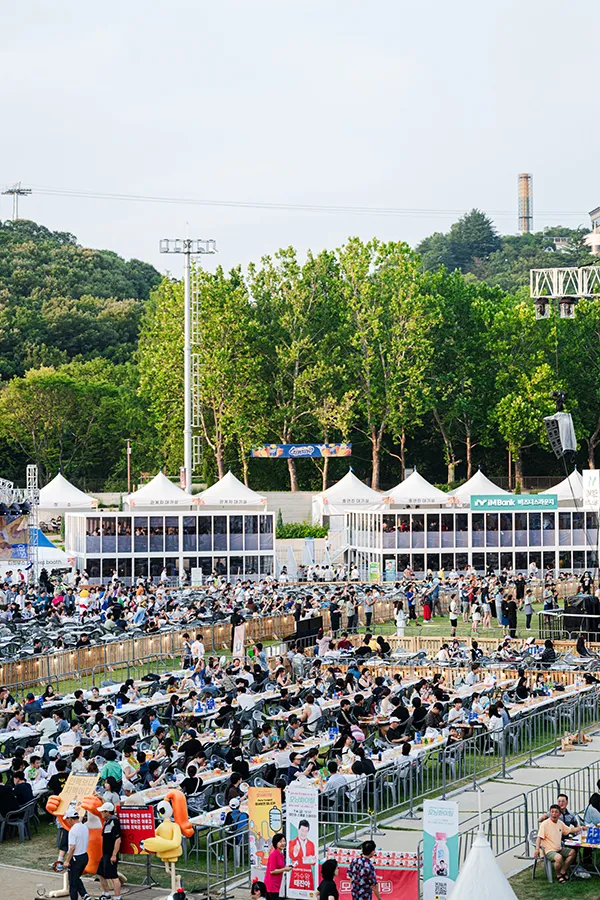
[2025 Daegu Chimac Festival venue © Daegu Chimac Festival Official Website]
How Festival Venues Are Changing for the Environment
That said, efforts to reduce waste at festival venues are not absent. Trash Busters, a domestic reusable container startup, provides a reusable container rental service to reduce disposables generated at festivals and events. At the festival venue, visitors return their reusable containers to designated return booths after meals and get their deposit back. At TSWC, Trash Busters’ specialized washing center in Anyang, 140,000 reusable cups are cleaned daily — a scale three times that of Seoul World Cup Stadium.
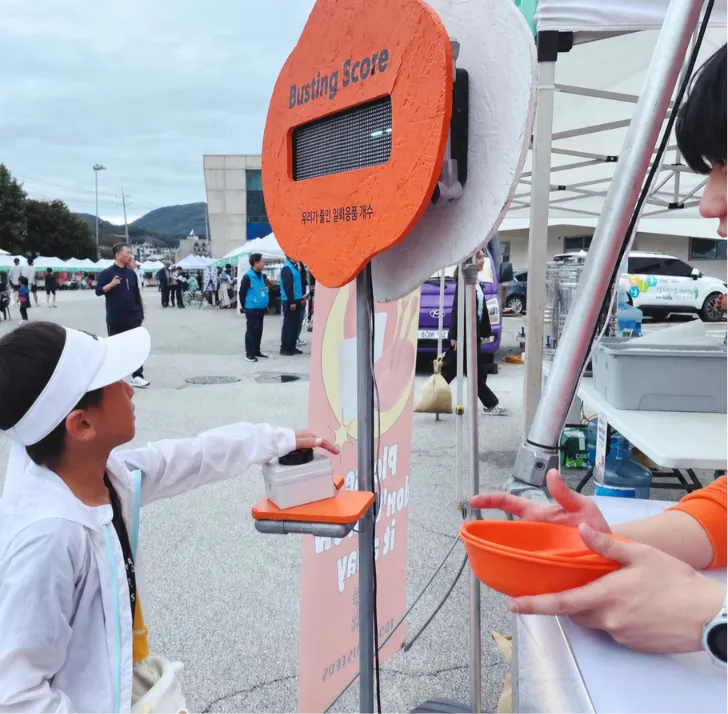
[Trash Busters providing reusable container rental services at festival venues © Trash Busters Official Instagram]
At the Suwon Theater Festival held in May 2025, efforts to create a disposable-free venue were evident. The eco-friendly startup Eatgreen collaborated with Suwon City to place reusable container return bins throughout the festival venue and directly guided visitors on how to return containers. As a result, reusable items were actively collected throughout the festival period.
The Regulatory Gap on Festival Disposables Between Korea and Overseas
Overseas, government-level regulations on waste discarded at festivals are already well established. In Austria, the use of disposables at large music festivals attracting three million visitors annually is completely banned by government policy. In contrast, South Korea’s festival and event venues are evaluated as being close to a blind spot for disposable regulation. The Ministry of Climate, Energy and Environment has been implementing the ‘Guidelines for Reducing Disposable Product Use by Public Institutions’ since July 2018, which public enterprises and local governments must follow. However, critics point out that the guidelines are effectively toothless, as they merely state that public institutions should ‘strive’ not to use disposables in meetings or events.

[Guidelines for Reducing Disposable Product Use by Public Institutions © Ministry of Climate, Energy and Environment]
In the summer of 2026, hundreds of thousands of visitors will flock to various festival venues. For only joyful memories to remain after the festival, something as essential as the goodwill of the audience is needed: systematic design by organizers and policy support to reduce waste. A great festival is not built on stage alone.
by Editor N