
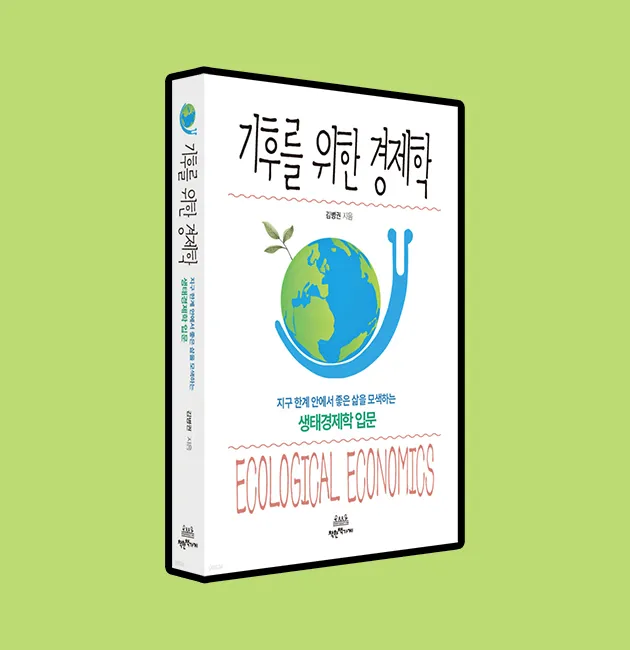
‘Economics for the Climate’ begins with an uncomfortable question. Climate crisis response has now reached a stage that demands changes in economic and social systems beyond the realm of the natural sciences, so why is our economics still repeating old answers? Kim Byung-kwon, a research fellow at the Green Transition Institute and the author of this book, notes that mainstream economics has failed to find answers in the face of the climate crisis and draws readers’ attention to the unfamiliar economic tradition of ecological economics.
If you are curious about a new perspective on the climate crisis and economics, read this book.
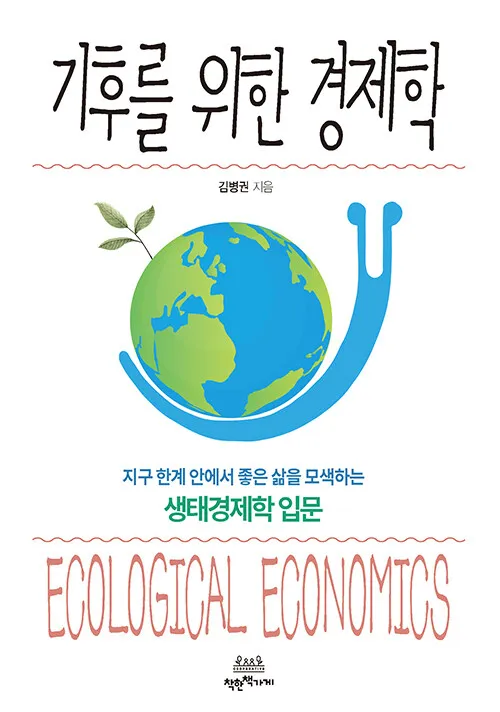
[Economics for the Climate Ⓟ Chakhan Chaekgage]
Why Mainstream Economics Has Failed to Find Answers to the Climate Crisis
‘Economics for the Climate’ states that the climate crisis cannot be resolved with the existing economic paradigm. Policies to date have failed to fundamentally solve the climate crisis and ecological problems, and it argues that new answers must be found through ecological economics. The book conveys that solving the climate crisis requires ecological economics — an economic perspective that understands the human economy within the Earth’s ecosystem. Ecological economics fundamentally prioritizes sustainability based on optimal economic scale and focuses on the long-term process toward that end. Even if not yet theoretically perfect, the crisis will deepen if we do not attempt new approaches.
Degrowth: Beyond Misunderstanding to Its Essence
Author Kim Byung-kwon focuses on the inverse proportional graph formed by carbon neutrality and unlimited economic growth. Let us recall the time of the COVID-19 pandemic. Governments around the world chose citizens’ lives over economic growth and mobilized fiscal resources to respond to the crisis. This was the actual experience of degrowth we went through. The degrowth spoken of in the book does not mean reducing the scale of the economy and consumption for the sake of the environment, but rather reducing energy throughput to restore the balance of the living world. It means bringing resource and energy use back to a level the ecosystem can sustain. We stand at a fork in the road: whether the climate crisis will forcibly halt economic growth, or whether we will first practice actions for the environment within a degrowth economy.
ESG: The Limits of Voluntarism
Mark Carney, former governor of the central banks of Canada and the United Kingdom who served as the UN Special Envoy for Climate Action and Finance, emphasized ESG management in his book <Value(s)> as follows: pursuing a balance between financial returns and social value benefits shareholders in the long term as well. However, this book poses the question of whether investors can pursue social value to the end even when returns decrease. Whether a company can forgo even a portion of profits and performance for the pursuit of values is a question that must inevitably be addressed when discussing ESG management. Author Kim Byung-kwon, while encouraging companies that voluntarily practice ESG, emphasizes the need for methods that ensure companies comply with socially agreed-upon carbon emission rules and systems. It is a sober diagnosis that the climate crisis cannot be averted by relying solely on voluntary commitments.
‘Economics for the Climate’ poses the question of how economics ought to explain the era of the climate crisis. Those who are pondering climate crisis response and ESG practice will be able to confirm through this book the questions we must ask and the direction of change needed to find the answers.
by Editor N