

In the K-pop scene, album sales are a leading indicator of an artist’s popularity. They show in numbers how much an artist’s music has been loved, and are also used at award ceremonies as an objective basis for determining winners. But should one person buying ten copies of the same album be considered the same achievement as ten people each buying one copy?
The 2026 MAMA AWARDS, hosted by CJ ENM, will take place on November 20 and 21 at Kyocera Dome Osaka in Japan. Launched in 1999 as the Mnet Video Music Awards, MAMA evaluates artists’ yearly achievements based on a combination of digital music performance, judges’ evaluations, and album sales. In particular, album sales account for 60% of the criteria for selecting the grand prize, ‘Album of the Year.’ Let’s examine what kind of consumption the album-sales figures that directly affect awards may reflect.
How Is MAMA’s ‘Album of the Year’ Determined?
According to the judging criteria released by MAMA organizers with the nominees on October 12, the artist categories—including ‘Artist of the Year,’ male and female artist awards, and group awards—are determined by judges’ evaluations (40%), digital download and streaming scores (30%), and album sales scores (30%). ‘Album of the Year’ reflects judges’ evaluations (40%) and album sales (60%), and only albums that sold at least one million copies during the tracking period are eligible for nomination.
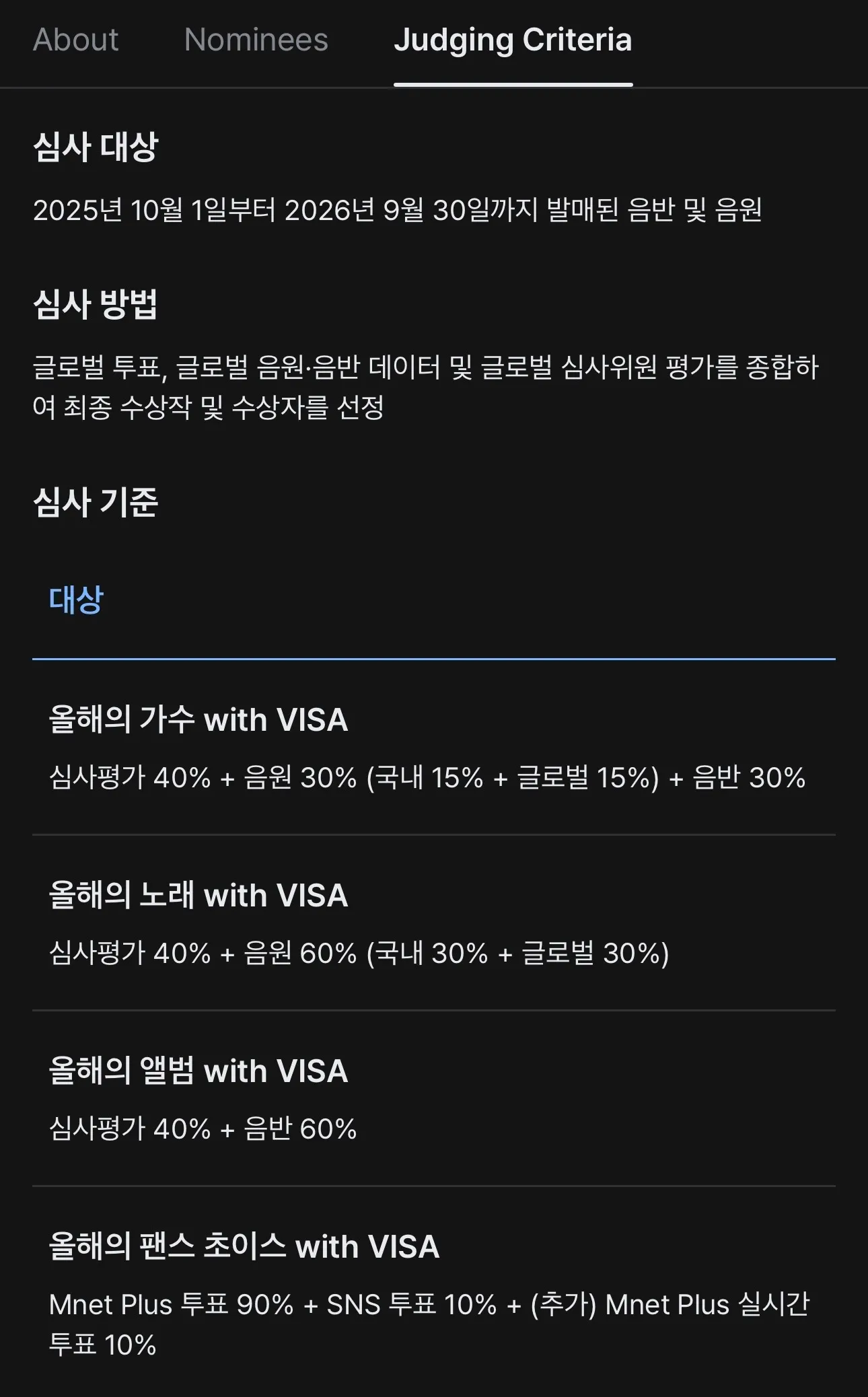
Here, album sales refer not to the number of buyers but to the number of albums sold. Whether ten different people each buy one album or one person buys ten, the sales figure is recorded as ten copies. This is a reasonable way to assess sales performance, but the figure does not show the size of the audience consuming the music. Reaching more people with music and selling multiple copies to fans who have already bought an album are different kinds of achievements. Yet when album sales are used as the standard, both are recognized as the same sales performance. This limits the ability to explain an artist’s popularity through album sales alone.
The physical album market has recently begun growing again. Based on the Circle Chart annual ‘Top 400,’ sales fell from 115.77 million copies in 2023 to 93.28 million in 2024 and 86.38 million in 2025. However, sales from January to September 2026 were 7.6 million copies higher than during the same period a year earlier, and Circle Chart projected that annual sales would exceed 100 million copies again this year for the first time in three years. As album sales rise again, it is also necessary to examine how the number of copies sold is being increased.
Why Does One Person Buy Multiple Copies?
K-pop albums are both products for listening to music and collectibles for fans. Even the same album may be released with multiple cover designs and inclusions, and some fans make duplicate purchases to collect randomly included photocards. Fan-sign raffle entries are another factor encouraging purchases. If the number of chances to enter increases with the number of albums purchased, fans buy multiple copies to improve their odds of winning. These sales methods can contribute to higher album sales. For fans, the purchases support a favorite artist or obtain desired inclusions; for agencies, they are recorded as sales performance. When award ceremonies reflect album sales in their evaluations, these additional copies are included in the score without distinction from other sales.
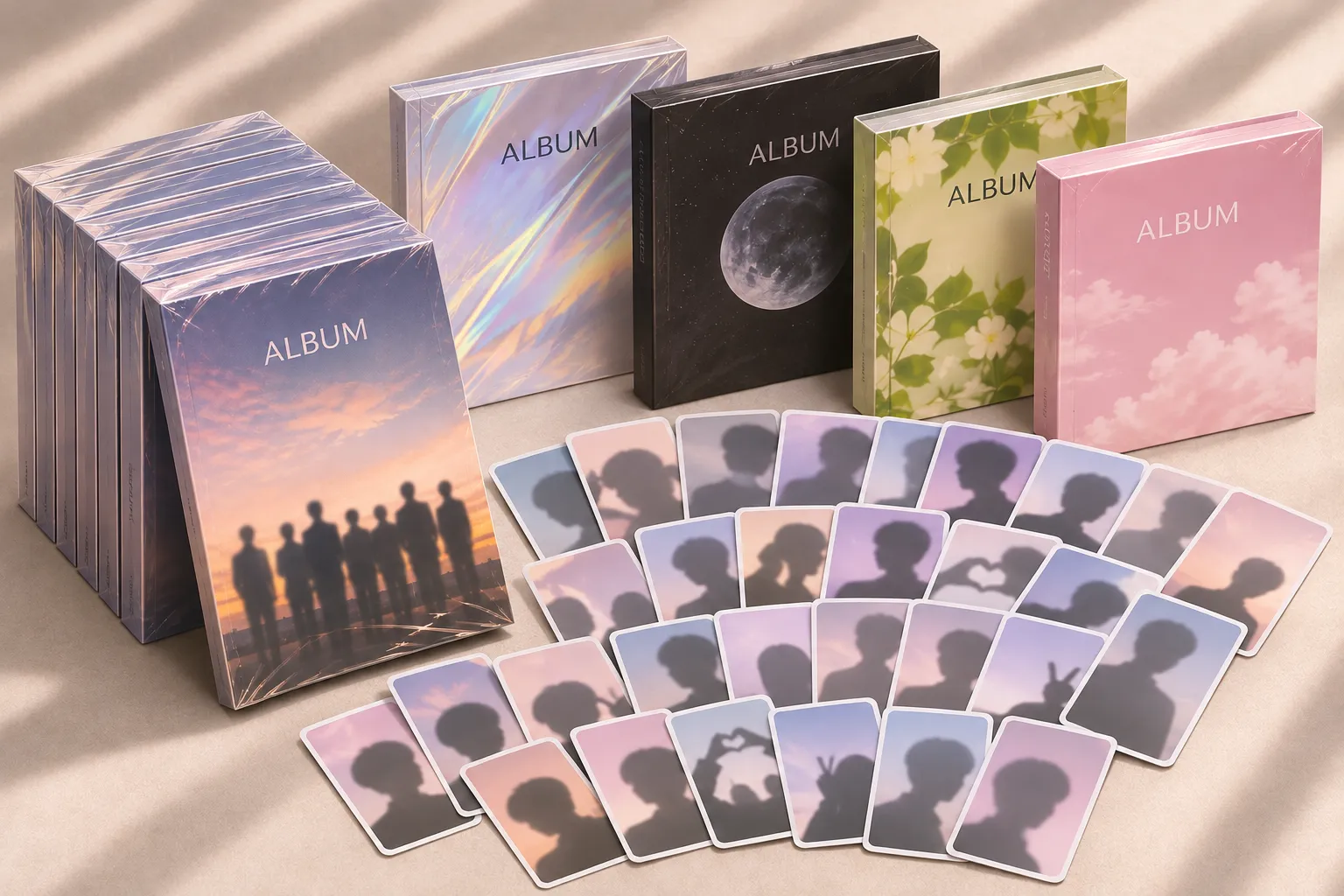
However, MAMA and other events that share artists’ achievements do not directly operate fan-sign events or photocard sales. Product designs and events that encourage duplicate purchases are primarily determined by artists’ agencies and distributors. Award ceremonies such as MAMA use the resulting sales figures as criteria for awards. It cannot be definitively said that award criteria directly create purchasing competitions within fandoms, but it is clear that a structure in which higher sales improve the chances of winning exists. The issue is what happens to albums left over after their purchase purpose has been fulfilled. If multiple copies were bought to obtain photocards or enter a fan sign, there may be no need to keep every album. This creates albums that are counted in sales but are no longer needed by actual consumers.
Where Do Albums Go After Their Purpose Is Fulfilled?
In November 2024, Kyunghyang Shinmun reported on intermediaries who unbox and handle bulk-purchased albums for overseas K-pop fans. If a fan wants only the photocards after purchasing an album, the company opens it and sends only the desired inclusions. One company interviewed quoted an unboxing fee of 1,000 won per album and said the remaining albums were discarded. In other words, disposing of albums also incurs a separate cost. Some companies said they donated the remaining albums, but it was unclear whether actual donation recipients had been secured. Cases were confirmed in which album sales increased while the purchased products were discarded without ever reaching consumers.
There are also cases in which leftover albums are distributed to other people. In October 2026, The Korea Herald reported on a K-pop store in Myeong-dong, Seoul, giving away albums by various artists for free. Albums remaining after bulk purchases for photocard collecting and fan-event entries were being given new owners. Sharing them can be a better option than disposal, as it reuses products that have already been made. However, it is difficult to determine whether all freely distributed albums are actually used. Donations must also take recipients’ demand and storage conditions into account. Simply passing purchased albums on to others cannot solve the problem of producing more albums than needed in the first place.
The Environmental Burden Left by 100 Million Albums
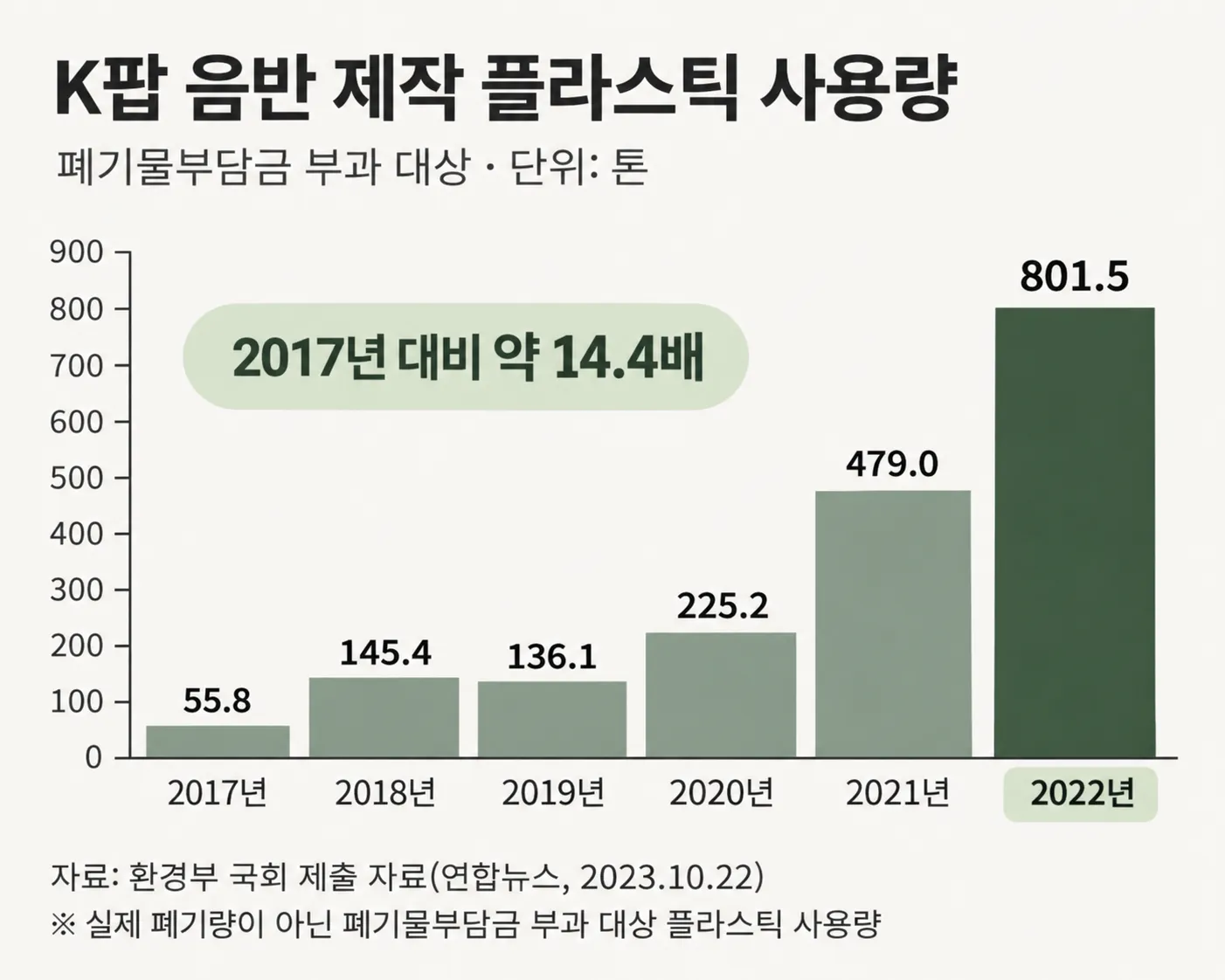
The resources used to produce albums are also substantial. According to data from the Ministry of Environment submitted to the National Assembly, the amount of plastic used in album production by domestic entertainment agencies subject to the waste charge increased approximately 14-fold, from 55.8 tons in 2017 to 801.5 tons in 2022. This figure counts only part of the plastic used during production; it is not the weight of albums actually discarded. Nor does it represent total resource use or waste, including paper photobooks and packaging. The environmental burden of albums does not end with production. Physical albums use resources during production, packaging, and transportation, and require processing when discarded. If albums purchased for photocards or raffle entries are thrown away unused, resources are wasted without being used to listen to music or keep the product.
Sales practices that encourage bulk purchases have also been criticized in the National Assembly. During the Ministry of Culture, Sports and Tourism’s parliamentary audit on October 7, 2024, calls were made to improve methods that encourage duplicate purchases through fan-sign raffle entries and random photocards. At the time, representatives of major agencies responded in a way that suggested they would improve their sales practices, but some agencies later failed to respond to media inquiries about specific improvement plans.
One alternative proposed by the industry is the ‘platform album,’ which excludes a physical CD. These products use QR codes or Near Field Communication (NFC) technology to enable music listening, and their share of Circle Chart’s Top 400 sales rose from 11.3% in 2023 to 17.8% in September 2026. However, platform albums are not entirely free of physical components. They may also be produced in forms such as photocards, keychains, and dolls. Eliminating the CD can reduce the resources used to make discs, but if other inclusions are added, how much the overall environmental burden of the product decreases must be examined separately. Changing the album format and changing a sales structure that encourages duplicate purchases are different issues.
What Sales Figures Do Not Show
The reason MAMA reflects album sales in its award criteria is that sales are an indicator of an artist’s commercial performance. However, as discussed above, sales include not only purchases for listening to or keeping music, but also repeat purchases for collecting photocards and entering fan signs. When albums purchased for different purposes are counted as a single sales performance, the fact that sales are high alone cannot fully explain how that achievement was created.
This does not mean album sales should be excluded from award criteria. Sales remain an important indicator of the K-pop industry’s scale and growth. However, in a structure where higher sales improve the chances of winning, attention must also be paid to how the number of copies sold is increased. MAMA does not directly determine how albums are sold, but what award ceremonies choose to value is also connected to how the industry views performance.
MAMA’s trophy celebrates artists and works that achieved outstanding results over the course of a year. If we go beyond confirming those achievements through sales figures and also pay attention to how the figures are created, the meaning of the records built by the K-pop industry will become even deeper.
by Editor N