

Recently, at the global ESG rating agency "Sustainalytics," NVIDIA received a very excellent rating—6th among 371 companies in the semiconductor industry. NVIDIA, a technology company drawing great attention for its unrivaled technological prowess and the resulting stock-market response, is in fact drawing attention from the ESG side as well. At the leading IT technology exhibition "CES (Consumer Electronics Show) 2025," NVIDIA CEO Jensen Huang appeared as a keynote speaker and introduced eco-friendly data centers and AI innovation technology. He expressed a commitment to sustainability and environmental-value creation. Can we connect NVIDIA and ESG management by this alone? Let us look at the sustainable-development philosophy that has supported the growth of the world's most-watched company.

[NVIDIA CEO Jensen Huang ©ESG.ONL/ESG Today]
Maximizing Energy Efficiency with Blackwell GPUs and Eco-Friendly Data Centers
NVIDIA is the world's largest AI-semiconductor company, headquartered in California, USA, and since its founding in 1993 it has led innovation in the graphics-processing-unit and AI-accelerator fields. In terms of market position, too, NVIDIA holds a world market share of 80–90% or more in AI semiconductors and, as of 2025, is No. 1 in the world by market capitalization and the leader of the global AI-semiconductor market. The chips NVIDIA makes have established themselves as core components of AI servers and data centers worldwide and are regarded as a key element in the advancement of cutting-edge technologies such as generative AI and large language models (LLMs). NVIDIA's technological leadership can be confirmed not only in the products it makes but also in the production process.
NVIDIA is directly contributing to greenhouse-gas-emission reduction by optimizing its data-center networks and infrastructure to reduce total power consumption and by covering about 76% of the power it uses with renewable energy such as solar and wind. NVIDIA stated that it aims for 100% renewable-energy use by 2025. The explanation is that, through Blackwell GPUs—which provide up to more than 20 times the energy efficiency of existing products—it greatly reduces power consumption in AI-computation tasks and can cut the cost and power needed for AI-inference tasks such as large language models (LLMs) by up to 25 times. At "2025 GTC (GPU Technology Conference)," the global AI and accelerated-computing conference NVIDIA hosts each year, it also conveyed its sincerity about energy savings by presenting a case of raising the energy efficiency of industrial AI servers and network equipment by more than 3.5 times. To overcome the climate crisis, NVIDIA is actively using the climate-modeling, energy-forecasting, and weather-analysis technology of its AI platform "Earth-2," and it is expected to create energy efficiency amounting to more than 3,000 times that of existing systems.
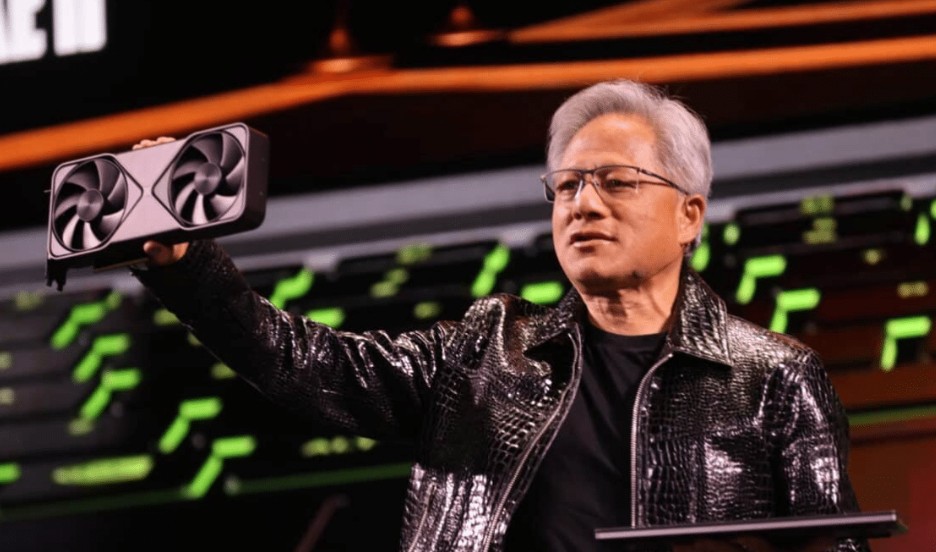
[Jensen Huang, who appeared as a CES 2025 keynote speaker ©NVIDIA blog]
Aiming for Transparent, Ethical Management That Creates Market Trust
Reducing carbon emissions through the energy efficiency of the production process is not NVIDIA's only ESG management. This company also emphasizes observing ethical standards within its supply chain. When selecting suppliers, it applies strict standards for environmental regulations and human-rights ethical management. Each year, in accordance with global ESG frameworks—the Global Reporting Initiative (GRI), the Sustainability Accounting Standards Board (SASB), the Task Force on Climate-related Financial Disclosures (TCFD), and the UN SDGs (Sustainable Development Goals)—it publishes a sustainability report and discloses its environmental and social impacts. In particular, it transparently shows indicators such as climate-change response, energy efficiency, renewable-energy use, carbon-emission reduction, employee welfare, diversity and inclusion, and supply-chain management.
There is also criticism that AI technology, situated everywhere in our lives, makes the Earth hotter through technology competition that prizes only speed and performance. But NVIDIA has become a company that leads the advancement of AI-semiconductor technology with eco-friendly, ethical management and, through an organizational culture that practices renewable-energy use and DEI, has won the full trust of diverse stakeholders such as customers and investors. We hope that NVIDIA's ESG management—finding solutions through ESG amid the problems it faces—can be evaluated as much as its technological fame.
by Editor N