

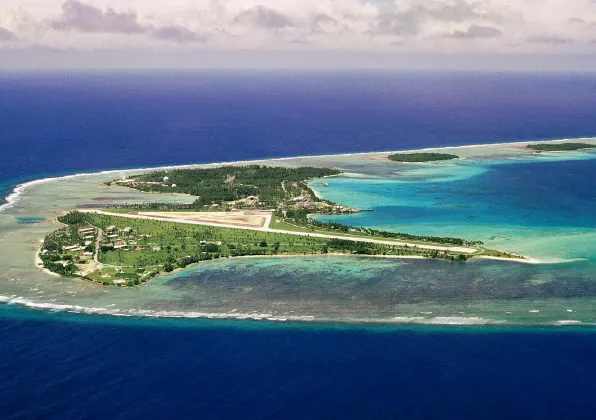
A wave the size of a building crashed into the U.S. military base on Roi-Namur Island in the Marshall Islands. The Marshall Islands is a republic in the South Pacific composed of 1,156 islands and 24 atolls. Quite literally, a massive wave surged far inland. Fortunately, no serious casualties have been reported, but the U.S. Army stated that repairs to facilities and housing could take several months.
Footage capturing the sheer force of the waves went viral on social media, rapidly spreading news of the urgency and severity of the damage around the world. Within seconds of the video starting, the first wave smashes through the door and floods into the building, followed immediately by a second wave that raises the water to waist height. In just two waves, the scene turned into chaos, and all the lights inside the building went out as if a power outage had occurred.
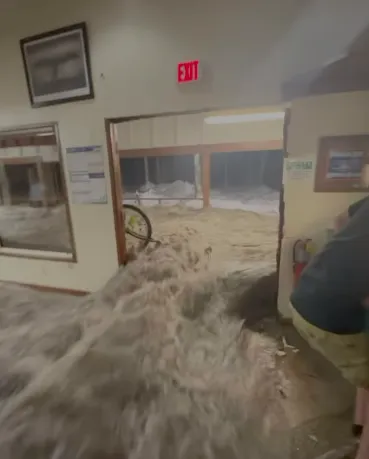
[Water Pouring into the U.S. Military Base @worldmaverik (Local Scuba Diving Instructor, Marshall Islands)]
* Click to watch the video
An Unusually High Wave: The Cause Was a Rogue Wave
The wave has been identified as being caused not by a tsunami (seismic sea wave) but by a rogue wave. A rogue wave is a phenomenon in which a wave reaching tens of meters in height suddenly appears amid ordinary waves, yet the exact causes of rogue waves and reliable methods for predicting them remain unclear. Only speculation and hypotheses exist suggesting that rogue waves may be the reason ships sometimes disappear without a trace. One thing, however, is certain: rising sea levels due to climate change have made the level of damage inflicted by rogue waves far more severe.
The Marshall Islands: Fully Exposed to Climate Change
If the Greenland ice sheet were to melt completely, global sea levels are said to rise by at least six meters. Were that to happen, most of the Marshall Islands would also disappear from the map. This is because the average elevation of the Marshall Islands is a mere two meters, and even the highest point reaches only ten meters above sea level. Over the past twenty years, the rate at which the Greenland ice sheet is melting has accelerated fivefold. The Marshall Islands Ambassador to South Korea once appealed to developed nations through a media interview, urging them to redouble their efforts to reduce carbon emissions. While the damage from this rogue wave appears to have been concentrated on the U.S. military base, the island is naturally also home to many residents who suffered damage alongside it. For the United States, the damage is limited to one military base; for the Marshall Islands, however, it is the very foundation of the people's livelihood that has been harmed.
Humanity Has Settled Close to the Sea
The problem of rising sea levels is not fatal only to island nations. Approximately 40% of the world's population lives within 100 kilometers of a coastline. According to research by the University of Melbourne, published in the journal Nature, rising sea levels could wipe out up to 20% of global GDP by 2100. Given this severity, the U.S. credit rating agency Standard & Poor's (S&P) has warned that businesses must absolutely prepare for rising sea levels. S&P is using its own analytical models to forecast the frequency of coastal flooding under various climate change scenarios, and the results confirm that rising sea levels can cause damage not only in coastal areas but also deep inland by following the flow of upstream rivers.

[S&P's projected coastal flooding map for the Miami area in the 2090s (scenario assuming a doubling of greenhouse gas emissions by 2100) © 2023 S&P Global]
Humanity, which has long focused on expanding its territory, now faces the crisis of that territory shrinking. While the entire world is suffering from climate change, regions like the Marshall Islands are being hit far harder. South Korea, surrounded by the sea on three sides, also has many vulnerable areas. The environmental group Greenpeace has even published a scenario in which the Marine City and Centum City areas of Haeundae in Busan are submerged. This is precisely why governments, local authorities, and businesses must all pay close attention to climate change and the resulting rise in sea levels.
by Editor N