

Microsoft has claimed the top spot on the "2023 ESG 100 Best Public Companies" list* compiled by IBD, a U.S. media outlet providing stock market information. With growing interest in ESG investment portfolios over the past four years, the perception has also expanded that companies adept at managing ESG risks are stable, well-managed enterprises with high investment value. As ESG regulations have become increasingly stringent, the preference for companies prepared to respond flexibly to ESG demands has also risen.
Keeping pace with this trend, IBD has been selecting its own list of the 100 Best ESG Companies for ESG investors over the past five years. And Microsoft, by applying ESG standards across multiple domains within a rapidly changing business environment, is regarded as one of the companies most actively practicing ESG management in the United States.
*If you are curious about IBD's selection process for the 100 Best Companies, click here to read this article.
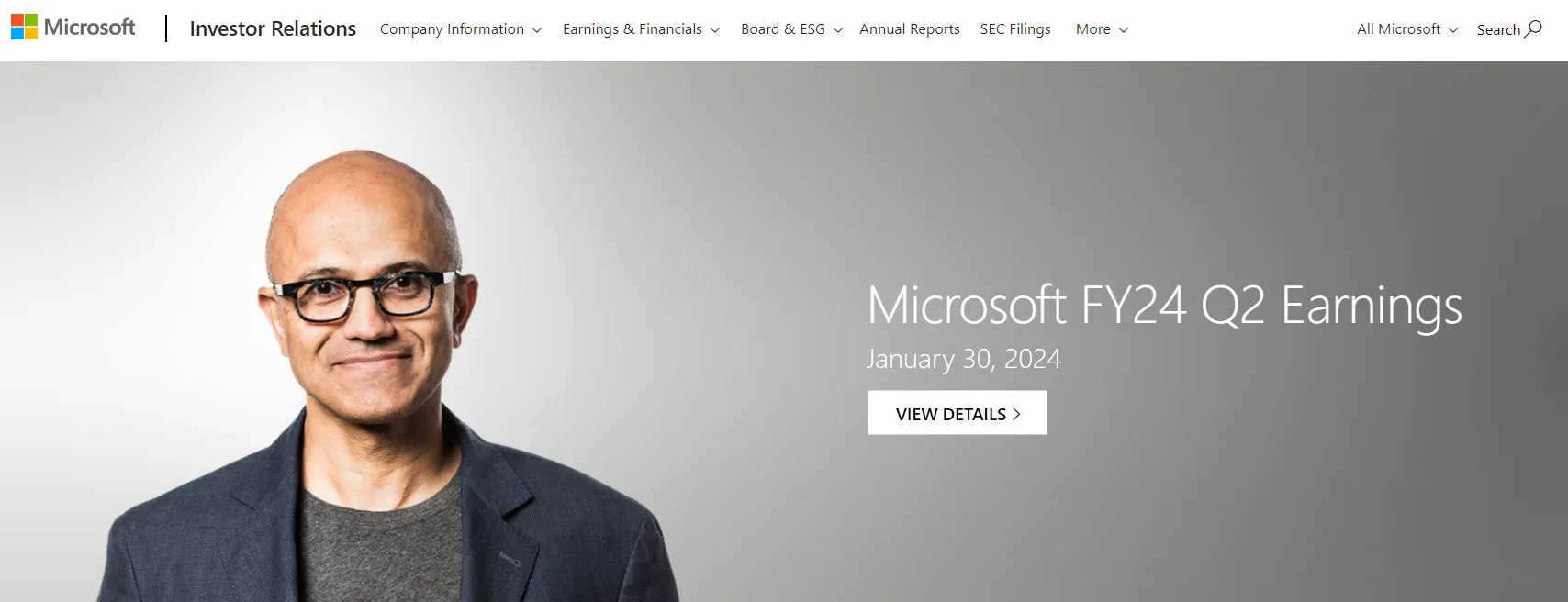
[Microsoft IR Webpage ©MICROSOFT]
Why Microsoft Took the Top Spot
IBD selects its ESG 100 Best Companies from among companies that have received outstanding scores across five categories: Business Model and Innovation, Environment, Human Capital, Leadership and Governance, and Social Capital. Among these five, Human Capital and Social Capital correspond to the Social (S) dimension, while Leadership falls under the Governance (G) dimension. IBD noted that it follows the five-category classification established by the Sustainability Accounting Standards Board (SASB), a nonprofit organization founded in 2011. Microsoft achieved the top overall ranking across SASB's five criteria while also claiming first place within the computer industry, establishing itself as a company consistently practicing ESG management. IBD highlighted the following representative activities as the reasons behind Microsoft's number-one ranking:
1. Leading the corporate carbon emission reduction trend
2. Developing technology (e.g., Microsoft Cloud) that enables thousands of customers to set and achieve their own sustainability goals
3. Supporting the White House's AI Bill of Rights and safeguarding labor rights
4. CEO Satya Nadella's two promises: to deliver returns to shareholders, and to build a path toward a sustainable future for both the company and the planet together
5. Setting corporate targets for carbon neutrality, water reduction, and zero waste by 2030
The Light and Shadow of ESG Leadership
Beyond the environmental sphere—for which Microsoft is best known as a leading ESG responder—the company has made strides in the social dimension as well. In 2022, Microsoft formally announced that it had adopted the principle of respecting the right to form labor unions. Last year, the company partnered with the Communications Workers of America (CWA) to complete its acquisition of major gaming company Activision Blizzard*, and jointly announced a "labor neutrality principle," under which it would take a neutral stance when employees wish to join a union.
*Activision Blizzard: The company behind well-known games such as Overwatch, Candy Crush, and StarCraft.

[Components of the Human Capital Category ©MSCI]
MSCI*, another issuer of major global investment indices, states that the human capital category consists of four elements: labor management, human capital development, health and safety, and supply chain labor standards. FTSE (Financial Times Stock Exchange) of the UK is another representative global investment indicator alongside MSCI. Unfortunately, however, Microsoft—which has been aggressively expanding its AI business this year—was reported to have notified approximately 1,900 employees, representing roughly 9% of the gaming division workforce centered on Activision Blizzard, of layoffs just three months after the acquisition.
*MSCI, along with FTSE of the UK, is cited as a representative global investment index provider.
ESG Management That Is Hard to Sustain Consistently
According to MSCI, ESG investing originated in the "socially responsible investing" of the 1960s. At that time, investors avoided putting money into companies associated with tobacco production or the South African apartheid* government, and as the scope expanded, it evolved into today's form of ESG investing. More recently, an investment trend has taken hold in which investment value is judged by applying both traditional financial criteria and ESG criteria.
*Apartheid: The policy of racial segregation and discrimination that the South African government formalized into law during the Cold War era.
However, investors differ in the investment criteria they favor, and companies find it difficult to satisfy every investor's preferences. The same holds true for ESG: among the multitude of ESG criteria, it is virtually impossible to concentrate on and satisfy only the ESG areas that investors care about. Moreover, practicing ESG management well does not mean there are no negative issues for investors to consider, and there are also voices of concern that a company might experience deterioration in its actual business performance while focusing on achieving its ESG goals. For these reasons, practicing well-balanced ESG management seems likely to remain no easy task for companies in the years ahead.
by Editor N