

There is a saying that the internet is a virtual planet created by humans. Through our screens, we move back and forth between that planet and Earth hundreds of times a day. The internet, which enables experiences, encounters, and collaborations previously unimaginable with ease, has become one of humanity's most vital infrastructures. Yet this essential internet planet has one problem: it is consuming the Earth's resources—and that consumption is growing rapidly. According to the International Energy Agency (IEA), the number of people using the internet doubled between 2010 and 2023, while the volume of internet traffic surged by a staggering twentyfold.
Our computers and mobile devices do not themselves emit carbon dioxide directly. But we ought to give at least some thought to the data centers that, after we request data through our devices, deliver that requested data to our screens.
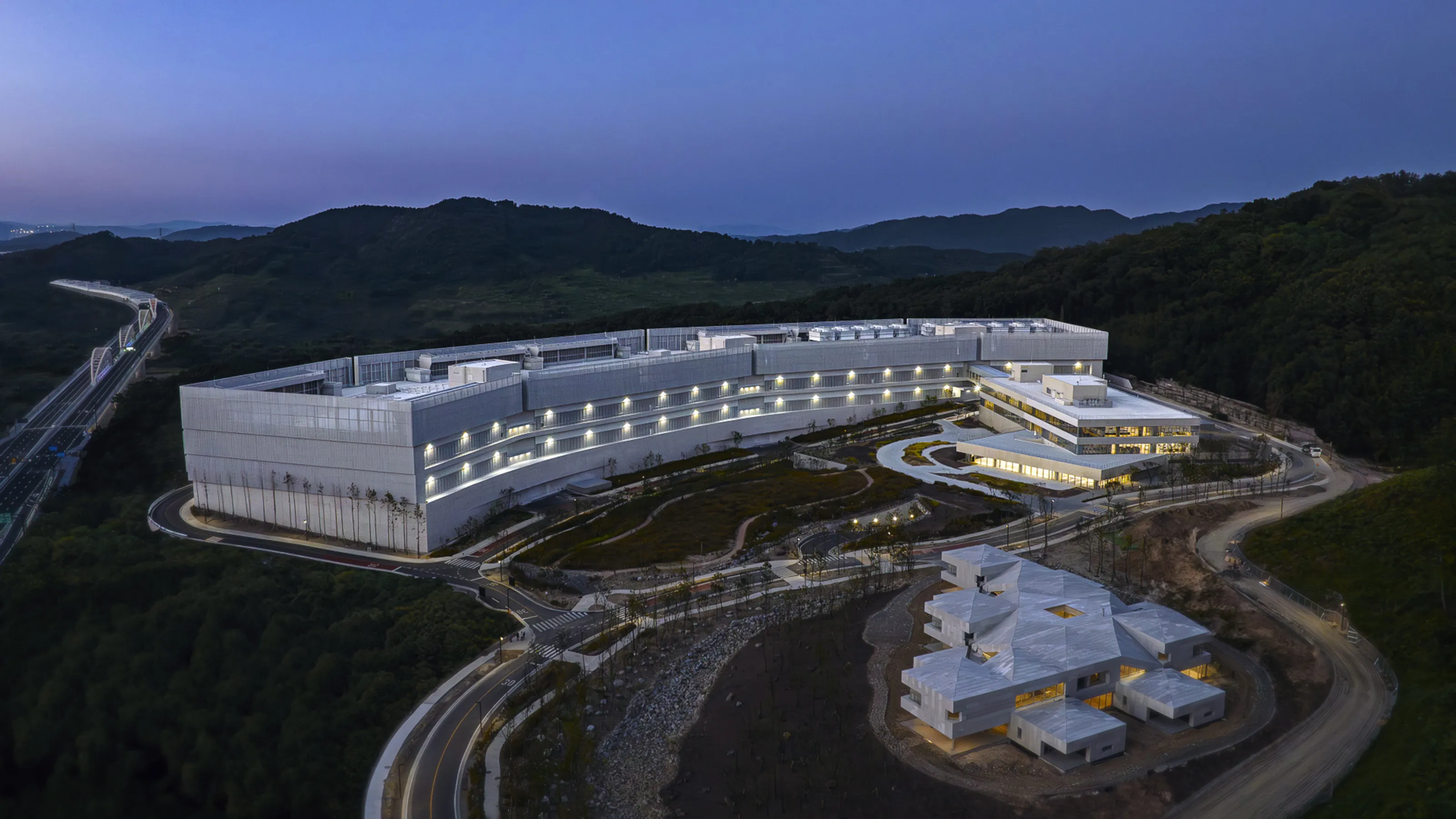 [Naver's Data Center 'Gak' in Sejong, with the largest server capacity in South Korea © NAVER]
Data Centers vs. Renewable Energy
Data centers are primarily responsible for storing and processing the vast amounts of data connected to the internet. Operating 24 hours a day, 365 days a year, data centers, together with data communication networks, account for 1 to 1.5% of global electricity consumption. While efforts are being made to reduce the power consumption of data centers—such as installing renewable energy generation facilities like solar power—many experts believe these efforts are still insufficient. Forbes reported an expert analysis showing that while the electricity consumption of large data centers grew at an average annual rate of 25% from 2015 to 2021, investment in renewable energy increased by only 7%. On top of this, the recent emergence of AI, which is now making its presence felt in earnest, is adding significant momentum to the growth in power demand.
AI, Studying Without Rest
AI appears poised to continue learning without a moment's pause until the day it can work flawlessly on behalf of humanity. The problem is that the AI era has only just begun. The AI industry is growing by the day, propelled by generative AI and AI-powered mobile services. The global accounting firm PwC has forecast that the AI market will surpass two quadrillion Korean won by 2030. This means data centers will face a corresponding volume of queries—requests for information from databases—which will in turn drive up power consumption. Researchers at Vrije Universiteit Amsterdam have released an analysis indicating that the electricity required by AI servers could reach 85 to 134 terawatt-hours (TWh) by 2027, roughly equivalent to the annual electricity consumption of the Netherlands.
Could AI Solve the Problem After All?
Paradoxically, the energy industry is attempting to use AI technology to solve the problem of energy efficiency. The idea is to move beyond simple power transmission and distribution by leveraging AI to manage electricity supply and demand in specific regions more precisely, and to optimize the charging and discharging cycles of energy storage systems. This concept is referred to as a "Virtual Power Plant (VPP)"—a notion that seems well suited to the virtual planet of the internet. Companies that operate hyperscale data centers, such as Microsoft, Google, and Amazon, are also reportedly working to make their data centers more environmentally friendly, especially in pursuit of the carbon neutrality goals they have each pledged. If we were to simply dichotomize the issue into AI's power demand versus the power supply from renewable energy, it would appear that AI's power demand is still growing faster for now. With AI technology having already penetrated nearly every industry, the response through renewable energy usage must accelerate at a pace matching the growth in electricity demand.
by Editor N