
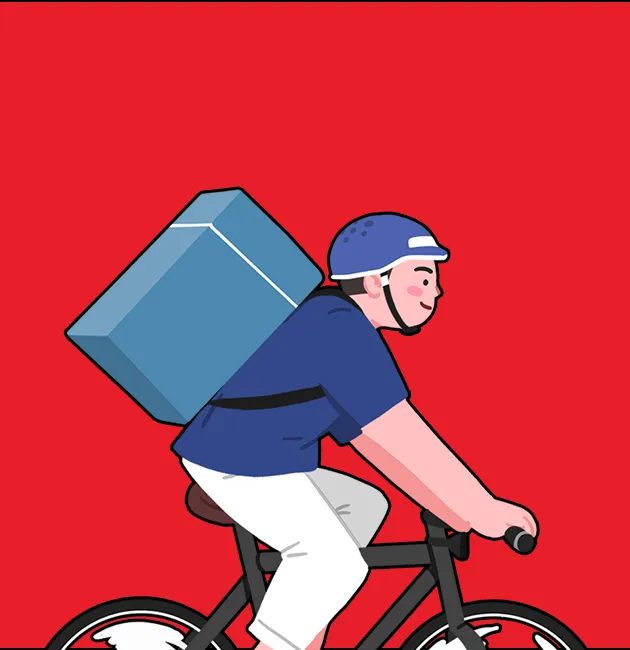
On February 14, Valentine's Day, delivery and ride-share drivers in the United States and the United Kingdom staged a collective strike. In the UK, workers from Deliveroo and Uber Eats joined forces, while in the US, drivers from Uber, Lyft, and DoorDash united. Fortunately, the strike had been announced in advance and appears to have avoided major disruption and discord. The reason these workers pushed ahead with the strike ahead of the lucrative Valentine's Day period was the issue of low delivery fees.
The UK newspaper The Guardian published two articles related to the strike. One was a journalist's report conveying the reality that delivery workers struggle to earn even a "living wage." The other was an anonymous contribution from a delivery worker stating that, after deducting fuel costs and insurance premiums from delivery fees, not even the "minimum wage" was left. Two different expressions—living wage and minimum wage—were used in reference to the same issue.

[Uber Eats promotional message: 'Work when you want, earn as much as you need' ©Uber]
How Do a Living Wage and Minimum Wage Differ?
While the minimum wage is easy to understand, the concept of a living wage is still unfamiliar to many. Both expressions refer to wages that take into account a minimum cost of living. The minimum wage holds significance in guaranteeing the lower limit of food, clothing, and shelter costs to protect workers' basic right to survival. The living wage, on the other hand, is a concept that goes beyond compensation for labor, aiming to ensure that a person's earnings can maintain an adequate standard of living, covering housing, food, healthcare, and education.
In the UK, the applicable group and amount are legally designated differently. Workers under 23 years of age are guaranteed the minimum wage, while workers aged 23 and over are guaranteed the living wage. For the 2023-2024 period, the UK minimum wage was set at £5.28 (approx. 8,895 KRW) for those under 18, £7.49 (approx. 12,618 KRW) for ages 18-20, and £10.18 (17,149 KRW) for ages 21-22. The living wage for those aged 23 and above was set at £10.42 (17,553 KRW). The minimum wage is determined through negotiation based on recommendations from companies and unions, while the living wage is set at 66% of median income. These amounts are updated every April.
The living wage is not a concept entirely remote from us. In South Korea, it is being implemented selectively at the local government level rather than by the central government.
Are Delivery Drivers Legal "Workers"?
At least in the UK, they are not. The UK Supreme Court has issued a ruling restricting the right to collective bargaining for people providing labor through gig economy* platforms. Delivery drivers and ride-share drivers were interpreted as being self-employed contractors who have entered into agreements with the app service provider, rather than as workers. South Korea is in a similar position: delivery workers do not qualify as workers under the Labor Standards Act. However, they differ from the UK in that they are recognized as workers under the Trade Union and Labor Relations Adjustment Act, and are thus guaranteed the constitutionally based three labor rights (the right to organize, the right to collective bargaining, and the right to collective action). In fact, negotiations in South Korea are already taking place between delivery workers and platform operators such as Baedal Minjok (Baemin) and Kakao Mobility. In May of last year, approximately 200 Baemin drivers held a march in downtown Seoul demanding guarantees of a living wage, among other things. At the time, the drivers raised the issue that Baemin's base delivery fee of 3,000 KRW per delivery had been frozen for ten years.
*Gig Economy: An economic form in which jobs are filled by short-term contract and temporary workers, rather than traditional regular and long-term employees. The terms "gig economy" and "gig economy platform" are frequently used to refer to on-demand labor and service-based sharing economies. The term originates from the 1920s American jazz club scene, where short-term contract musicians or performance groups (gigs) were brought in to sustain club performances.
Forms of Labor Change
The gig economy, which gives the impression that anyone can easily earn money, is now settling in as an entrenched mode of employment. In this context, it ultimately falls on companies to set the appropriate price for the labor they purchase. The UN Global Compact (UNGC), the UN's corporate sustainability initiative, defines a living wage as compensation that goes beyond the minimum wage to ensure fair remuneration for employees. Of course, ride-share and delivery drivers are not employees of the platform companies. But as a workforce that is indispensable to business operations, they will require thoughtful consideration and decisions aimed at mutual prosperity. While the living wage may be difficult to serve as a legal basis for adjusting low delivery fees to realistic levels, it can at least serve as a minimum yardstick for responding to newly emerging forms of labor.
by Editor N