
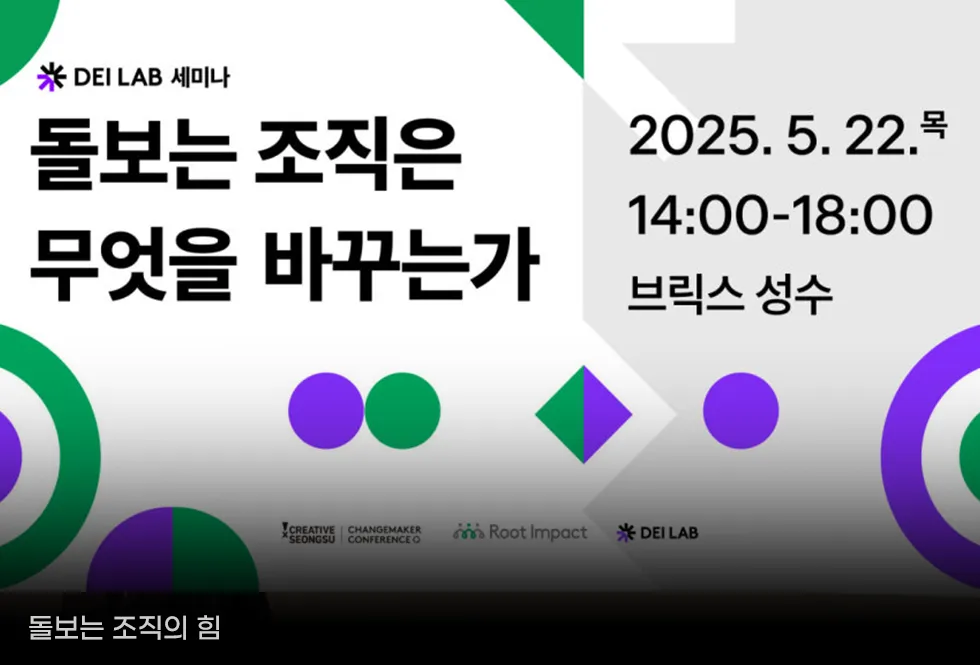
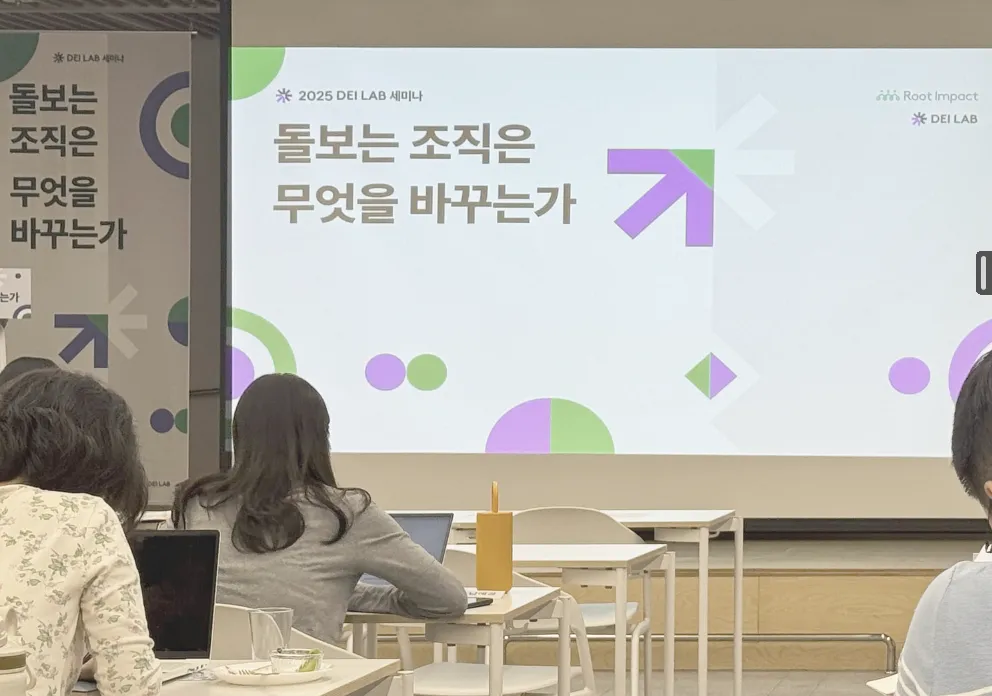
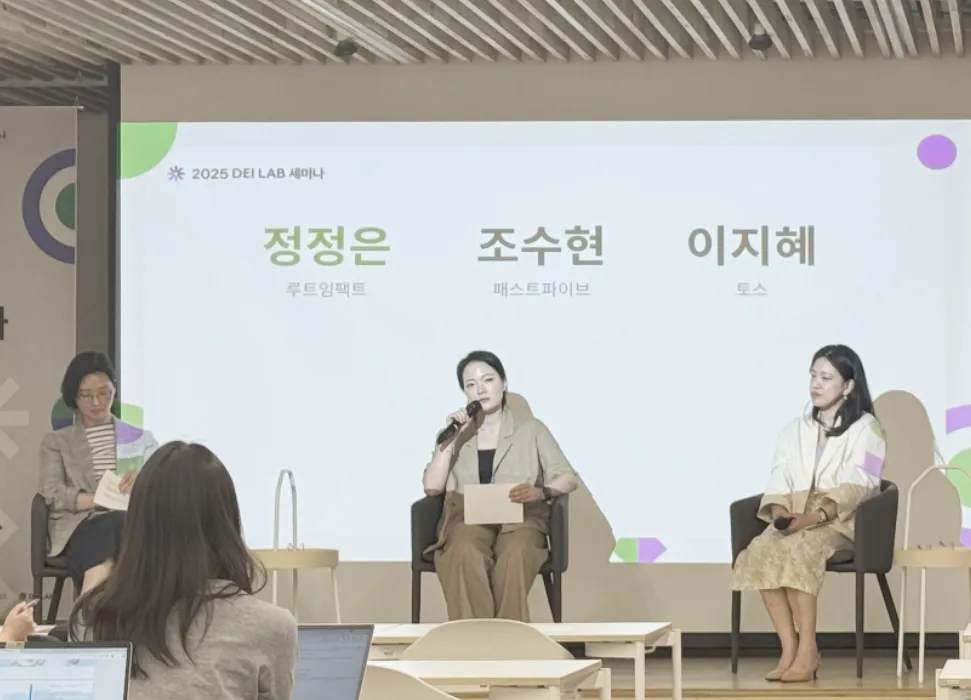
This past May 22, the DEI (Diversity, Equity, Inclusion) Lab seminar "What Does a Caring Organization Change?", held at Bricks Seongsu, was an occasion to share about the inclusive workplace, centered on the keyword "care." Here, through a keynote speech and three sessions, "care" was redefined and it was examined from multiple angles how a caring organization can affect the lives of its members. In particular, in the session "The Power of a Caring Organization," which ESG.ONL paid attention to, three organizations practicing DEI — "Root Impact," "FastFive," and "Toss" — introduced the workplace-daycare cases they have implemented. Let us confirm the power of the three organizations, which emphasized that care is an important task the organization should take responsibility for together, beyond a mere welfare system.

[The DEI LAB seminar "What Does a Caring Organization Change?" © ESG.ONL]
A Workplace-Daycare Solidarity That Shares the "Experience of Caring Together"
"Root Impact," a nonprofit incorporated association that pursues social value and impact, operates a consortium-type workplace daycare named "Everyone's Forest Daycare." It is the result of keenly feeling the need to establish a workplace daycare, as members faced the task of care according to their life cycle and experienced cases of being unable to return to work after childbirth. Though the intention was set, given the nature of a small organization, it was not easy to establish a daycare on its own. After much deliberation, Root Impact arrived at the solution of "a workplace-type daycare jointly operated in cooperation by multiple impact organizations."
"Everyone's Forest Daycare" was designed as a space where children, parents, and teachers all create a culture together, beyond a mere childcare space. It maintains a teacher-to-child ratio lower than the legal standard and operates through parents' voluntary participation. Making use of the advantage that linkage activities among various organizations are possible, it is raising both the quality of and trust in care. Through this model, Root Impact presents the alternative that "it's hard alone, but possible together." It also shows the possibility of an organizational culture that expands care into a shared responsibility. The message resonates that one can experiment with an inclusive workplace through the "experience of caring together" and expand an organizational culture of care through organizational solidarity.
[Panelists from Root Impact, FastFive, and Toss during the DEI LAB seminar © ESG.ONL]
The Link Between Business Continuity and Care
"FastFive," widely known as a shared-office-space service company, operates "Daram FastFive Daycare" to practically reduce the childcare burden of startup members. It began with the recognition — based on the fact that members of startups and other founding companies find it hard to enjoy welfare, and from seeing cases of women CEOs suspending their businesses over childcare issues — that childcare support is directly linked not merely to welfare but to business continuity. FastFive emphasized that expanding its scope beyond providing workspace to supporting the whole lives of its tenant members also connects to the company's brand value.
True Care That Meets Members Close By
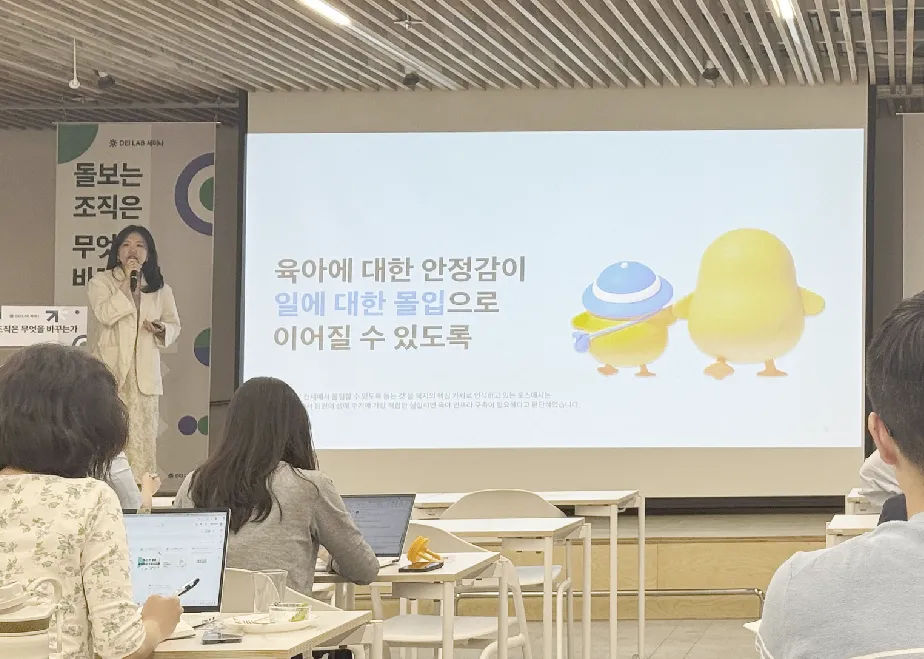
The fintech company "Toss" developed the "Our Neighborhood Toss Daycare" model tailored to members' living environments, instead of installing physical infrastructure. Existing workplace daycares had the problems of low accessibility due to the inconvenience of having to commute with a child, and a low capacity-fulfillment rate. To solve this, Toss partners with excellent daycares in the base areas where members actually reside, supporting members in using childcare services closer to home. After introducing this model, a culture in which members naturally share childcare stories formed within the organization, and female members in particular came to feel the possibility of balancing work and life even after childbirth and childcare. The explanation is that this model, in that it could provide members with the trust that they can maintain the same performance as before even after childbirth and the sense of stability that it's okay to raise children, had a positive impact on the organizational culture as a whole, beyond mere welfare.
[Care done together leads to immersion in work © ESG.ONL]
Creating an Organizational Culture for a Sustainable Organization
The three organizations approached care in different ways, but commonly emphasized "the power of culture that goes beyond systems." The point is that, beyond simply providing parental leave, flexible work, and workplace daycare, real change is possible only when a culture is in place that lets members actually use those systems "safely" and "without being self-conscious." It was also an answer to how an organization can ease the parenting guilt and the anxiety about career interruption that female members commonly feel when they take on care responsibilities.
Care in our society is no longer the responsibility of individuals and families alone. An organization can create sustainable relationships when it recognizes members' lives not as an "area outside of work" but as a condition of living together. This seminar showed with concrete cases what change a movement to embrace care as an organization's strategy and culture — rather than an individual's share — can create. The empathy and trust that arise in an organization that embraces care ultimately become an important foundation that raises the organization's resilience and prevents talent outflow. If you want to create a sustainable organization, you must first ponder how the organization "cares together" with its members.
by Editor L