


[Microsoft signs a 10-year, long-term carbon-removal contract with the Norwegian energy company Hafslund Celsio ©ESG.ONL/ESG Today]
"Microsoft" signed a 10-year, 1.1-million-ton carbon-removal contract with "Hafslund Celsio," Norway's largest waste-incineration and district-heating company, on July 1. It is a starting signal that corporate carbon-neutrality strategy is evolving beyond the concept of "carbon offset" toward the direct approach of "carbon removal."
Carbon Removal and Carbon Offset—What Is the Difference?
Carbon removal is a fundamentally different approach from carbon offset. If a company's carbon offset is the concept of "offsetting" its own emissions through emission reductions or forest creation elsewhere, carbon removal is an approach of physically capturing and removing carbon dioxide that already exists in the atmosphere. Through the contract with Hafslund Celsio, Microsoft stated that it would directly remove carbon with "Bioenergy with Carbon Capture and Storage (BECCS)" technology using biomass waste. Here, biomass waste mainly means organic matter such as wood chips, sawdust, and agricultural residues. This method of carbon removal is carried out by burning biomass to produce energy while simultaneously capturing the carbon dioxide generated and permanently storing it underground.

["Hafslund Celsio's" waste-incineration plant located in Oslo, Norway ©Hafslund Celsio]
Why Carbon Removal Is Attractive to Companies
The reason companies pay attention to carbon removal is the practical limits of achieving carbon-neutrality goals. Regarding carbon emissions, no matter how much energy efficiency is raised and how much one transitions to renewable energy, it is hard to reduce emissions below a certain level, so the concept of "residual emissions" exists. In particular, for technology companies like Microsoft that operate large-scale data centers, such residual emissions are of considerable scale. The quality and reliability problems of the existing carbon-offset market are also a reason companies turn their eyes to carbon removal. Carbon credits based on forest creation or renewable-energy projects have been much disputed in terms of "additionality" and "permanence." Whether trading credits actually has an additional carbon-reduction effect, and whether the reduction effect can maintain its effect over the long term, still remains a concern for companies. By contrast, direct carbon removal is easy to measure and verify. It is a method by which one can hold a result value in hand.
We Must Pay Attention to the Rapid Growth of the Carbon-Removal Market
The carbon-removal market is growing rapidly. The Swiss climate-tech company "Climeworks" attracted 162 million dollars in investment in the first half of 2025 alone. That major technology companies such as Google, Amazon, and Meta, besides Microsoft, are signing carbon-removal contracts one after another also indicates the present state of the carbon-removal market. It is worth noting that these companies are playing the role of technology-development partners beyond being mere buyers. In particular, Microsoft is leading the market's expansion by investing in various carbon-removal technologies under the goal of achieving carbon negativity* by 2030.
*Carbon negativity: a State in which a company or organization removes or reduces more carbon than the amount emitted by its own activities.
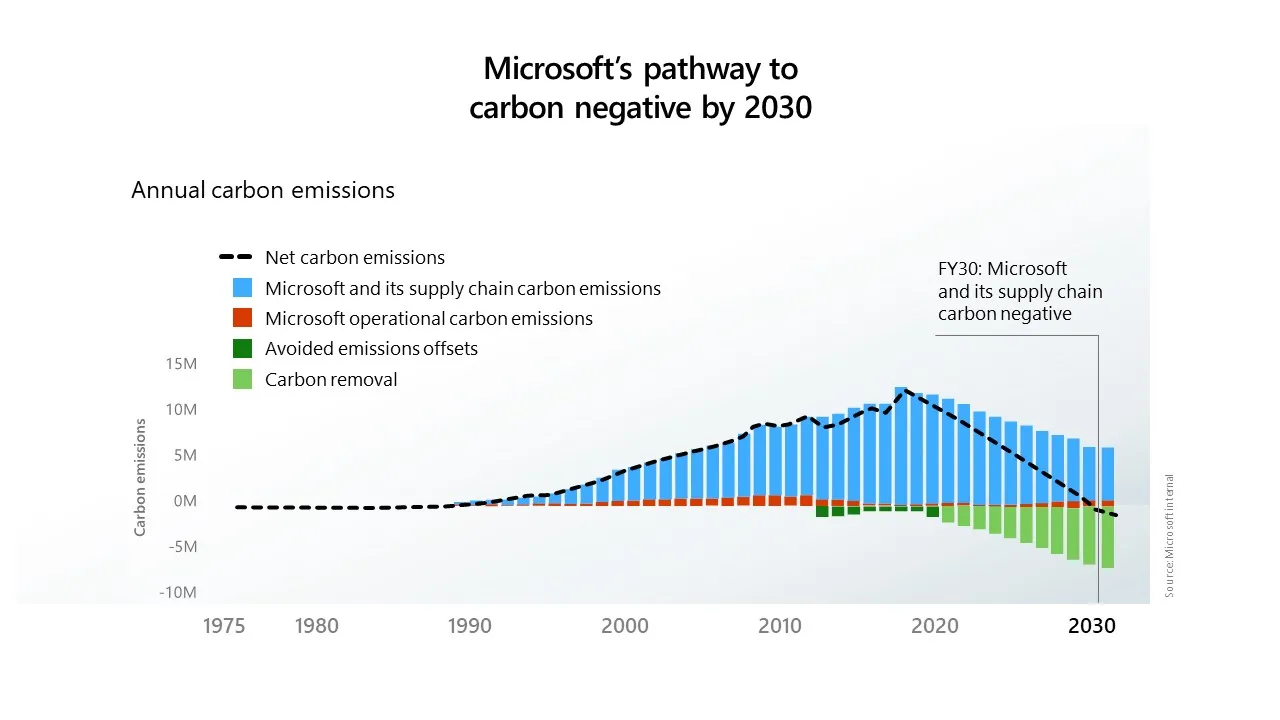
[The "carbon negative" plan Microsoft announced in 2020 ©Microsoft]
Carbon-removal contracts can be a new challenge and opportunity for our companies as well. First, we must pay attention to how carbon-removal technology will be classified in the K-Taxonomy and green-classification system, and what role it will play in the government's carbon-neutrality policy. Korea's large companies, too, bear the task of having to achieve carbon-neutrality goals. For energy-intensive manufacturers such as Samsung Electronics, LG Energy Solution, and SK Hynix, carbon removal is highly likely to become an essential option. In fact, some Korean companies are already showing related movements: "POSCO" is investing in developing technology to capture carbon dioxide generated in the hydrogen-production process, and "Hyundai E&C" is showing interest in plant projects using carbon capture, utilization, and storage (CCUS) technology. "SK Group" is newly establishing a dedicated organization for developing carbon-reduction technology and seeking investment opportunities in the carbon-removal field. At the government level, the Ministry of Trade, Industry and Energy recently presented, through a "CCUS Commercialization Roadmap," a target of capturing 12 million tons of carbon dioxide annually by 2030.
Challenges and Outlook
The biggest challenge for carbon-removal technology is still the high cost. If the carbon-removal cost—currently at the level of 100–600 dollars per ton—can be lowered to an economically viable level, the pace of commercialization will become even faster. Infrastructure building and policy support for large-scale commercialization are needed. In a situation where corporate carbon-neutrality strategy has entered the process of evolving from "emission reduction" to "direct removal," it is a point at which our companies too must respond.
by Editor N
[Reference Article] [Climate-Tech Brands and ESG] Climeworks, Which Gave CO₂ a New Role *