
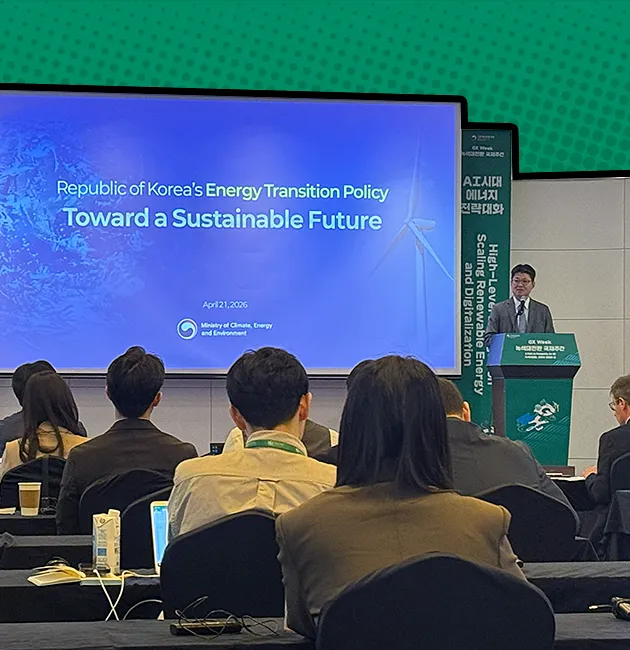
On April 21, the Ministry of Climate, Energy and Environment and the Climate Group, the operating body of the global RE100 initiative, jointly hosted the ‘Energy Strategy Dialogue in the AI Era’ at the Sono Calm Hotel in Yeosu. Organized as a key session of the Green Transformation International Week held in conjunction with UNFCCC Climate Week, the event drew officials from the Ministry of Climate, Energy and Environment, GE Vernova, domestic and international RE100-implementing companies, and global energy solution organizations. Let us examine the discussions that took place among institutions and companies on energy transition in the AI era.
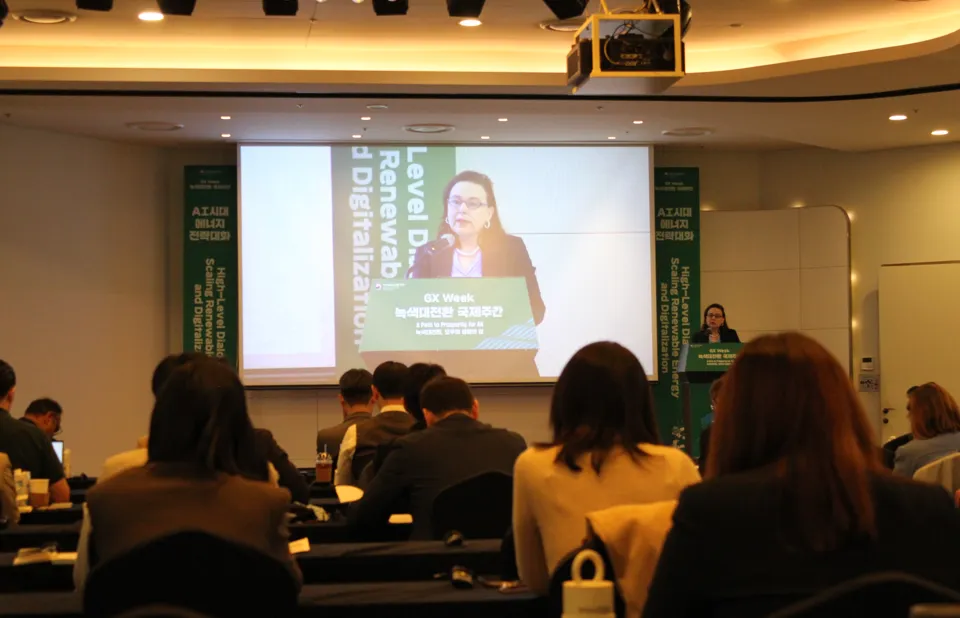
[UNFCCC Deputy Executive Secretary Noura Hamladji speaking at the ‘Energy Strategy Dialogue in the AI Era’ © ESG.ONL]
First, the UNFCCC warned that in the era of digital transformation, energy transition is essential, and that failing to handle power energy in a responsible manner could slow the pace of energy transition. In a situation of surging data center power consumption, securing clean power has become a necessity rather than an option. To advance digitalization for all while preventing electricity price increases, securing finance through international cooperation is essential. As the digital divide widens, ensuring that the benefits of innovation are shared by all requires not only energy transition but also sustainable political leadership at this juncture.
The Climate Group then emphasized that while South Korea’s policy direction regarding renewable energy is clear, stronger demand forecasting and enhanced support for RE100-compliant companies are needed.
Discussions also continued on the day’s key agenda items: responding to the surge in power demand driven by the spread of AI and data centers, managing energy supply chain risks, and building the RE100 ecosystem. The Ministry of Climate, Energy and Environment stated that its goal is to achieve 100 GW of renewable energy installed capacity by 2030. Three major transition directions were also presented: the phased phase-out of coal-fired power, expansion of electric vehicle deployment, and utilization of transition finance. The Ministry also emphasized that a significant portion of the 6.9 tons of greenhouse gas emissions comes from the steel, city gas, and petrochemical sectors, making the electrification of the industrial sector a key task.
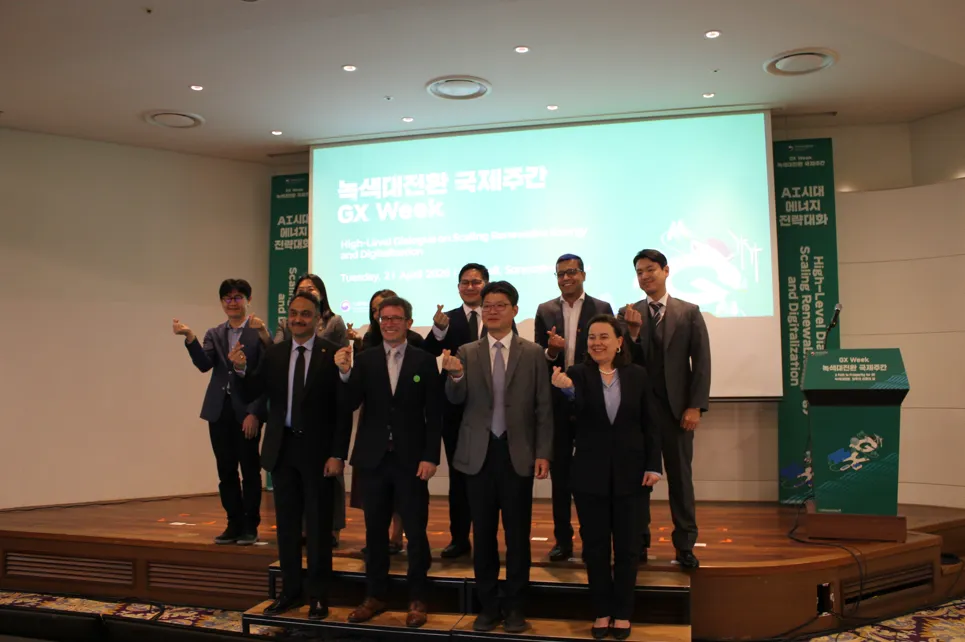
[Group photo of panelists at the ‘Energy Strategy Dialogue in the AI Era’ © ESG.ONL]
Naver shared its implementation strategy from the consumer perspective. It presented the case of leveraging outside air and geothermal energy for data center cooling, reducing cooling equipment utilization to below 10%, and applying double-glazed windows, rooftop solar panels, and geothermal pipes at its headquarters building to reduce energy consumption itself. It is also aiming to achieve 40% RE100 by 2028 by combining long-term renewable energy Power Purchase Agreements (PPA) with direct investment in power plants. In terms of the RE100 initiative, Naver stressed that as the renewable energy demand of Asian companies is rapidly growing, there is an urgent need to revitalize the PPA market and improve the institutional framework so that companies can procure renewable energy at predictable prices.
Finally, GE Vernova introduced its ultra-high-voltage direct current (HVDC) and Flexible AC Transmission System (FACTS) technology solutions that address the issue of renewable energy’s lack of inertia, and expressed expectations for cooperation with South Korea by mentioning the West Coast renewable energy interconnection project.
Now, as the speed and direction of energy transition are being reshaped faster than ever before, we look forward to seeing what energy policy formulation will result from the dialogue shared in Yeosu.
by Editor N