

When April 5 arrives, corporate press releases pour in without fail. The articles contain a familiar scene: a photo of dozens of employees holding shovels in front of saplings, the phrase ‘a first step toward carbon neutrality,’ and even a wooden plaque inscribed with the number of trees planted.
The sight of a company that emits hundreds of billions of won worth of carbon annually planting one hundred trees on Arbor Day and distributing a press release has, before we knew it, become a standardized ESG activity among domestic companies. However, fundamental questions about corporate forest-related ESG activities have recently been raised both at home and abroad. Does ‘having planted’ trees mean they have ‘lived’?
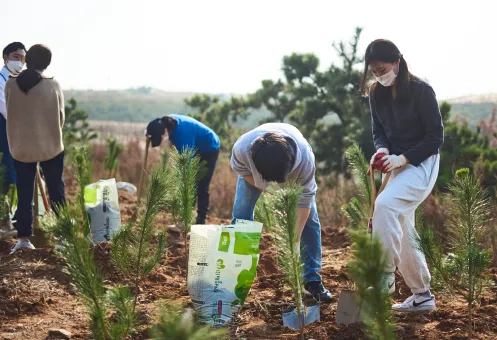
[Social contribution activities through tree planting Ⓟ Hyundai Motor Company CSR Digital Magazine]
The Evolution of the Tree-Planting Business: From Citizen Participation to Corporate Partnerships
The tree-planting business has a history of approximately 15 years in South Korea. The social venture Tree Planet, which began as a mobile game in 2010 and drew attention for its model in which ‘users planting trees in virtual space leads to actual trees being planted in reality,’ is regarded as a pioneer in the field. At its peak, it was selected as the official app of the UN Convention to Combat Desertification (UNCCD), one of the three major UN environmental conventions, and attracted participation from overseas fans through ‘Star Forest’ campaigns named after K-pop stars such as ‘TVXQ Forest’ and ‘Girls’ Generation Forest.’
However, the center of gravity of Tree Planet’s business today is no longer the citizen participation app. Tree Planet has agreed to carry out a five-year forest ecological restoration project with Hyundai Motor Company starting in 2024, and has signed partnerships with corporations and local governments, including a business agreement with Chilgok-gun, Gyeongsangbuk-do for the creation of honey source forests.
The Credibility Crisis of Carbon Credits Hidden Behind ESG Demand
This change signifies an overall directional shift in the tree-planting business: from a B2C emotional model in which consumers directly ‘purchase’ trees, to a B2B commissioned model in which companies ‘order’ forests for ESG performance. Behind this is the trend of corporate demand for visible nature-based activities surging after the declaration of 2050 net zero targets.
However, this demand does not always lead to genuine forest restoration. The carbon reduction effect of the Brazil REDD+ project (activities to prevent deforestation and degradation) purchased by Samsung Electronics’ UK subsidiary in 2025 was found to be zero, and the reduction effect of the Cambodia REDD+ project purchased by SK Securities amounted to only 11.52%.
In July 2024, Google completely halted its purchase of forest carbon credits — emission rights that are certified based on the amount of greenhouse gases reduced and absorbed and can be traded on the market — and declared a shift toward directly reducing its own emissions. MSCI Carbon Market, a global carbon market research firm, estimated the size of the voluntary carbon market in 2024 at approximately USD 1.4 billion (about KRW 2 trillion), but the actual quantity of carbon credits purchased, used, and retired has remained at 180 million tons for three consecutive years from 2023 to 2025. This is a signal that companies are beginning to question the credibility of carbon credits.
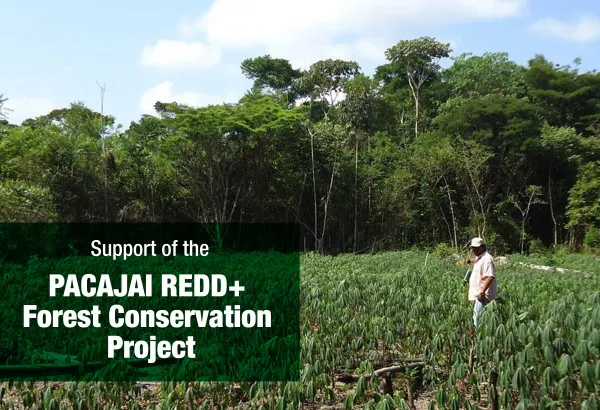
[Pacajai REDD+ Project Ⓟ Kluthe]
Steps Toward Verified Forests
The simplistic notion that ‘one tree-planting event completes ESG’ can only diminish now. The strengthening trend of greenwashing regulations is also a pressure factor. During the 2024 National Assembly audit, it was pointed out that the greenwashing judgment criteria of the Korea Environmental Industry and Technology Institute under the Ministry of Climate, Energy and Environment are ambiguous and the level of punishment is weak. Accordingly, the government has signaled amendments to related laws. The EU has already adopted the ‘Green Claims Directive,’ which mandates the presentation of verifiable evidence when making eco-friendly claims. This stricter environment may, in fact, become an opportunity for operators equipped with the quality of ecological restoration and a transparent verification system.
Ultimately, the conditions for survival in the tree-planting business today are not merely the number of trees, but clearly establishing the quality of ecosystem restoration, multi-year tracking and management rather than one-off events, and the role as verification infrastructure rather than a marketing tool. The scene of companies holding shovels and standing before cameras every time Arbor Day comes around will not disappear for the time being, but if five years of monitoring data does not follow behind that single photo, the meaning of tree planting will gradually fade.