
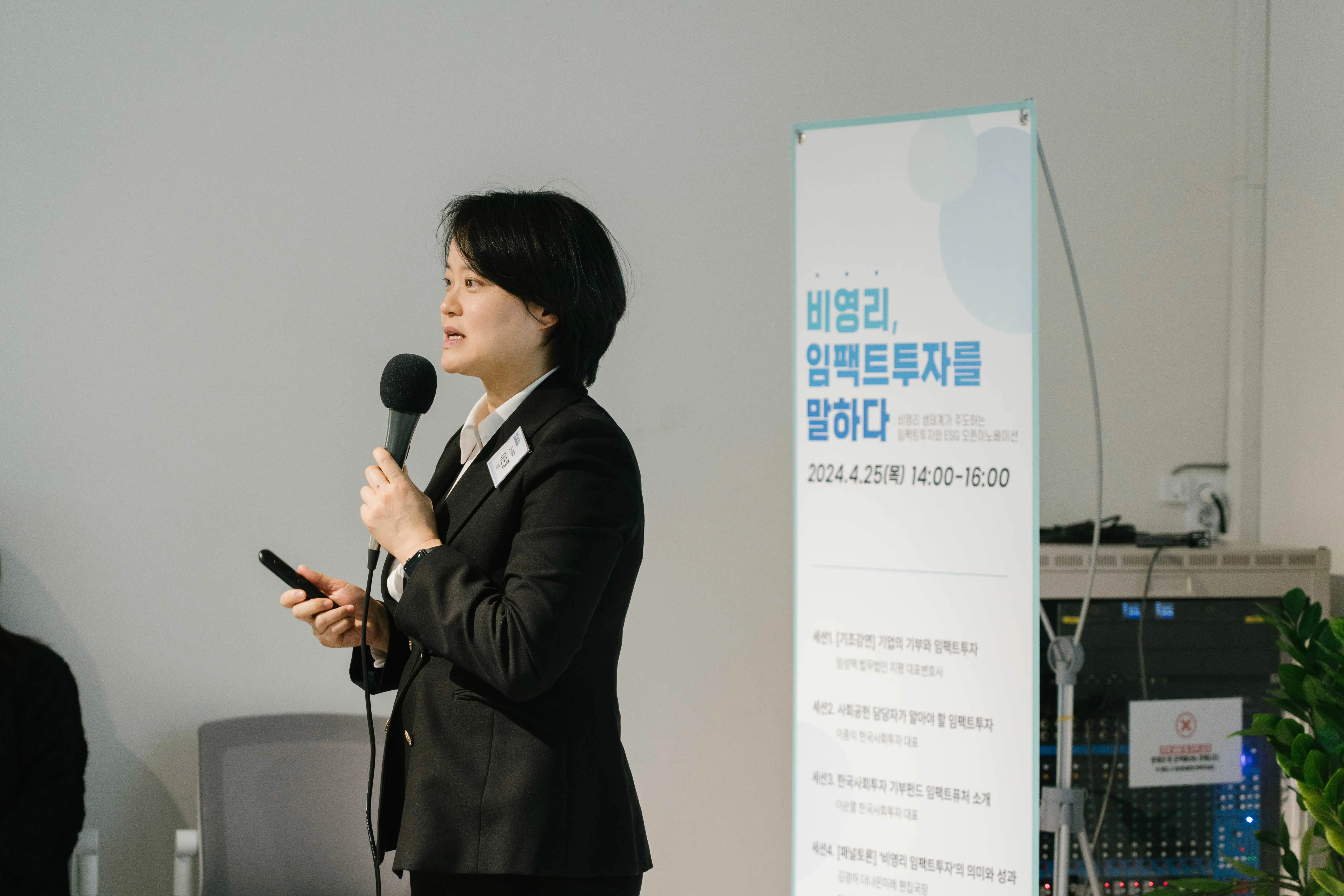
On April 25, Korea Social Investment (hereafter KSI) held a seminar under the theme "Nonprofits Speak of Impact Investing," together with experts from various fields — academia, the legal community, nonprofits, and the private sector. Through expert presentations and discussion, this seminar shone a light on donation-based nonprofit-ecosystem impact-investing activities and the results of ESG open innovation. Founded in 2012, KSI is an ESG and impact-investing firm that, under the mission "We support the growth of businesses that make a better world," focuses on investment in ESG and social-impact fields such as climate tech, social services, and agri-food.

[The "Nonprofits Speak of Impact Investing" seminar © Korea Social Investment]
"Impact investing," counted as the most active method among ESG investments, refers to investment that considers businesses which, through the investment, deliver not only returns but also a positive impact on society and the environment. It is similar to socially responsible investment (SRI)* in that it excludes so-called "bad companies" and invests in "good companies," but it differs in that it invests long-term, with concrete rates of return, in businesses that can exert a positive influence on social or environmental problems.
*Socially Responsible Investment (SRI): a financial activity that invests in companies using not only their financial performance but also various social achievements — such as human rights, the environment, labor, and community contribution — as a yardstick.
"Impact Future," for the Sustainability of ESG Startups
The donation fund "Impact Future," which KSI unveiled in February this year, began from a question like "What would 'impact investing' based on donation funds look like?" The main financial resource of Impact Future — which drives the sustainability of a future society by considering both the economic and the social aspects — is corporate donations. When investment capital is gathered through donations from various companies that are interested in or agree with the investment targets and fields KSI focuses on, investment is made in domestic startups and global impact companies after evaluating their impact-creation and social-problem-solving capacity, business sustainability, and more.
That KSI could carry out impact investing at scale in earnest owes much to the "Hana ESG Double Impact Matching Fund," one of Hana Financial Group's ESG projects, in 2022. The Hana ESG Double Impact Matching Fund is operated with Hana Financial Group's donations, and it invests in 10 or more ESG startups each year, drawing out the business scale-up of companies and the spread of social impact. KSI CEO Lee Soon-yeol (hereafter CEO Lee) emphasized the role of donations, saying, "The most important thing when actually doing impact investing is to properly fulfill the role of capital," and, "In a situation where you must not only wait a long time after investing in a target company until full-fledged commercialization takes place, but where the possibility of an exit is also not high, donations must play the role of patient capital."
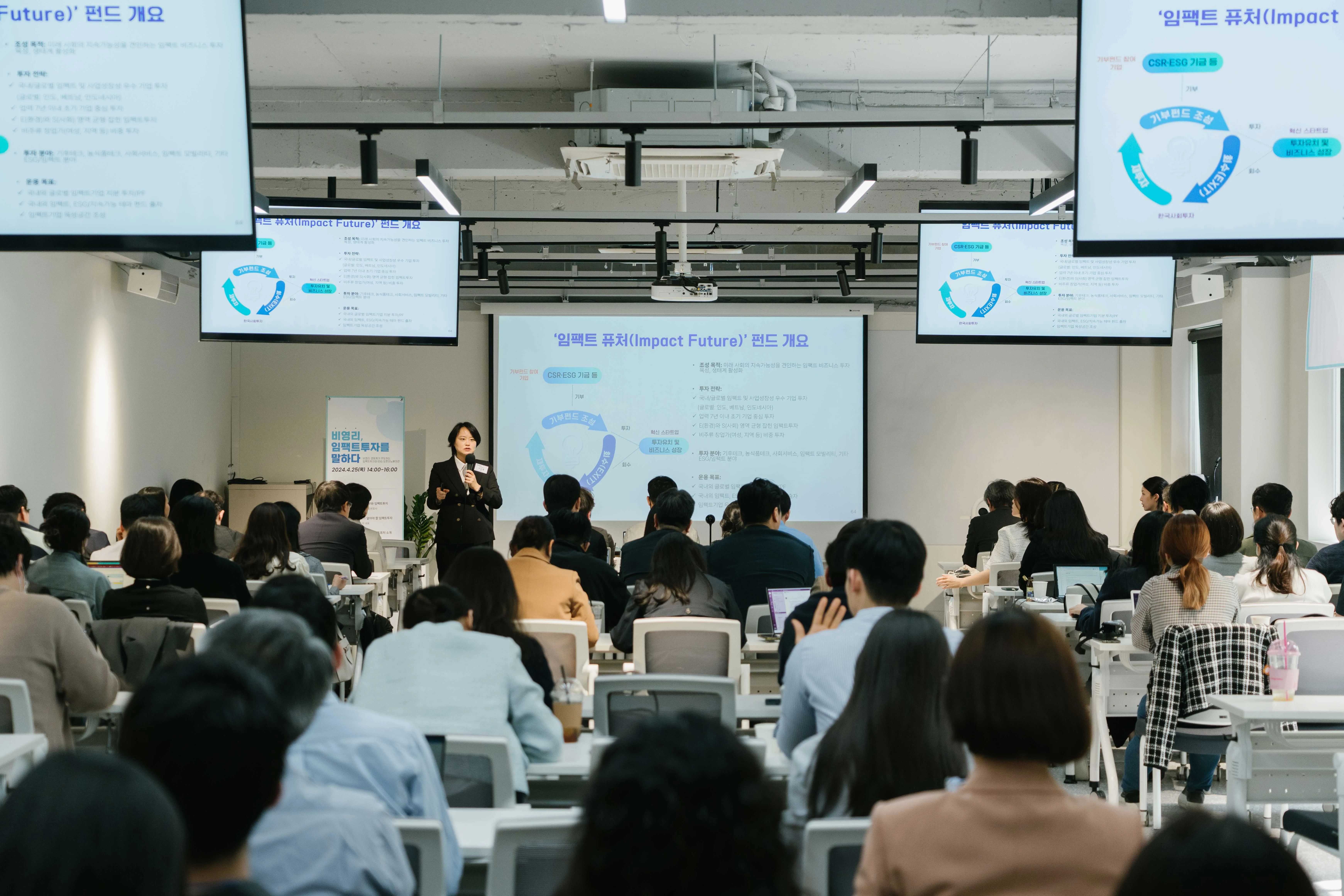
[KSI CEO Lee Soon-yeol explaining Impact Future © Korea Social Investment]
And as important as the "initial investment" that serves as the priming water for a company's commercialization is "follow-on investment." CEO Lee says, "Because the donation becomes first-loss capital, it can lower the investment risk and play the role of catalytic capital so that other for-profit capital can come in." In other words, once a company receives investment through Impact Future, it has been "verified" within the investment market as one that KSI has already invested in, making it easier to draw follow-on investment from other investment firms. In fact, when impact investing was carried out, the investment results also proved high. Korea Social Investment executed investments totaling 2.9 billion won in 24 startups in 2022, and totaling 2.7 billion won in 15 startups in 2023. To date, Korea Social Investment has executed investments in 53 startups, and two of them are already preparing for an IPO.
Exit: refers to an exit strategy after investment — a way for the investor to recover funds.
The Virtuous Cycle of Investment to Be Achieved Through Impact Future
There are for-profit and nonprofit institutions in impact investing too. One of the most important criteria is "who takes the returns when an investment profit is made." So then, who takes the investment profit generated at a company that received investment through Impact Future? The recovered investment profit becomes a business resource for Impact Future and a donation for yet another impact company, playing the role of patient capital and catalytic capital. Usually, even with impact investing, if the investment is made through a for-profit investor, the owner or shareholders take the investment profit as dividends; but in the case of a nonprofit organization, because there is no owner, when profit arises it does not end up as a specific person's profit. Therefore it can be reinvested, and the "virtuous cycle of finance" — most important in impact investing — can also be realized. It is a structure in which, as a company's business is run sustainably, social value is also continuously created, and those results return to the donor so that investment can continue — a structure where company and company can each win (win-win).
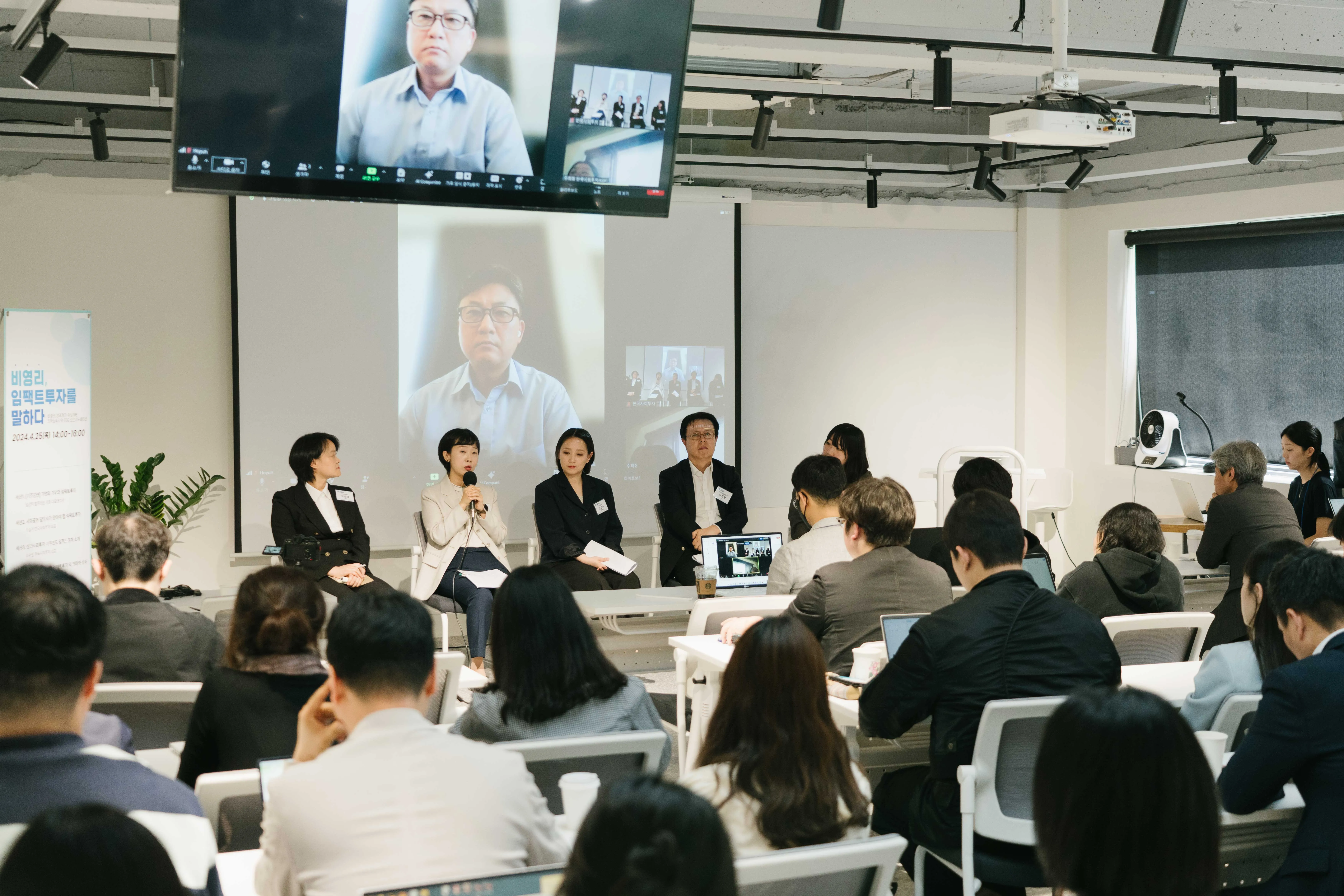
[(From left) Lee Soon-yeol, CEO of Korea Social Investment; Jang Hee-jin, Deputy General Manager of Hana Financial Group's ESG Planning Team; Jeong Ho-yoon, Head of Management Innovation at World Vision; Kim Kyung-ha, Editor-in-Chief of The Better Future; Lee Ji-hwan, Professor of Management Engineering at KAIST; Lee Hye-mi, Director of Korea Social Investment © Korea Social Investment]
At the seminar that day, a panel discussion under the theme "The Meaning and Achievements of Nonprofit Impact Investing" was also held so that participants could gain insight related to nonprofit impact investing. Asked what the achievements would be of using impact through corporate donations and of operating a donation fund through social contribution or ESG activities, Lee Ji-hwan, a professor of management engineering at KAIST who participated in the panel discussion, emphasized the value that the expanded reproduction of impact investing through donation provides. "As part of impact investing, by donating to sustainable businesses, they can run self-sustainingly without an organization, and there is ample room to use this to draw a new S-curve (growth curve) in an existing business." He also explained that corporate participation is important, saying, "If large corporations actively step up to operate donation funds, the effect spreading across society as a whole will of course occur greatly," and, "Ultimately, we will be able to achieve a greater effect in solving the social problems we seek to solve."
Social problems are becoming more advanced by the day. As the saying goes, "Let companies solve social problems. The answer is in companies," to solve social problems more surely, we cannot but call for companies' interest and active movement. KSI's Impact Future will become a novel and meaningful investment model in social and environmental terms. We look forward to the expansion of ESG investment through donation funds bringing a greater impact to our society.
by Editor L