Loading Data
Please wait a moment...
Update Cal.
2026.08
03
Mon
04
Tue
05
Wed
06
Thu
07
Fri
08
Sat
09
Sun
Update Calendar
2026.08
01
Sat
02
Sun
03
Mon
04
Tue
05
Wed
06
Thu
07
Fri
08
Sat
09
Sun
10
Mon
11
Tue
12
Wed
13
Thu
14
Fri

Loading Data
Please wait a moment...
Evening ESG news and briefings to wrap up your day.

Energy obtained through sunlight and wind has the variable of being generated intermittently, so power production is irregular. For this reason, an "ESS (Energy Storage System)"—which stores the electricity produced and supplies it when needed—is necessary.[An ESS that stores wind and solar energy ©LG Energy Solution]Driven by government policy support, ESS saw one wave of an investment boom, but after 2017, more than 50 ESS-related fire incidents occurred domestically, and interest slowed. The causes of the fires were internal battery defects and operational problems in the charging and discharging processes. Due to the successive fire accidents, the number of ESS installations in Korea also plunged. But as a result of efforts to strengthen safety, the ESS battery market is rising again.Companies Responding to Tariffs by Entering the U.S. ESS MarketMany of our companies are entering the U.S. market as they seek countermeasures to the tariff problem. "LG Energy Solution" recently signed a partnership with "Delta Electronics," a global energy-management company in the U.S., to supply residential ESS batteries from 2025 to 2030. LG Energy Solution has already supplied batteries to "Vistra Energy Corp.," a U.S. power-generation company that operates "Moss Landing," the world's largest ESS facility. In addition, it plans to operate—from 2025—the plants it is currently building to produce ESS batteries in states such as Arizona and Michigan."Hanwha Qcells," a comprehensive renewable-energy solutions company, is also in an important position in the U.S. renewable-energy market. Hanwha Qcells is currently pushing the "Atlas ESS Project," which is creating a standalone ESS complex of 4 gigawatt-hours (GWh)—the world's largest on a single-site basis—in Arizona, and it is set for completion this June. It is also carrying out a renewable-energy-supply project for the U.S. IT company "Meta," building an ESS complex in Borrego Springs, California. Such advances by our companies onto the American continent are expected to show the utility of responding to rising ESS demand within the U.S. and of reducing tariffs.Our Companies Handling the Growing Demand of the European ESS MarketAt this point, along with companies advancing into North America, companies advancing into Europe must also be examined. Europe is interested in energy issues in the aftermath of the Russia-Ukraine war. Against this backdrop, the use of renewable energy and the ESS to store it have clearly emerged as important industries. "Samsung SDI" operates a battery production facility in Hungary. On top of this, it is investing about 1 trillion won more to expand its production scale. Hungary in particular is a supply-hub region for ESS within Europe, and "SK On (formerly SK Innovation)" also operates two production facilities in Hungary. In Hungary, our companies provide high-quality ESS equipment and are meeting European market demand—expanding market share with products of guaranteed safety and efficiency.Recently, LG Energy Solution has begun business in earnest not only in the U.S. but also in Europe. On the 24th of last month, LG Energy Solution met the good news of being selected as a major partner in a large-scale ESS project pushed by "PGE (Polish Energy Group, Poland's state-owned power corporation)." With this, our companies have become able to greatly contribute to expanding the ESS supply chain in the European market. In tandem with the trend of the expanding renewable-energy market in Europe, interest and investment in ESS are expected to continue going forward.Strengthening Safety and Technological InnovationThat ESS plants are newly built or expanded in places such as the U.S. and Europe is welcome news, but the news that our ESS technology is evolving into advanced technology with heightened safety is also encouraging."LS Electric" developed an "all-in-one ESS platform" based on real-time data analysis to strengthen the safety of ESS. It monitors the state of the ESS in real time and can prevent fire accidents by detecting abnormal temperature rises or voltage and current anomalies. In particular, using AI algorithms, it optimizes the timing of charging and discharging and extends battery life, maximizing safety."Samsung SDI" also developed a system that directly sprays a fire-suppression agent when a fire occurs inside a battery module, immediately blocking the spread of fire, and "Hanwha Aerospace" and "SK Enmove" even developed the world's first non-flammable ESS. In Hanwha Aerospace's case in particular, it has the advantage of being usable in various industrial fields, such as ESS for marine vessels.Because ESS is a core technology that lowers dependence on fossil fuels, it is both an essential solution for the carbon-neutral era and a core technology leading the renewable-energy era. Now the fruits of the technology-development efforts our companies have poured into the safety problem are also appearing. For the time being, we can expect to watch our country's ESS technology establish itself as an efficient energy-storage solution and be active in the global market. by Editor N

In this era of climate crisis, marine ecosystems are drawing attention as the last relief pitcher that will save the Earth. The sea's carbon sinks—called "blue carbon," such as seaweeds, mangrove forests, halophytes, eelgrass, salt marshes, and tidal flats—boast a carbon-absorption and storage capacity 50 times faster than that of land forests.Jeju Island is rich in these blue-carbon resources. The "Knowledge Exchange on Blue Carbon" event, organized by the "World Bank," is held in Seoul and Jeju from March 31 to April 4. Jeju's resource-management activities have recently drawn attention in connection with responding to climate change, and during the event Jeju Island introduces on-site blue-carbon policy locations within Jeju—such as the marine-forest creation site off the coast of Jongdal-ri in Gujwa-eup, wind-power complexes, and the carbon-reduction facilities and solar facilities of Jeju Port. Kang Ae-suk, director-general of Jeju's Climate and Environment Bureau, said, "This event is a meaningful occasion in which the international value of Jeju Island's blue-carbon policy is recognized."[The "Carbon-Eating" Sea — the Potential of Blue Carbon ⓒESG.ONL]The environmental organization "Friends of Jeju's Nature" raised its voice, saying that along with Jeju's marine-forest creation and port carbon-reduction facilities, attention should also be paid to "measures to conserve existing halophytes." It also stressed that a policy to conserve "coastal dunes"—one of the important forms of blue carbon—is as important a strategy as growing halophytes, urging the importance of balanced ecological formation.Currently, there are not many blue-carbon-related social enterprises active in Korea. But blue-carbon-related technology is evaluated as having great growth potential, and many companies are interested. In 2024, the Hyundai Motor Chung Mong-koo Foundation invested in a blue-carbon climate-tech startup. "Blue Carbon," an eco-friendly climate-tech company founded by Professor Hwang Dong-soo of Keimyung University and others, holds source technology for carbon capture. With Hyundai Motor's support, Blue Carbon received an innovation award last year at "CES (Consumer Electronics Show)," the world's largest IT expo. GS Caltex carries out blue-carbon creation activities at the Ramsar wetland in Buan-gun, North Jeolla Province, and Kia is also cooperating with the Ministry of Oceans and Fisheries to restore domestic tidal-flat vegetation. Companies such as Hyosung, POSCO, and KB Kookmin Bank are also lending strength to eelgrass-propagation projects—eelgrass being a plant effective for spreading marine forests.In responding to global climate change, we should pay attention to the growth and contribution of Korea's blue-carbon-related climate-tech companies. by Editor N

Korea has suffered serious human and economic damage from the worst wildfires in its history. The cause of the wildfires appears to be human error. Large wildfires also occurred in Japan, Thailand, and Chile. In the U.S., wildfires broke out in North Carolina, causing damage over an area eight times that of Yeouido. In this way, wildfire damage continued around the world. As reasons this Korean wildfire spread, environmental factors are also drawing attention—such as abnormal high temperatures due to the climate crisis, extremely dry weather, and typhoon-class winds generated by abnormal atmospheric-pressure patterns.[Wildfires directly linked to the climate crisis ©Yonhap News]This Korean wildfire began on March 21 in Uiseong-gun, North Gyeongsang Province, due to a grave-visitor's mistake. In Gimhae, South Gyeongsang Province, too, a fire spread during burning after grave maintenance. In Sancheong, North Gyeongsang Province, an ember caused by a brush cutter spread into a large fire. The causes are various, but the problem is why the wildfires grew so large. Given our topography, which originally has many mountains, once a fire breaks out, it is difficult for firefighting crews to approach. Also, with much wind, the "spot-fire" phenomenon—embers riding the wind and spreading far—commonly occurs.But these are unchanging conditions. If there is something that has changed among our environmental conditions, it is that abnormal high temperatures have arisen in spring. Currently, Korea's temperatures are about 4.5 to 10 degrees higher than the annual average temperature of the 1990s. Not only in Korea, but the average temperature of major wildfire-damaged areas across East Asia showed figures about 2 degrees higher on average compared with recent decades.The nonprofit climate-change research organization "Climate Central," in a report released on March 26, forecast that human-caused climate change will continue to increase wildfire risk in the future. In particular, viewed through the "Climate Shift Index (CSI)"—an indicator that shows the degree of climate change—high-temperature phenomena during the current wildfire-damage period occurred about five times more than before.Not only abnormal high temperatures, but drought that continued from last winter—that is, dry weather and insufficient rainfall—is also cited as a cause of the large wildfires. The Yeongnam region had rainfall of only about 50% of an average year, and the minimum humidity was 14% in Sancheong and 17% in Uiseong, North Gyeongsang—conditions in which fire spreads easily. Amid this, the hot, dry winds that blew from the Taebaek and Sobaek Mountain ranges also made fire suppression difficult.According to research by the "National Institute of Forest Science," if the temperature rises 1.5 degrees, the wildfire weather index increases by 8.6%, and if it rises 2 degrees, it climbs 13.5%. Large wildfires, which in the past were concentrated in Gangwon Province in April, now occur nationwide. Now is the time not only for much investment in wildfire prevention and the expansion of specialized personnel but also for long-term climate-change-mitigation efforts to be carried out together. Only then will it be possible to protect precious lives and forests. by Editor N

2024, Which Became a Major Turning Point for Climate ChangeThe "World Meteorological Organization (WMO)" announced on March 19 that in 2024 the global average surface temperature rose 1.55°C (±0.13°C) above the pre-industrial average from 1850 to 1900. With this, 2024 was officially confirmed as the first year in which the global average temperature exceeded 1.5°C above pre-industrial levels. 2024 was the warmest year in the WMO's 175 years of observational records, and can be seen as a major turning point for climate change. The comprehensive analysis of international data from six institutions—the "European Centre for Medium-Range Weather Forecasts (ECMWF)," the "Japan Meteorological Agency," the "U.S. National Aeronautics and Space Administration (NASA)," the "U.S. National Oceanic and Atmospheric Administration (NOAA)," the "UK Met Office" together with the "University of East Anglia," and "Berkeley Earth," a climate-science institution in California—also reported the fact of exceeding 1.5°C.[2024 Confirmed as the First Year to Cross 1.5°C, the Last Line of Defense Against Climate Change ⓒESG.ONL]Achieving the Paris Agreement's Goal Has Not Yet FailedThrough the 2015 Paris Agreement, the world set "keeping the average temperature rise below 1.5°C" as a long-term goal. But humanity—having piled up the record of the hottest decade ever from 2015 to 2024—saw 2024 achieve the Earth's highest temperature. That said, because the Paris Agreement's goal refers to a 20-year average temperature, it is difficult to conclude that the goal has failed based on a single year's exceedance in 2024 alone. The "World Meteorological Organization" estimated that, based on the current situation, long-term global warming will lead to a temperature increase of between 1.34 and 1.41°C. Whether it exceeds 1.5°C or not, as long as temperatures rise, ecosystem changes such as biodiversity destruction, glacier reduction, and threats to polar ecosystems are expected to continue to progress. There is also an observation that the extreme weather anomalies and natural disasters that have astonished the world—great floods, wildfires, heat waves, droughts, and the like—will likewise continue. Scientists' warnings about the problem of carbon-dioxide concentration, which is being maintained at a high level in the atmosphere, also continue."Celeste Saulo, Secretary-General of the World Meteorological Organization," said, "Climate history is unfolding before our eyes," also emphasizing the need to strengthen early-warning systems. "UN Secretary-General Antonio Guterres" expressed the view that "limiting the level of the Earth's temperature rise to below 1.5°C (presented as a long-term goal) is still possible, and the whole world must strive through the '2035 National Climate Plans (NDCs; Nationally Determined Contributions),' which are scheduled to be held in 2025." Unless the whole world shows the will to achieve the long-term goal of reducing fossil-fuel emissions, it appears that stopping global warming will be difficult. Now is the time for the international community to put all its strength into efforts to reduce greenhouse gases through even stronger climate-change-response measures. by Editor N
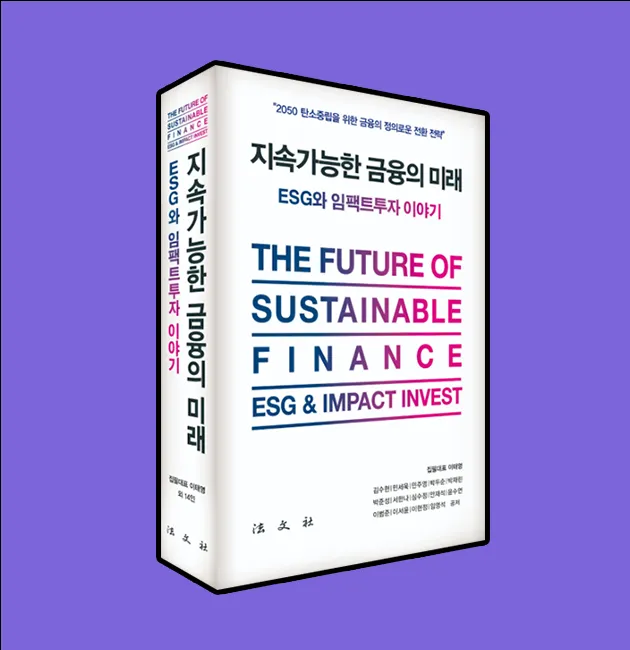
"The Future of Sustainable Finance," a new book dealing with the story of ESG and impact investing, is a book that offers guidelines to corporate ESG officers and green investors preparing to respond to the 2050 net-zero goal."The Future of Sustainable Finance," written by 15 authors including Lee Tae-young, is an up-to-date book covering ESG and finance. The book's appearance—boasting a solid thickness at a vast 672 pages—may feel somewhat hard to approach. Yet this volume was used to faithfully contain information about the investment environment surveyed through ESG-related standards and systems at home and abroad. Compiled in that way, this book has been put together as a resource providing comprehensive and in-depth information to readers interested in sustainable finance and ESG investing.[The Future of Sustainable Finance ⓒESG.ONL]A Guidebook for Sustainable-Finance Practitioners"The Future of Sustainable Finance" substantially contains a wide range of topics—from the basic concepts of ESG investing, such as ESG and impact investing, to the background of sustainable finance's emergence, sustainable-finance systems at home and abroad, and cases of ESG and impact investing. In particular, it helps the reader's understanding by explaining in detail international sustainable-finance systems and policies such as the UN Sustainable Development Goals, the Paris Climate Agreement, the EU's sustainable-finance strategy, and Korea's Framework Act on Carbon Neutrality and Green Growth. It also provides practical knowledge related to our ESG-investment environment by introducing in detail domestic investment cases such as the National Pension Service's ESG investing, the impact-investment firm "Sopoong Ventures," and impact investing through crowdfunding. In the last part of the book, it also presents future prospects for sustainable finance, such as the "Carbon Border Adjustment Mechanism (CBAM)," the future of the ESG-disclosure system, and changes in climate risk and financial supervision.The book's authors stated, "We wrote this book in the hope that it would help policymakers and officials at government agencies and financial authorities—who strive to solve the climate-crisis problem and settle sustainable finance—in preparing policy, and financial institutions in implementing sustainable-finance policy." Actually written based on the content of the "Sustainable Finance and Impact Investing" course at Yonsei University's Graduate School of Law, this book provides an expert-level understanding of ESG and sustainable finance, making it sufficient to use as a guidebook for responding to the global ESG-regulatory trend on the front lines of practice. We recommend drawing out "The Future of Sustainable Finance" by reading one chapter at a time, as if taking a class. by Editor N

Korea's climate-tech industry is growing rapidly. Along with it, government support is also gradually strengthening. But as several problems with climate-tech investment have been raised, there are also voices of awakening that it is time to re-examine the situation.Is It Time to Re-Examine Korea's Climate-Tech Investment?[Shall We Re-Examine Korea's "Climate-Tech Investment"? ⓒESG.ONL]The Government's Vision of Fostering 10 Climate-Tech UnicornsOur govErnment set a goal of investing 450 trillion won in Green Finance by 2030 and fostering 10 climate-tech unicorn companies. It plans to invest 145 trillion won through public-private cooperation, but currently there are no climate-tech unicorn companies in Korea. With the total number of unicorn companies at 15, the question is being raised of whether the goal of fostering 10 from climate-tech companies alone is excessive optimism.Startup Alliance pointed out the problems of this government policy in a recently released report.As of February 2025, a total of 272 climate-tech companies are active in Korea. Among these, "eco-tech" (25.7%) and "food-tech" (27.6%) account for more than half, because they are fields where small-capital startups are possible compared with other fields. On the other hand, "geo-tech" (11.4%)—related to carbon observation and carbon-emission rights—shows a relatively small share. "Geo-tech" has a comparatively small share of companies in that domestic regulatory barriers trip it up first, it requires advanced technology and infrastructure, and it is hard to start without large-scale investment.Currently, investment in climate tech is concentrated in clean-tech companies related to renewable energy and carbon-tech companies related to carbon-capture technology. This is because the technologies have already entered the commercialization stage, so returns relative to investment are clear. Solar, wind, energy-storage systems, and the like have high market growth potential, and global initiatives such as RE100 are stimulating this market. Since 68% of global climate-tech companies belong to the clean-tech and carbon-tech fields, this concentration of investment can be seen not as Korea's problem alone but as a global trend.Although eco-tech and food-tech are numerous in company count, they are being pushed out of investment priority. Currently, the domestic average cumulative investment amount is about 25 billion won for clean-tech and about 15.8 billion won for carbon-tech. On the other hand, eco-tech is about 7.5 billion won, food-tech about 7.1 billion won, and geo-tech only about 2.5 billion won. This shows that a clean-tech- and carbon-tech-centered investment strategy is relatively suppressing investment in eco-tech and food-tech.The Need for Consistency in Government Policy and a Long-Term VisionLooking at the climate-tech-fostering cases of the U.S. and China, one can see that a long-term roadmap and consistent policy are important. The U.S. achieved large-scale investment in the climate-tech field through powerful government support programs such as the "Inflation Reduction Act (IRA)." China, given its political characteristics, grew competitive companies through investment with policy consistency and a long-term vision. From these cases, Korea can draw the lesson that it should choose a more long-term plan and a way of concentrating investment first on specialized technologies.Yoon Min-hye, senior researcher at Startup Alliance, emphasized, "Because the climate-tech field requires long-term investment and stable market formation for technology development and commercialization, creating a sustainable ecosystem and support strategy should take priority over simple numerical targets." For this reason, it is important to invest in the climate-tech field with a long-term outlook and form the market. In particular, since Korea is a country that shows strength in food-tech, biased investment even within climate tech should be avoided.In conclusion, Korea's climate-tech industry needs the fostering of innovative companies that can substantially contribute to responding to climate change, rather than simply fostering unicorn companies. The government must strive to resolve market uncertainty and must reorganize its support policy by improving regulations and overcoming the limits of individual companies. Through this, it will be possible to overcome the climate crisis and build a world where we can all live well together. by Editor N

A Practical Guidebook for Sustainable Global ESG Business Is PublishedThe recently published "ESG Business Guidebook" from Doublebook Publishing is a book that will greatly help companies and organizations establish an ESG strategy and plan its implementation methods when they seek to participate and act in the 2050 carbon-neutral economy. Containing every aspect of ESG business along with cases from large corporations to small, medium, and mid-sized enterprises, this book tells how an organization should approach the topic of ESG—which it will encounter as part of its work—and structure it as work.[The ESG Business Guidebook ⓒESG.ONL]Every company today, at home and abroad alike, faces various problems such as artificial intelligence, social inequality, and the climate crisis. The topic of ESG is no different. In this situation, this book explains ESG not as a mere trend but as a core strategy for an organization's long-term and sustainable growth. To carry out such an important ESG strategy, an organization must clarify its purpose of existence. It is also necessary to build the organizational culture accordingly. The ESG Business Guidebook shows practical methods for how to concretize the aforementioned requirements and apply them as work, through the application cases of major global companies such as Nestlé, Unilever, and Toyota. In particular, practitioners at organizations encountering ESG as work for the first time will be able to use this book as a practical guide.The authors, who organized methodologies and cases for the practical application of ESG strategy, are also excellent. Written by experts in the ESG field—such as David Grayson, Emeritus Professor at Cranfield School of Management; Chris Coulter, CEO of "GlobeScan"; and Mark Lee, director of the "ERM Sustainability Institute"—this book was translated by Yoo Myung-hoon, an international director of the Korea ESG Management Association and a sustainable-management consultant. Through this book, which provides useful information worth reading for all corporate stakeholders interested in practicing ESG, anyone can now begin the A to Z of ESG business. by Editor N

The relationship between generative AI and ESG is drawing ever greater attention as the technological progress of recent years dovetails with interest in the sustainability of technology. Now that generative AI—which sparks innovation across industries and offers opportunity and challenge at the same time—has settled into our daily lives, it is a good time to question whether we may enjoy AI technology without limit simply because it is convenient.Carbon Emission vs. Carbon Reduction: the Two-Sidedness of AI Technology's Effects[What Is the Relationship Between Generative AI and ESG? ⓒESG.ONL]Viewed from the environmental side, one cannot ignore the criticism that generative AI is burdening the environment with its enormous power consumption. To train AI models, countless servers must be run at data centers. Because of the problem of increased carbon emissions in this process, the advancement of AI technology becomes entangled with environmental issues. Recently, a Chinese AI model called "DeepSeek" drew attention by touting low cost and high efficiency. Even so, data-center power use across the AI industry is surging, so it is not easy for the environmental problem to come off the chopping block. In particular, when electricity is drawn from regions highly dependent on fossil fuels, the carbon footprint inevitably grows larger.On the other hand, news is also heard at the same time that generative AI is contributing to establishing companies' carbon-reduction strategies by analyzing greenhouse-gas emission sources. AI can also contribute to the planning and design of sustainable products. Therefore, it is not right to lean only toward the negative thought that generative AI simply harms the environment.Privacy Controversy and the Possibility of Solving Social Problems CoexistOn the social side, data-privacy and ethical problems remain. An AI model like DeepSeek—which drew hot attention on a global scale—became embroiled in controversy over suspicions that it stores user data on Chinese servers, and in Korea there was even an incident in which access to DeepSeek was blocked. Such cases are also problems directly linked to consumer trust in AI technology and social responsibility. In addition, AI's learning of erroneous data can produce biased results such as racial or gender discrimination, and advanced deepfake technology carries the risk of leading to crime. Because social responsibility at the ESG level is also connected to protecting personal information and fair use of technology, there is a need to pay attention to such problems of AI technology.There are also cases opposite to the worrisome ones. Projects like Microsoft's "AI for Good" continuously show AI's positive social impact by using AI to contribute to disease diagnosis, the improvement of public health, and the advancement of human rights.Contributing to Strengthening Information Transparency... Unclear Accountability and Data-Security Problems Are HomeworkViewed from the governance side, AI can contribute to raising corporate transparency in ways such as monitoring regulatory compliance in real time. Of course, the risk of posing risks to governance due to data-security problems coexists. To prevent negative outcomes, global companies have begun to introduce new standards for digital ESG and seek transparent modes of operation suited to the AI era.In this way, the topic of generative AI and ESG has become an inseparable relationship. From the environmental side, there is the two-sidedness of the burden of carbon emissions and improved efficiency; socially, it carries both privacy controversy and the possibility of solving social problems at the same time; and in governance, there is the possibility of it acting as a tool that strengthens ethics and transparency. Considering the ESG-level impacts during AI development and use is not merely jumping on a trend but an essential task to consider. We must watch how the producers and consumers of AI technology strike this balance going forward. by Editor N