Loading Data
Please wait a moment...
Update Cal.
2026.08
03
Mon
04
Tue
05
Wed
06
Thu
07
Fri
08
Sat
09
Sun
Update Calendar
2026.08
01
Sat
02
Sun
03
Mon
04
Tue
05
Wed
06
Thu
07
Fri
08
Sat
09
Sun
10
Mon
11
Tue
12
Wed
13
Thu
14
Fri

Loading Data
Please wait a moment...
Evening ESG news and briefings to wrap up your day.
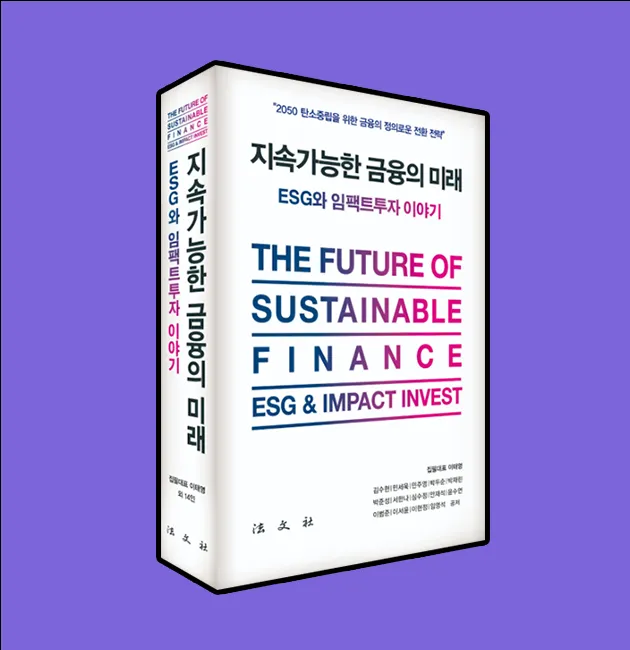
"The Future of Sustainable Finance," a new book dealing with the story of ESG and impact investing, is a book that offers guidelines to corporate ESG officers and green investors preparing to respond to the 2050 net-zero goal."The Future of Sustainable Finance," written by 15 authors including Lee Tae-young, is an up-to-date book covering ESG and finance. The book's appearance—boasting a solid thickness at a vast 672 pages—may feel somewhat hard to approach. Yet this volume was used to faithfully contain information about the investment environment surveyed through ESG-related standards and systems at home and abroad. Compiled in that way, this book has been put together as a resource providing comprehensive and in-depth information to readers interested in sustainable finance and ESG investing.[The Future of Sustainable Finance ⓒESG.ONL]A Guidebook for Sustainable-Finance Practitioners"The Future of Sustainable Finance" substantially contains a wide range of topics—from the basic concepts of ESG investing, such as ESG and impact investing, to the background of sustainable finance's emergence, sustainable-finance systems at home and abroad, and cases of ESG and impact investing. In particular, it helps the reader's understanding by explaining in detail international sustainable-finance systems and policies such as the UN Sustainable Development Goals, the Paris Climate Agreement, the EU's sustainable-finance strategy, and Korea's Framework Act on Carbon Neutrality and Green Growth. It also provides practical knowledge related to our ESG-investment environment by introducing in detail domestic investment cases such as the National Pension Service's ESG investing, the impact-investment firm "Sopoong Ventures," and impact investing through crowdfunding. In the last part of the book, it also presents future prospects for sustainable finance, such as the "Carbon Border Adjustment Mechanism (CBAM)," the future of the ESG-disclosure system, and changes in climate risk and financial supervision.The book's authors stated, "We wrote this book in the hope that it would help policymakers and officials at government agencies and financial authorities—who strive to solve the climate-crisis problem and settle sustainable finance—in preparing policy, and financial institutions in implementing sustainable-finance policy." Actually written based on the content of the "Sustainable Finance and Impact Investing" course at Yonsei University's Graduate School of Law, this book provides an expert-level understanding of ESG and sustainable finance, making it sufficient to use as a guidebook for responding to the global ESG-regulatory trend on the front lines of practice. We recommend drawing out "The Future of Sustainable Finance" by reading one chapter at a time, as if taking a class. by Editor N

A Practical Guidebook for Sustainable Global ESG Business Is PublishedThe recently published "ESG Business Guidebook" from Doublebook Publishing is a book that will greatly help companies and organizations establish an ESG strategy and plan its implementation methods when they seek to participate and act in the 2050 carbon-neutral economy. Containing every aspect of ESG business along with cases from large corporations to small, medium, and mid-sized enterprises, this book tells how an organization should approach the topic of ESG—which it will encounter as part of its work—and structure it as work.[The ESG Business Guidebook ⓒESG.ONL]Every company today, at home and abroad alike, faces various problems such as artificial intelligence, social inequality, and the climate crisis. The topic of ESG is no different. In this situation, this book explains ESG not as a mere trend but as a core strategy for an organization's long-term and sustainable growth. To carry out such an important ESG strategy, an organization must clarify its purpose of existence. It is also necessary to build the organizational culture accordingly. The ESG Business Guidebook shows practical methods for how to concretize the aforementioned requirements and apply them as work, through the application cases of major global companies such as Nestlé, Unilever, and Toyota. In particular, practitioners at organizations encountering ESG as work for the first time will be able to use this book as a practical guide.The authors, who organized methodologies and cases for the practical application of ESG strategy, are also excellent. Written by experts in the ESG field—such as David Grayson, Emeritus Professor at Cranfield School of Management; Chris Coulter, CEO of "GlobeScan"; and Mark Lee, director of the "ERM Sustainability Institute"—this book was translated by Yoo Myung-hoon, an international director of the Korea ESG Management Association and a sustainable-management consultant. Through this book, which provides useful information worth reading for all corporate stakeholders interested in practicing ESG, anyone can now begin the A to Z of ESG business. by Editor N

The relationship between generative AI and ESG is drawing ever greater attention as the technological progress of recent years dovetails with interest in the sustainability of technology. Now that generative AI—which sparks innovation across industries and offers opportunity and challenge at the same time—has settled into our daily lives, it is a good time to question whether we may enjoy AI technology without limit simply because it is convenient.Carbon Emission vs. Carbon Reduction: the Two-Sidedness of AI Technology's Effects[What Is the Relationship Between Generative AI and ESG? ⓒESG.ONL]Viewed from the environmental side, one cannot ignore the criticism that generative AI is burdening the environment with its enormous power consumption. To train AI models, countless servers must be run at data centers. Because of the problem of increased carbon emissions in this process, the advancement of AI technology becomes entangled with environmental issues. Recently, a Chinese AI model called "DeepSeek" drew attention by touting low cost and high efficiency. Even so, data-center power use across the AI industry is surging, so it is not easy for the environmental problem to come off the chopping block. In particular, when electricity is drawn from regions highly dependent on fossil fuels, the carbon footprint inevitably grows larger.On the other hand, news is also heard at the same time that generative AI is contributing to establishing companies' carbon-reduction strategies by analyzing greenhouse-gas emission sources. AI can also contribute to the planning and design of sustainable products. Therefore, it is not right to lean only toward the negative thought that generative AI simply harms the environment.Privacy Controversy and the Possibility of Solving Social Problems CoexistOn the social side, data-privacy and ethical problems remain. An AI model like DeepSeek—which drew hot attention on a global scale—became embroiled in controversy over suspicions that it stores user data on Chinese servers, and in Korea there was even an incident in which access to DeepSeek was blocked. Such cases are also problems directly linked to consumer trust in AI technology and social responsibility. In addition, AI's learning of erroneous data can produce biased results such as racial or gender discrimination, and advanced deepfake technology carries the risk of leading to crime. Because social responsibility at the ESG level is also connected to protecting personal information and fair use of technology, there is a need to pay attention to such problems of AI technology.There are also cases opposite to the worrisome ones. Projects like Microsoft's "AI for Good" continuously show AI's positive social impact by using AI to contribute to disease diagnosis, the improvement of public health, and the advancement of human rights.Contributing to Strengthening Information Transparency... Unclear Accountability and Data-Security Problems Are HomeworkViewed from the governance side, AI can contribute to raising corporate transparency in ways such as monitoring regulatory compliance in real time. Of course, the risk of posing risks to governance due to data-security problems coexists. To prevent negative outcomes, global companies have begun to introduce new standards for digital ESG and seek transparent modes of operation suited to the AI era.In this way, the topic of generative AI and ESG has become an inseparable relationship. From the environmental side, there is the two-sidedness of the burden of carbon emissions and improved efficiency; socially, it carries both privacy controversy and the possibility of solving social problems at the same time; and in governance, there is the possibility of it acting as a tool that strengthens ethics and transparency. Considering the ESG-level impacts during AI development and use is not merely jumping on a trend but an essential task to consider. We must watch how the producers and consumers of AI technology strike this balance going forward. by Editor N

"Exxon Mobil Corp.," the largest oil company in the U.S., recently filed a lawsuit against its own investors, "Arjuna Capital LLC" and "Follow This." For a company to sue its own shareholders is unusual even in the U.S., the land of lawsuits. Both of the investment firms Exxon Mobil accused are "activist investor groups" that demand a company's sustainable management as shareholders. This lawsuit shows, beyond the tension between fossil-fuel companies and activist investors, the "anti-ESG sentiment" arising in the U.S. in full.The lawsuit began with the shareholder proposals that Arjuna Capital and Follow This submitted to place items on the agenda of the shareholders' meeting. Exxon Mobil claims that the two investment groups deliberately acquired small amounts of stock to obstruct corporate governance. The proposals mainly contained content demanding a reduction of Scope 3 emissions, and the argument is that these proposals are unrealistic and, in the long term, run counter to shareholder value.[Exxon Mobil, which ranked No. 1 in market capitalization among the world's oil and gas companies as of 2023 ©Statista]How Is Governance Intervention Possible with Only a Small Investment?Even small investors can sufficiently intervene in corporate management under the U.S. "Securities and Exchange Commission (SEC)" Rule 14a-8. That rule allows shareholders to submit items for a company's annual meeting. The qualification can be met if a shareholder holds at least $2,000 worth of stock, or 1% of the company's securities, for at least one year. In other words, Arjuna Capital and Follow This's agenda proposals are lawful. But Exxon Mobil argues that it is improper for investors to repeatedly submit proposals that do not consider the company's long-term value while holding only a minimal amount of stock.The Two Investment Firms That Withdrew Their Agenda RequestsWhen Exxon Mobil filed the lawsuit, the two investment firms withdrew their agenda requests. It is highly likely they feared that the cost and duration of the lawsuit would grow astronomically. But Exxon Mobil stated that it would continue the lawsuit. This is because the lawsuit had the purpose not only of preventing the two firms' proposals from being placed on the shareholders' meeting agenda, but also of fundamentally blocking activist investors from influencing corporate governance with small investments. There is a view that Exxon Mobil is trying to use this opportunity to also influence the SEC's rules.Exxon Mobil, Which Moved the Playing FieldThe conflict moved from inside the company to the court. The court will review the intent and legality of the agenda the two firms attempted to place, and—more broadly—investors' rights regarding corporate governance, the interpretation of the SEC's rules, and so on. The investment firms have argued that their proposals lower the company's environmental impact and align with broad social values and sustainability goals, while Exxon Mobil sees such small investors' actions as not only running counter to shareholder value but also as a kind of abuse of rights. Whether it is Exxon Mobil or the investors that truly values the company's long-term interests will now be decided in court. And that outcome will cause a great reverberation in the changing role of shareholders regarding corporate governance. by Editor N

On April 30, Korea's exposure draft of sustainability-disclosure standards was announced. Going forward, as in the U.S., domestic listed companies will have to disclose sustainability- and climate-related risk information in line with the disclosure standards. For example, if a company purchased greenhouse-gas-emission-reduction facilities in line with the Scope 1 standard, it can disclose the facility-purchase cost and the greenhouse-gas emissions that the facilities will reduce.The timing of the disclosure's introduction has not been finalized. Scope 3* disclosure, which had been at the center of controversy, was classified as optional to ease the corporate burden. It appears that the mandating and timing of application will be decided through later discussion.*Scope 3: a supplier's greenhouse-gas emissionsThe exposure draft is broadly divided into three items: No. 1, general matters for the disclosure of sustainability-related financial information; No. 2, climate-related disclosure matters; and No. 101, additional disclosure matters considered for policy purposes. The purpose of this exposure draft is to provide sustainability information to help corporate investors' decision-making. According to the disclosure standards, a company must provide information on sustainability- and climate-related risks and opportunities that are expected to affect its management.[A summary of the sustainability-disclosure-standards exposure draft, No. 1 General Requirements ©KSSB]No. 1 includes content that must be complied with when preparing and reporting sustainability-related financial information. Going forward, companies must prepare prior-period comparative information, the fact of compliance with the sustainability-disclosure standards, key elements when disclosing non-climate matters, information on significant judgments in the process of preparing sustainability-related financial disclosures, measurement-uncertainty information, and information on previously reported errors. Besides the disclosure standards, it proposes referring to the standards of the "Sustainability Accounting Standards Board (SASB)" or the "Climate Disclosure Standards Board (CDSB)" for water and biodiversity.No. 2 requires climate-related risk information regarding a company's governance, strategy, risk management, and metrics. Companies must disclose both the negative physical risks and the transition risks that climate will pose to the company. In the governance item, they state the decision-making body that will oversee climate-related risks and the climate-related risks that management considers in the decision-making process. In the strategy item, they disclose information on the impact of climate-related risks on the company's business model and value chain, along with information on the company's capacity to respond to its climate risks. The risk-management item records the process of assessing and monitoring climate risks and opportunities. In the metrics item, information belonging to the following seven metric categories must be indicated.1. Greenhouse-gas emissions2. Information on assets or business activities vulnerable to transition risk3. Information on assets or business activities vulnerable to physical risk4. Information on assets or business activities aligned with opportunities5. Capital deployment6. Internal carbon price7. Executive compensationFinally, the No. 101 exposure draft—an additional disclosure matter considering policy purposes—requires the disclosure of information already being disclosed under law, as well as additional information such as childcare-friendly management and safety management. It is part of a policy that proposes that companies, too, help solve social problems in line with the intent of ESG policy.The Korea Sustainability Standards Board (KSSB) will hold an opinion-consultation period until August 31 and plans to seek stakeholders' opinions before announcing the final disclosure draft. The questionnaire for the disclosure-standards exposure-draft opinion consultation can be found on the Sustainability Standards Board's website. by Editor N

The emergency press conference by ADOR CEO Min Hee-jin on the 25th was hotter than the recent general election. The internal strife of a company representing Korea's entertainment industry is being laid bare day after day. HYBE (CEO Park Ji-won)—ADOR's parent company and standing at the opposite pole of the confrontation—is a KOSPI-listed company. Besides HYBE, it is true that SM, JYP, and YG, which also represent Korea, are listed companies, but all three are listed on KOSDAQ. KOSPI requires more demanding listing criteria than KOSDAQ in terms of scale and revenue. By that much, HYBE's revenue, market capitalization, and social influence are ahead of the other entertainment companies.Being a listed company also means being subject to mandatory ESG disclosure. In Korea, the exact standards and subjects have not yet been legislated, but HYBE—which met the large-business-group criteria last year—is highly likely to become subject to mandatory disclosure under the strictest standards. Just as many listed companies have voluntarily published sustainability-management reports as a kind of rehearsal for mandatory disclosure, all of the three companies—SM, JYP, and YG—and HYBE published sustainability-management reports last year. Things such as "transparent and professional board operation," "eco-friendly performance and employment diversity," "enhancing shareholder value," and "risk prevention such as financial management" were mentioned in their sustainability-management reports.[The cover of HYBE's 2022 sustainability-management report ©HYBE]The ADOR Situation Is Directly Linked to Corporate GovernanceCEO Min Hee-jin began the press conference with the story that HYBE had blocked NewJeans's promotion. Within HYBE, various labels and artists exist. Mutual competition is naturally inevitable, and competition itself is not the problem. Not only in the entertainment industry but companies in any industry hold various product lines and gain market competitiveness through competition and collaboration. However, CEO Min Hee-jin claims that, in the process of competition, the decision-making process of HYBE's board was not fair. Conversely, HYBE claimed that CEO Min Hee-jin tried to lower ADOR's value and illegally increase her stake; if true, CEO Min Hee-jin would have betrayed not only shareholder value but also the expectations and trust of ADOR's executives and staff.HYBE, Which Had Pondered the Sustainability of the Entertainment IndustryOn the cover of HYBE's 2022 sustainability-management report, the phrase "For Sustainable Entertainment" is written. And three pages later, HYBE Chairman Bang Si-hyuk opens the report, saying, "We will ponder the sustainability of the entertainment industry ahead of others and become a company that contributes to society and grows through its core business." He also promises to make HYBE a long-loved company, a company that brings about positive change in the industry. If it goes as promised, the conflict between HYBE and ADOR should, as a result, also be able to remain a positive influence on the industry. It could be an opportunity for the entertainment industry to break away from long-standing practices and transform into an industry based on good governance—that is, a fair system.The Homework of an Entertainment Industry of Growing InfluenceThe word "fandom" long ago changed to "fandustry." As the concerts of Taylor Swift, a pop singer representing the U.S., moved entire regional economies, terms such as "Swiftonomics" and "Touronomics" came into being. HYBE, too, has a plan to provide artist-linked attractions, food, and lodging products through "The City" project, which turns entire cities where concerts are held into theme parks. It appears it will contribute considerably not only to local governments but also to the national economy.As performance and influence have grown, the scale of shareholders in the entertainment industry is also increasing together. That means interest in companies' operations is rising by that much. This is all the more so because it is an industry on which people's attention is concentrated. This situation reminds us that organizational satisfaction stemming from governance can be important from a risk-management standpoint. by Editor N

ThEre is an opinion that the Korean government's climate policy is insufficient for crisis response. Amid this, the release date of the domestic climate-disclosure draft was announced as the 30th of this month. Unlike the industry's expectation that it would be released this week, the full text of the draft will be viewable on the 30th, delayed by a week. In the draft, among the ESG areas, climate (E; Environment) disclosure—for which international consensus has formed—is set to be introduced first, and since it is estimated highly likely to include "Scope 3 disclosure," which was even omitted from the U.S. climate-disclosure final draft, voices of concern are growing in some quarters.[The basic structure of the climate-disclosure draft ©Financial Services Commission]At the fourth meeting of the ESG Finance Promotion Group, held on the 23rd, the basic structure and key content of the draft—allowing an advance look at the draft to be released next week—were shared. The structure is basically divided into mandatory-disclosure standards and selectable additional-disclosure standards, with the gist being "governance for climate-risk management" and that "a company must disclose its response strategy and management process related to climate risk." Among these, the phrase "a company must disclose the impact of climate-risk factors affecting corporate value on the value chain" is specified, giving rise to the opinion that the draft will include Scope 3.Scope 3, beyond a company's direct and indirect greenhouse-gas emissions, designates even the value chain as a target for emission reduction. In the U.S., which announced its climate-disclosure adoption draft this past March, the intent to actively respond to the climate crisis was good, but the opinion that it realistically burdens corporate management clashed, and a tense controversy arose. In the end, Scope 3—which had been included in the 2022 draft—was excluded from the final draft. Domestically as well, one could approach the greenhouse-gas-reduction target quickly, but because companies' cost burden grows, attention is focused on whether Scope 3 will be included in the draft to be released.[The fourth meeting of the ESG Finance Promotion Group, where heated debate was exchanged ©Financial Services Commission]Another point of contention is expected to be the "timing of mandating." The earlier the introduction timing, the more effectively one could mitigate the climate crisis and respond to international standards, but there is also an opposing opinion that the burden on companies unprepared for climate disclosure grows. Such a clash can also be confirmed in the case of domestic ESG disclosure, which was originally to be mandated from 2025 but was delayed to 2026 for the reason of easing corporate burden. It was expected that the mandating timing would be released simultaneously with the announcement of the disclosure-standards draft, but the mandating timing was reportedly not included in the agenda of the fourth ESG Finance Promotion Group meeting, which discussed the climate-disclosure draft.The Korean climate-disclosure draft will be prepared by the "Korea Sustainability Standards Board (KSSB)" within the Korea Accounting Institute, which belongs to the Financial Services Commission. Because the Accounting Institute establishes accounting standards for companies' financial reporting, it takes on the role of presenting the government's sustainability guidelines. The Sustainability Standards Board has been reviewing appropriate climate-disclosure guidelines to apply to domestic companies ever since it was newly established in 2022 to effectively respond to the mandating of climate disclosure in advanced countries such as the EU and the U.S.[The Korea Accounting Institute reviewing points of contention with the Hong Kong Institute of Certified Public Accountants ©Korea Accounting Institute]In particular, as this draft is the first domestic climate disclosure to be released, bilateral talks were held with major sustainability-disclosure-standard-setting bodies on the 17th and 18th to review international compatibility. With the Australian Accounting Standards Board (AASB), the Sustainability Standards Board of Japan (SSBJ), the Hong Kong Institute of Certified Public Accountants (HKICPA), and the International Public Sector Accounting Standards Board (IPSASB), they checked and discussed recent exposure-draft trends and the points that became contentious in each country.In early April, the U.S. Securities and Exchange Commission (SEC)—which had put forward climate-disclosure-mandating regulation—decided to temporarily suspend the mandating regulation for listed companies as various lawsuits contesting the system's legality continued. Following this, according to Bloomberg, Europe's private banks are also reportedly appealing to the European Central Bank (ECB) to "not take the lead in responding to the climate crisis," worried that the competitiveness gap between U.S. Wall Street and European banks will widen. As lukewarm moves regarding the mandating of climate-crisis disclosure and the inclusion of financial elements continue in Europe and the U.S.—which released climate disclosures ahead of others—the direction of Korea's draft announcement is also hard to conclude. by Editor N

Amid the International Energy Agency (IEA) stating that last year's carbon emissions recorded an all-time high, "Carbon Majors," a civic group that analyzes carbon-emitting-company data, announced on the 4th that energy companies' carbon emissions account for 80% of global emissions. The point is that, after the Paris Agreement, the carbon emissions of energy companies producing coal and cement actually increased.Literally translated, the name of the group that reported this fact, "Carbon Majors," means "the chief culprits of carbon." The group is known to have started on the occasion of a HuffPost article in 2013 that pointed out that a mere 90 companies accounted for two-thirds of global carbon emissions. Back in 2017, too, CDP (Carbon Disclosure Project)—a global civic group engaged in carbon-emission-reduction activities—revealed the fact that the carbon emissions of 100 energy companies accounted for 70% of global emissions. As Carbon Majors' data released this month revealed that energy companies' carbon emissions increased after the Paris Agreement—which targeted the reduction of greenhouse gases including carbon—voices continue that we must be vigilant about the climate crisis.[A graph of the increasing trend of global carbon emitted by major carbon-emitting companies ©Carbon Majors]Carbon Majors, which tracked the greenhouse-gas emissions of 122 energy companies, pointed out in its report that from after the Paris Agreement until 2022, a mere 57 energy companies were the chief culprits producing 80% of global carbon emissions. Over the same period, 117 companies produced 88% of global carbon emissions, and among these, state-owned enterprises directly operated by the state or belonging to the government amounted to 69%, while private companies amounted to 31%.[The top 10 companies with the highest carbon emissions after the Paris Agreement ©Carbon Majors]Among these, the energy companies with the highest shares are Saudi Aramco, Gazprom, Coal India, and others. According to Reuters, in reporting on these figures, Saudi Aramco refused to answer, and Gazprom and Coal India did not immediately respond. Carbon Majors' corporate carbon-emission data was also cited in a lawsuit filed this past March by a Belgian farmer against the French oil-and-gas company "TotalEnergies." That lawsuit is proceeding with the issue that TotalEnergies—one of the top 20 companies with the highest carbon emissions—bears some responsibility for causing the climate crisis and inflicting damage on agriculture.The Paris Agreement is a term referring to the 21st UN Framework Convention on Climate Change, held in Paris, France, in 2015, and has the significance that 195 countries worldwide participated in greenhouse-gas reduction. The Paris Agreement is meaningful in that, going beyond the 1997 Kyoto Protocol—which imposed greenhouse-gas-reduction obligations only on developed countries—it drew out an agreement in which the vast majority of countries worldwide would set greenhouse-gas-reduction targets and join in. The common goal adopted in the Paris Agreement is "preventing the Earth's average temperature from rising 2 degrees or more above pre-industrial levels." It is time to look back on the Paris Agreement's principle that each country's government has the obligation to slow global warming by demanding carbon-emission reductions from its own companies. by Editor N