Loading Data
Please wait a moment...
Update Cal.
2026.08
03
Mon
04
Tue
05
Wed
06
Thu
07
Fri
08
Sat
09
Sun
Update Calendar
2026.08
01
Sat
02
Sun
03
Mon
04
Tue
05
Wed
06
Thu
07
Fri
08
Sat
09
Sun
10
Mon
11
Tue
12
Wed
13
Thu
14
Fri

Loading Data
Please wait a moment...
Evening ESG news and briefings to wrap up your day.

The ‘Food Safety Day’ observed every year on May 14 was designated to raise awareness of food safety and promote a safety-conscious mindset among food industry workers. Established by the Ministry of Food and Drug Safety (MFDS) in 2002, it was elevated to a statutory commemorative day through a 2016 amendment to the Framework Act on Food Safety. Now, ten years after becoming a statutory day, the meaning of ‘food safety’ has transcended the realm of simple food hygiene management. On Food Safety Day, we contemplate not only the safety of food but also the agenda of a society where everyone can eat safely without any members being left behind. From an ESG perspective as well, food safety is understood as an issue demanding responsibility toward the socially vulnerable and an institutional safety net.Food Deserts That Still ExistNear Exit 6 of Seoul’s Yeongdeungpo Station, by the roadside, stands a soup kitchen called ‘Thomas’s House.’ Opened in 1993, this soup kitchen provides lunch at a price of 200 won each day to homeless individuals, elderly people living alone, and jjokbang (small single-room dwelling) residents in the surrounding community who have difficulty feeding themselves. Serving an average of over 300 people daily, it has held its place for more than 30 years through the efforts of volunteers and individual donors, without support from local governments or the national government. It is a symbolic place showing that blind spots in the food safety net still exist in our society. Socially vulnerable groups such as children, the elderly, and persons with disabilities find it difficult to secure balanced nutrition on their own, and in the absence of systematic societal management, they are easily exposed to nutritional imbalances. It is also a reality that members of environments where hiring a professional nutritionist is difficult — such as small childcare centers or welfare facilities for the disabled — can hardly be guaranteed adequate hygiene management or nutritional balance. For food safety to establish itself as a social responsibility, a cooperative operational system tightly connecting the government, public institutions, and local governments is necessary.Nutrition Management Supported by the Food Safety Management InstituteTo build a food safety net, the MFDS is responsible for overseeing food safety policies based on the Framework Act on Food Safety, while local governments are entrusted with establishing and operating Children’s and Social Welfare Meal Service Management Support Centers to provide locally tailored services.[Customized In-Depth Nutrition Management Special Project run by the Jincheon County Children’s and Social Welfare Meal Service Management Support Center in 2025 © Jincheon-gun, Chungcheongbuk-do]The MFDS, in cooperation with its affiliated institution the Food Safety Management Institute, has established a meal service support system for vulnerable groups. The Food Safety Management Institute supports the improvement of dietary safety for nutritionally vulnerable groups through two key programs. The first is the operation of the Children’s Meal Service Management Support Centers. At these centers, responsible nutritionists make direct visits to small childcare centers and child welfare facilities that are not required to employ a nutritionist, providing巡回 guidance on hygiene and nutritional status. The centers also develop customized educational materials for children, provide tailored menus and standardized recipes, and conduct dietary education for children, kitchen staff, and parents.The second key program is the operation of the Social Welfare Meal Service Management Support Centers, which began in 2023. These centers support customized hygiene and nutrition management for small-scale elderly and disabled welfare facilities that lack a nutritionist. Specifically, they design meal plans that account for the physical conditions and health status of elderly and disabled individuals requiring social care, and conduct hygiene inspections of cooking environments.A Safe Meal That Must Be Guaranteed for AllRecently, in addition to the on-site visit support approach for food safety, the MFDS also operates digitally-based management programs to enhance transparency. A representative example is the website ‘Food Safety Korea’ operated by the MFDS. On this website, consumers can access the food history information menu, enter a product name or company name, and view information on every stage from production to sale. Food Safety Korea also offers a safety management certification product verification service, serving as a window through which consumers can access food safety information.[Screen of the Food History Information Search menu on the Food Safety Korea website © Food Safety Korea]When the institutional efforts of public agencies including the MFDS meet the dedication of private organizations like Thomas’s House, the food safety net will become even tighter. A safe and balanced meal for sustaining life is a universal right that must be guaranteed to every member of society, and a sustainable society is one where all members can sit at a safe table equally. Food Safety Day is one small step in that direction. by Editor N

Stella McCartney is a designer who has utilized vegan materials and recycling technologies for over 20 years. Her first collaboration collection with the fashion brand H&M in November 2005 sold out within minutes of its release. At the time, this collaboration drew attention simply for being a meeting between a world-class fashion designer and an SPA (Specialty Store Retailer of Private Label Apparel) brand, but it carried an even more significant meaning: it was a signal that vegan fashion pursuing sustainability could reach the masses. Twenty-one years after that first collaboration, on May 7, 2026, the two brands once again joined forces with the goal of presenting a collection that is sustainable and familiar to the public. All products in this collection by Stella McCartney and H&M were made using certified eco-friendly materials. [Printed cotton hoodie from the Stella McCartney x H&M collaboration collection © H&M Official Instagram]Connecting Vegan Philosophy and the MassesSince the founding of her brand in 2001, Stella McCartney has steadfastly adhered to a vegan philosophy, refusing to use not only leather, feathers, and fur but even animal-based adhesives. This collaboration collection with H&M likewise utilizes eco-friendly materials such as metal chains made from 100% recyclable aluminum, regenerated fibers from collected clothing, and organic cotton.Stella McCartney has previously showcased products using next-generation vegan materials such as Mylo mushroom leather and AppleSkin leather made from apple waste, but there was the downside that these products carried high price tags. In the summer of 2025, when Stella McCartney collaborated with the American biotech startup Hydefy, the handbags made from vegan textiles that the two brands introduced at the time reached prices in the millions of won. However, the products in this H&M collaboration are presented to the public at relatively accessible prices ranging from KRW 50,000 to 400,000.[Trench coat made from organic cotton from the Stella McCartney x H&M collaboration © H&M Official Website]A Virtuous Cycle Driven by Sustainable InfrastructureIn its 2025 Sustainability Report, H&M announced that 91% of the materials used in its products were either recycled or from sustainable sources. Among these, the share of recycled materials was 32%, exceeding the 2025 target of 30%. Greenhouse gas emissions were reduced by 41% in Scope 1·2 and by 34.6% in Scope 3 compared to 2019. The supply chain transformation goes further. The number of suppliers using coal-fired boilers decreased from 118 in 2022 to 27 in 2025, with the goal of completely phasing out coal boilers by 2026.H&M’s global supply chain and mass-production infrastructure play a decisive role in scaling up sustainable materials. For materials like the vegan leather and natural rubber leather used by Stella McCartney to be produced at a commercial scale, large-volume orders are necessary. When a global SPA brand like H&M adopts these materials, suppliers can expand production lines, and unit costs fall, making them accessible to more brands. At the time of the Stella McCartney and H&M collaboration in 2005, the materials used amounted to little more than organic cotton and recycled polyester. This year’s collaboration between the two brands has expanded the range to include coating materials derived from raw materials such as sugarcane and industrial corn, and even mushroom-based leather alternatives.Brand Value Expanding Alongside SustainabilityEven before the full launch of the Stella McCartney and H&M collection began, H&M released campaign photos and videos announcing the collaboration through its official website and social media. The campaign video centers on the key phrase ‘&Stella (Stella and You).’ The &Stella concept expands into meanings such as ‘&Here,’ ‘&Now,’ ‘&Me,’ and ‘&You,’ conveying values of care and connection that encompass the past, present, and future. Stella McCartney said, “This collaboration collection brings together the materials I use now with those I have long loved. It is playful, sparkly, joyful, and chic.” [Stella McCartney x H&M collaboration campaign image © H&M Official Instagram]This collaboration collection with H&M carries meaning not only in the pursuit of sustainability but also in how it looks toward Stella McCartney’s past and future. It is also important that vegan materials can now become the mainstream rather than merely an alternative in fashion, and that sustainability can become a choice for everyone, not just a select few. The meaning of the Stella McCartney and H&M collaboration collection, officially launched on May 7, will endure not in whether it sells out but in how many people get to experience sustainable fashion in their daily lives. by Editor N
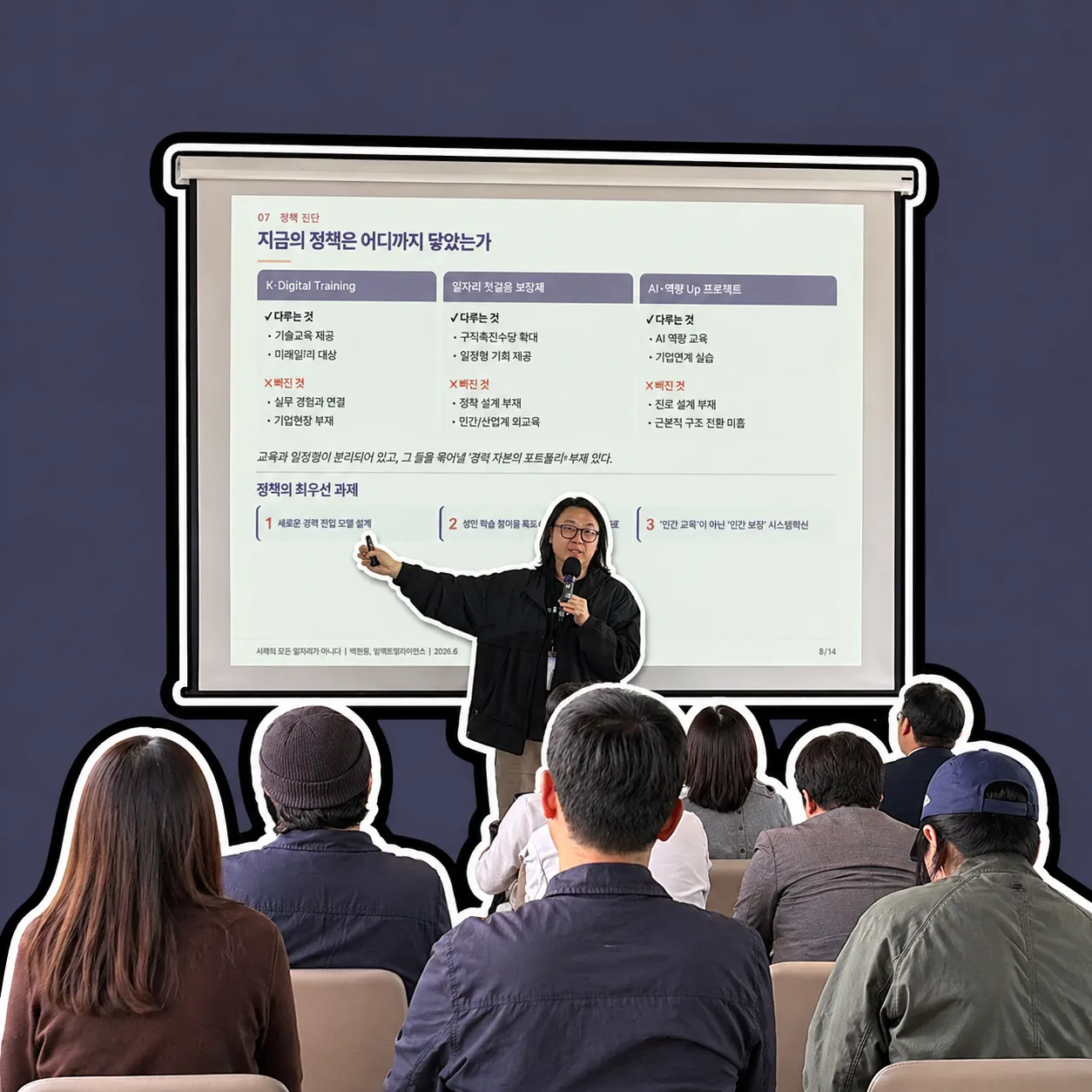
The discussion that AI Transformation (AX) replaces jobs is no longer unfamiliar. The ‘AI Basic Society Action Seminar,’ held on April 23 at Seongsu Heyground hosted by the Underdogs Impact Alliance, went a step further. At the seminar, the conversation centered on who is being left behind in this transition and whether the newly opening jobs are genuinely open to everyone.[Bank of Korea analysis data © Based on Bank of Korea data/ChatGPT]According to Bank of Korea analysis, from July 2022 to July 2025, youth jobs in their 20s and 30s decreased by 211,000, while jobs for those in their 50s increased by 209,000 during the same period. A striking 98.6% of the decline was concentrated in industries with high AI exposure. It was not that the total volume of jobs had vanished, but that a generational shift had occurred. In a Stanford University seminar this past January, Harvard Economics Department graduate students Hosseini and Reitinger presented the results of an analysis of resume data for 62 million workers across 620,000 U.S. companies. They found it significant that the jobs AI is replacing first are not low-difficulty ‘easy work’ but rather ‘junior work.’ Tasks considered junior work — such as standardized document editing, information retrieval, and entry-level coding — are not simply easy tasks. They are the process through which new hires first learn the organization, make mistakes, receive feedback from senior colleagues, and build their professional instincts. That process is quietly disappearing.What the AI Basic Society Asks[AI+ Skill Up Project ©Ministry of Employment and Labor Instagram]The ‘AI Basic Society’ promoted by the government is a vision of making AI a public infrastructure for all citizens, not just a tool for some experts. The Ministry of Employment and Labor plans to support the AI vocational skills development of one million people in the labor market over the next five years, and to invest a total of KRW 254 billion in 2026 to train approximately 240,000 AI personnel. This spans the entire life cycle, from jobseekers to current employees to career changers. At the seminar, shortcomings regarding this policy were aired. It was noted that while current policies reach the point of connecting education provision to work experience, what comes after is left to individuals. Programs are multiplying without a designed connection from internships — where career capital actually accumulates — to employment, and from employment to growth.[AI Works Curator Lee Hye-min speaking on ‘Inclusive AX Job Creation for Vulnerable Groups’ © ESG.ONL]Nevertheless, there are already parts that are working on the ground. AI Works is implementing a roadmap that transforms the job functions of workers with disabilities — who had mainly handled simple repetitive tasks — through the stages of AX education, intellectual property creation, and revenue model proliferation. It is an example of redefining the automation of repetitive tasks not as a threat but as a catalyst for transition. At regional youth startup sites, AI agents have begun to supply resources that previously did not exist. In environments with no developers, no designers, and no mentors, AI is taking over coding, marketing, and market research, and a change is emerging in which the execution capability gap between the capital region and local areas is narrowing.Models That Must Be Built on the GroundHowever, for such experiments to become the standard rather than the exception, the role of companies must change. The AI utilization rate stands at 49.2% for large enterprises versus 4.2% for SMEs — a twelvefold difference. Given that 89.1% of all workers in South Korea are employed by SMEs, this gap is effectively a gap in overall productivity. This is why it is critical for companies to open their AI infrastructure and training programs to SMEs and local communities.Social jobs in the AX era are not a substitute for low-value-added jobs. They are jobs that bridge the technology gap, maintain services in which human interaction is key, and support the transition of vulnerable groups. The OECD has analyzed that social economy organizations can serve as a ‘buffer zone’ for the employment of vulnerable groups during the AI transition. What must be designed now is not the total volume of jobs, but pathways through which people can grow. For the AI Basic Society to become a society for everyone, those pathways must not be open only to certain groups. by Editor N

On weekend mornings, a long line forms in front of the Cheongnyeongpo ferry dock in Yeongwol-gun, Gangwon-do. Testimonies of visitors keep appearing on social media: arriving at 9 AM only to find an already lengthy queue, with some saying they waited three hours just to board the ferry. This is the overtourism scene driven by the film ‘The Man Living with the King,’ which has surpassed 16 million viewers. Since late February, the cumulative number of tourists visiting Jangneung and Cheongnyeongpo has exceeded 80,000. Buoyed by the film’s box office success, visitors to Cheongnyeongpo — the place of exile of King Danjong — have surged explosively, and Gangwon State has launched an emergency response.[Poster for the film <The Man Living with the King> © Showbox]An Island on Land Overwhelmed by CrowdsCheongnyeongpo is a peninsular landform surrounded on its east, south, and north sides by the upper reaches of the Namhangang River, with its west side blocked by cliffs. With no road access and reachable only by ferry, Cheongnyeongpo is called an ‘island on land.’ It is also a geological landmark forming part of the Gangwon Paleozoic National Geopark — a park spanning Yeongwol, Jeongseon, Taebaek, and Pyeongchang that showcases Korea’s representative Paleozoic sedimentary rocks — and is designated Scenic Site No. 50. It is precisely this Cheongnyeongpo that draws crowds exceeding 6,000 per day on weekends. Yeongwol-gun ultimately posted a social media notice warning that visitors scheduled to arrive at Cheongnyeongpo after 4 PM might face restricted same-day entry. Ecological Debt Carried by the FerryOvertourism does not simply mean there are many tourists. The problem arises when tourism exceeds the carrying capacity — the level at which the local ecosystem and residents’ quality of life are substantively damaged. At Cheongnyeongpo, this problem becomes more complex. The grove of pine trees over 600 years old filling the interior of the island is an ecological and historical resource that has stood since the time of King Danjong’s exile. When the footsteps of tens of thousands repeatedly press down on the soil, the root systems of the trees are damaged, and when rain falls, soil and sand can be eroded and washed away. National park research has also confirmed that concentrated visitor patterns are a primary factor in the degradation of vegetation and soil around trails. The Cheongnyeongpo ferry carries not only tourists but also the ecological debt that accumulates with every footprint.[Cheongnyeongpo © National Heritage Portal]The Ministry of Food and Drug Safety also conducted inspections from March 4 to 13 of approximately 100 restaurants near Cheongnyeongpo for hygiene conditions and price labeling compliance. This is a short-term response focused on the safety and hygiene of the suddenly increased number of tourists. However, a long-term institutional framework for managing tourist capacity remains weak. The first place in South Korea to tackle overtourism was Bukchon Hanok Village in Seoul, which was designated a ‘Special Management Area’ under the Tourism Promotion Act in July 2024. It was the first case nationwide, yet even that merely amounted to nighttime passage guidance without separate mandatory regulations. Discussions on visitor cap systems or reservation systems for scenic sites remain at the discussion level. [Cheongnyeongpo Closure Day Notice © Yeongwol-gun Instagram]What Remains After the Box Office SuccessThe box office success of a film will subside someday. The problem is what comes after. Especially when specific photo spots rapidly gain fame through social media, concentrated tourist visits over a short period can sharply damage the ecosystem, and that damage remains even after the popularity fades. What Cheongnyeongpo needs now to pass on its value as a geological landmark intact to the next generation is not a welcome banner for visitors, but a management plan based on carrying capacity. As long as tourism policy uses only economic effects as its performance indicator, the degradation of natural and historical assets is bound to repeat. For sustainable tourism, the invisible costs of ecosystem degradation around cultural heritage sites must be reflected in policy design. Cheongnyeongpo has withstood some 600 years of time; making the island endure the years ahead is the responsibility of the system. by Editor N

We know the number of unread emails and messages, and the notification counts from various content platforms, all left in a state of ‘not read.’ We know that it is most effective to set up pension savings or insurance for old age as early as possible. But between knowing and doing lies a vast river. Even when the tasks we have put off are not difficult or time-consuming, when left as solo undertakings, they are endlessly pushed down the priority list by more urgent matters. And they ultimately remain as unresolved tasks. There is a new form of gathering culture in which such postponed tasks are resolved by coming together with others in one space. It is called ‘Admin Night.’Alone Together, Together but AloneAmong the 20s and 30s generations in the United States and the United Kingdom, Admin Night — where friends gather to process backlogged tasks — is spreading. Since the meeting venue is usually someone’s living room, the cost burden is also less than when using cafés or study rooms. They do not help each other with their tasks or hold conversations. They simply bring their laptops and to-do items, gather in one space, and then each do their own work.[Admin Night: gathering in a friend’s living room to tackle each person’s backlogged tasks © AI Generated]Admin Night spread rapidly on TikTok at the end of 2025 and began to be introduced in domestic media from early 2026. A productive meetup that shares the time spent processing tasks such as backlogged emails is the core value of this gathering, and it is premised on the idea that being together makes each person’s work go better.Recently, small one-off gatherings have also been active domestically, such as ‘Police and Thief Meetups’ for playing the cops-and-robbers game, and ‘French Fry Meetups’ for eating French fries. But while these aim for light connections with people of similar hobbies or interests, Admin Night is closer to a loose solidarity that shares the realistic burdens of life.The Influence of the Presence of Others on Work EfficiencyYou may have experienced that a task that was difficult to even start on your own suddenly feels far easier simply by being in the presence of others. The most common example is tasks that are difficult to do at home but can be completed with focused intensity at a café. The psychological foundation of such experiences lies in the concept of ‘Body Doubling’ (working or studying alongside another person in a physical or virtual space). [Working/studying together in one space © Unsplash]Body doubling originally drew attention as a strategy for treating and managing ADHD. ADDitude, a magazine specializing in ADHD, introduced body doubling as a practical method to help people with ADHD accomplish tasks that are easy to put off, such as bills or administrative paperwork. It is a method of supplementing the difficulty of execution by creating an external environment.Last year, a study published on arXiv, an academic platform operated by Cornell University, titled <You Are Not Alone: Designing Body Doubling for ADHD in Virtual Reality>, tested the effects of body doubling. Comparing three conditions — ‘working alone, human body double, and AI body double’ — with 12 adults with ADHD, the results showed that those who worked with a human or AI showed higher task completion speed and levels of concentration than those who worked alone.Time Set Aside Together to Get Through the BacklogIt is natural that Admin Night has emerged as a social trend. According to a survey conducted last year by global consulting firm Deloitte of 23,000 MZ generation respondents across 44 countries, 40% of Gen Z reported spending all or most of their time in stress and anxiety, and 74% said they had taken time off because of stress. In an era of overlapping high inflation and burnout, young people have chosen small-scale gatherings where they can share and resolve realistic burdens together. In that sense, Admin Night is also a quiet pushback against ‘hustle culture’ — the social pressure to keep running without rest.Furthermore, Admin Night can also be seen as a social phenomenon in which the culture that once emphasized individual self-discipline and productivity is shifting toward a model of sharing responsibility within solidarity. In this context, Admin Night even appears to be a modern transformation of the communal labor in which villagers once gathered to sew or harvest together.The backdrop of the Admin Night trend is simple. Tasks piling up may not be due to mere laziness, but rather a state in which one lacks the capacity to begin alone, and that capacity can be generated simply by the act of being in the same space as someone else. This is why the global spread of Admin Night also means that, all along, the space of being together with others was needed by far more people than we thought.[Related Article] Why People Eat French Fries with Strangers by Editor N
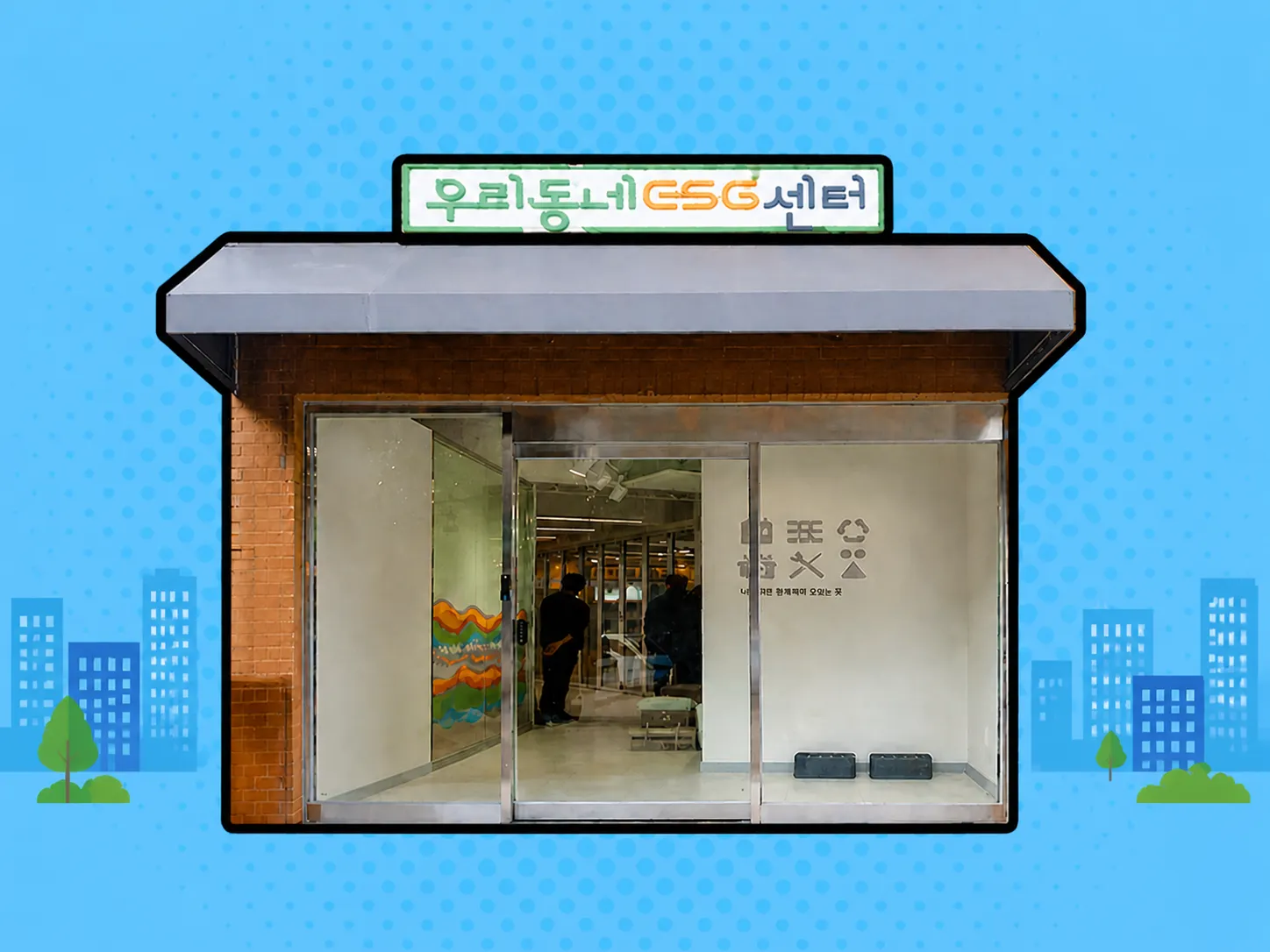
One can glimpse a company’s ESG status through its sustainability report. But how can citizens experience ESG in their daily lives? It is no easy task to think of ESG while sorting recyclables, or at a senior job site.Busan Metropolitan City has embarked on a new challenge to bring ESG closer to citizens’ everyday lives. The ‘Our Neighborhood ESG Center’ is a living-zone hub that combines resource circulation with senior job programs, creating a space where citizens can experience ESG. Starting with the first center in Geumjeong-gu, Busan in 2022, it has spread across the city and continues to receive favorable assessments as a policy model that integrates environmental conservation and social care, reaching the opening of the seventh center this year. So what process has the Our Neighborhood ESG Center undergone, from the first to the seventh center, to arrive at its current form?The Path to the Seventh ‘Our Neighborhood ESG Center’The first center, which opened in Geumjeong-gu in 2022, upcycled approximately 30 tons of waste plastic to produce and distribute LED lighting, safety handles, baseball uniforms, and more. Alongside this, it linked senior job programs to establish an operating model combining resource circulation and welfare policies. The second center, which began expanding its functions in phases, introduced a sales structure for upcycled products to explore the potential for business self-sufficiency. The third center constructed a system that completes the resource circulation process within the region by having seniors carry out the entire process from washing and disassembling to compressing the waste plastic they collect. [Our Neighborhood ESG Center No. 1 (Geumjeong-gu, Busan) Ⓟ Busan Metropolitan City]The fourth center broadened its scope, forming the ‘Coffee Grounds Resource Circulation Group’ in partnership with cafés in the Yeongdo area to expand the resource scope from plastic to coffee grounds. The fifth center then strengthened resident-participatory experience and education programs, transforming ESG into a ‘value to be experienced.’ The sixth center added community functions, expanding into a living-zone platform combining environmental education and local gatherings.An Empty Space Becomes the Center of a Circular EconomyThe seventh Our Neighborhood ESG Center, which opened this February in Jin-gu, Busan, can be said to epitomize the culmination of this accumulation. Newly created in the space of the now-closed Bohyun Daycare Center, this center transformed an urban idle space arising from low birthrates and an aging population into a composite hub combining environmental and caregiving functions. A space less frequented due to demographic changes has been transformed into a venue for regional circular economy and intergenerational connection.[Our Neighborhood ESG Center No. 7 (Jin-gu, Busan) Ⓟ Busan Metropolitan City]At the seventh center, resident-participatory programs are operated on an ongoing basis, including resource circulation activities utilizing waste plastic, ice packs, and banners, as well as carbon neutrality environmental education and mini hydroelectric generator experiences. Going beyond merely being a facility that collects recyclables, it contributes to providing stable jobs and roles for local seniors, while creating an educational space that nurtures environmental sensitivity in children. It also offers opportunities for participating companies to practice their social responsibility. Through Our Neighborhood ESG Center, practices for the environment that once felt distant have now become something citizens can experience right in their own neighborhoods. The seventh center has become an example that concretely demonstrates a sustainable lifestyle model along with the circular economy that residents, companies, and the local community build together.The Achievements of the Seventh Center, the Future of the SixteenthBy the time it reached the seventh center, Our Neighborhood ESG Center has grown into a pillar of the city’s strategy. To date, it has achieved approximately 3,500 senior job placements, the collection of 126 tons of plastic, and the participation of some 20,000 people in environmental education.Busan City has announced plans to expand Our Neighborhood ESG Centers to 16 locations across the city within this year, in cooperation with public institutions and private companies. As this model combining environment, care, and participation spreads throughout the city, we look forward to seeing what changes ESG will create in citizens’ everyday lives. by Editor N

The 2008 Marvel film ‘Iron Man’ tells the story of Tony Stark, CEO of weapons manufacturer Stark Industries, who awakens as a superhero after witnessing the victims of the missiles he created. In this globally popular film, narratives also emerge in which those harmed by Tony Stark’s weapons awaken as villains. A weapon that is an instrument of ‘deterrence’ and ‘security’ for some can be the seed of anger and revenge for others. This paradox is not fiction. The U.S.-Iran war, which unfolded through the February 28, 2026 U.S.-Israeli airstrikes on Iran, the blockade of the Strait of Hormuz, and the death of Ayatollah Khamenei, summoned that paradox into reality. The Defense Investment Frenzy Fueled by War CrisisOn March 3, 2026, the stock market opened after the holiday and war news with the KOSPI surging to the 6,200 level before plunging to the 5,800 level, while foreign investors unleashed a massive sell-off of approximately KRW 5.1 trillion, drawing sighs from investors. Yet on the same day, defense stocks moved in the exact opposite direction. Shares of LIG Nex1, a representative defense stock, surged 27.11% to KRW 647,000, hitting an all-time high, while Hanwha Aerospace shares rose 24.85% to KRW 1,492,000, also setting a record. Hanwha Systems shares also skyrocketed 29.40% to reach an all-time high. The strength of defense stocks continued the following day. As it became known that the domestically produced air defense weapon ‘Cheongung-II’ deployed in the United Arab Emirates (UAE) had actually intercepted missiles launched by Iran in combat, it drew attention as a case in which superior domestically produced air defense weapons exported abroad were deployed in actual combat. The market, in effect, has already firmly classified defense as a ‘crisis beneficiary sector.’[Cheongung-II © LIG Nex1]Lockheed Martin, the largest U.S. defense company, saw its stock price surge by more than 40% after the first airstrikes on Iran last June, and the returns of the American aerospace technology company Northrop Grumman (NOC), which possesses stealth bomber, drone, and radar technologies, also rose overwhelmingly. Europe is no different. Mikael Johansson, CEO of Swedish defense company Saab, revealed that the number of shareholders, which was about 50,000 before the 2022 Russia-Ukraine war, rose to more than 175,000 after the war. In Europe, movements to expand investment targets to sectors including defense are already becoming visible alongside the relaxation of ESG regulations. Can the Defense Industry Be ESG?Amid Middle East instability following the U.S. attacks on Iran, news also emerged that South Korea and the UAE have confirmed USD 35 billion in defense cooperation, going beyond simple weapons exports to build a full-cycle cooperation structure encompassing everything from design to maintenance. The securities industry predicts that, independent of the Iran situation, new order momentum will be highlighted, including the final approval of major projects within the EU SAFE program (a large-scale joint borrowing/defense capability enhancement project to strengthen EU defense capabilities) in March, and the resumption of Middle East business after Ramadan in April. However, domestic pension funds including the National Pension Service have yet to codify ESG investment criteria for defense companies. Amid a situation where defense stock prices are breaking all-time highs day after day, ESG fund managers face a vacuum in the criteria for judging inclusion.[Smoke rising following the Israeli airstrike on the southern suburbs of Beirut on the 2nd (local time) © AFP]There is also strong opposition to including the defense industry in ESG. Like the villains that appeared in ‘Iron Man,’ if the weapons produced by defense companies cause civilian casualties or are supplied to authoritarian regimes, this directly collides with ESG’s ‘Do No Significant Harm’ principle. This war has dispelled the hypothesis that the era of expensive manned fighter jets is over and that the era of low-cost unmanned drones is coming, instead reaffirming the importance of stealth capabilities. While the logic that advanced weapons contribute to minimizing civilian harm could be used as a basis for ESG inclusion, the irony that the victims created by those weapons become the seeds of new threats remains unresolved.Time for Criteria That Squarely Face the Light and Shadow of the Defense IndustryThe securities industry diagnoses that since the outbreak of the Russia-Ukraine war in 2022, with conflicts expanding through Syria in 2024, Israel in 2025, and Iran in 2026, ‘the defense industry is a representative sector that cuts across the flow of the times.’ Conflicts are not one-off events, and clashes are not stopping. In this situation, the simple binary of excluding defense from ESG investment while including renewable energy no longer works. Just as Tony Stark established new principles after witnessing the damage his weapons had created, the investment industry is now at a point where it needs differentiated criteria that squarely face the light and shadow of the defense industry. Unless a multilayered evaluation system is put in place — encompassing the types of weapons, the human rights level of export destination countries, the presence of technology to minimize civilian harm, and governance transparency — the silence of ESG funds in the face of surging defense stocks can only continue. by Editor N
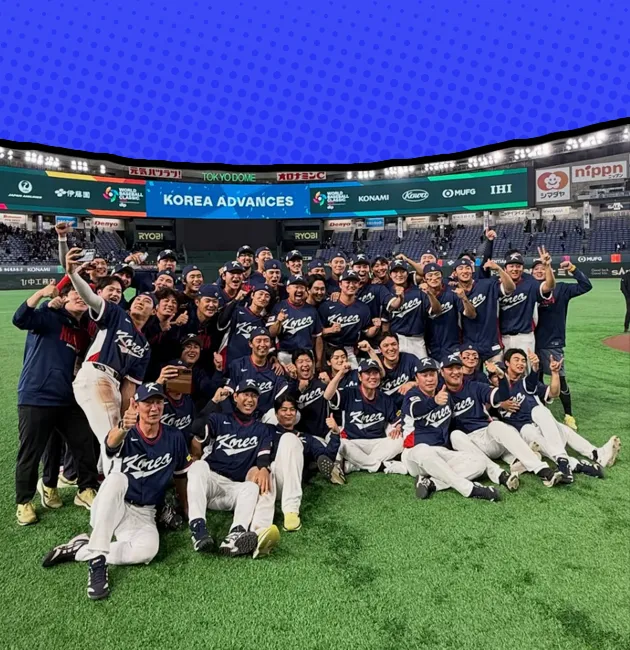
Amid the fervor of Korean baseball continuing hotly through tomorrow’s quarterfinals at the WBC, the national team produced a scene in their match against Australia on the 9th that captivated even those with no interest in baseball. In the game called the ‘Miracle of Tokyo,’ Korea pulled off a dramatic victory. To advance to the quarterfinals, where only the top two from each group advance, the national team had to meet the demanding conditions of ‘two or fewer runs allowed and a win by at least five runs,’ and they ultimately pulled it off. It was a moment that stirred not only South Korea but all participating nations enjoying the WBC.[2026 WBC National Team Roster Ⓟ KBO Website]Taking a closer look at the WBC, an unfamiliar yet fascinating scene catches the eye. Among the players wearing the Taeguk mark, somewhat exotic-looking faces can be seen. Under WBC rules, a player with at least one parent of Korean descent may compete for the Korean national team. Pitcher Dane Dunning, infielder Shay Whitcomb, and outfielder Jomay Jones — these three are players born and raised in the United States with Korean mothers. This is why they were able to wear the flag of their mother’s country, the Republic of Korea, on their chests and become members of Team Korea.The age spectrum was also broad. The oldest player on this national team is 42-year-old Noh Kyung-eun. Far past the average retirement age for a professional baseball player, he has continued his active career for over 20 years since his debut in 2003. On the same team were also players born in 2005. When starter Son Ju-young was suddenly substituted in the second inning of the Australia game due to elbow pain, it was Noh Kyung-eun who took the mound. Before the game, he had told Son, “I’ll block everything from behind, so just throw comfortably,” and he kept that promise by holding the line for two innings. Twenty-plus years of accumulated experience shone quietly but weightily in a moment of crisis.[Noh Kyung-eun competing in the WBC Ⓟ KBO Instagram]In this way, a team woven from diverse races, ages, and careers was able to respond flexibly even to unexpected variables. It was not through a single flashy ace, but through players of different backgrounds filling the gaps as the situation demanded. The approach taken by manager Ryu Ji-hyun in weaving together different players into one team provided the foundation for that design.The moment when diversity truly demonstrates its power is when an unexpected variable arises. The Miracle of Tokyo Dome showed that with unmistakable clarity. by Editor N