Loading Data
Please wait a moment...
Update Cal.
2026.08
03
Mon
04
Tue
05
Wed
06
Thu
07
Fri
08
Sat
09
Sun
Update Calendar
2026.08
01
Sat
02
Sun
03
Mon
04
Tue
05
Wed
06
Thu
07
Fri
08
Sat
09
Sun
10
Mon
11
Tue
12
Wed
13
Thu
14
Fri

Loading Data
Please wait a moment...
Morning features and interviews. A morning story over a cup.
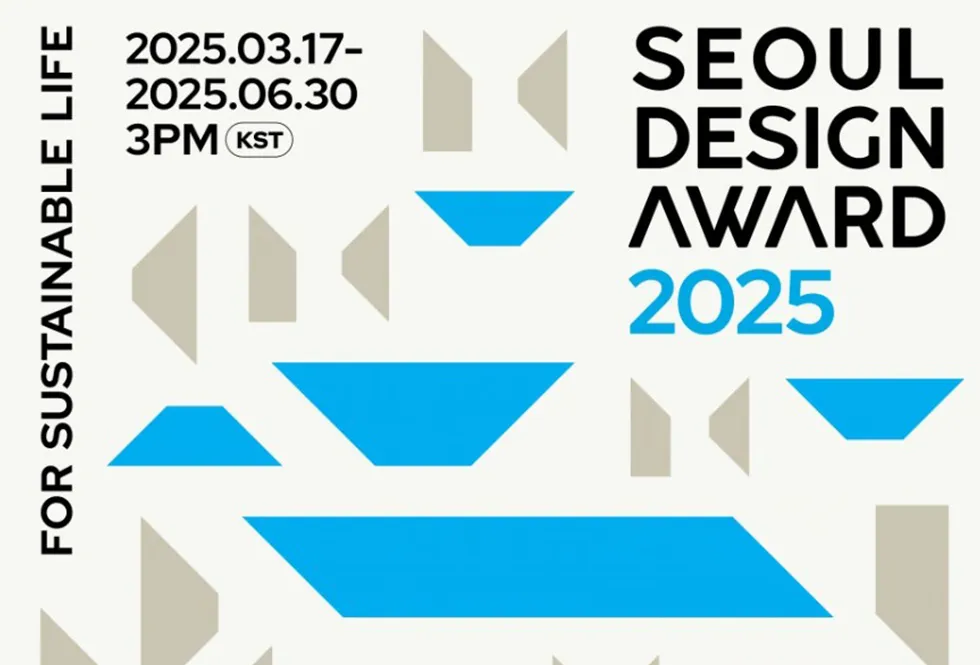
The World's Only "Sustainable Design Award," Together with Global Design LeadersEntries for the "Seoul Design Award 2025" are in full swing. The Seoul Design Award, which marks its 6th edition this year, is the world's only "sustainable design award," developed with sustainability and social value at its center. The Seoul Design Award, established by the Seoul city government in 2019 and organized by the Seoul Design Foundation, has discovered design projects that solve real social problems and have a positive impact on the local community and the environment. Starting with 75 entries at its launch, last year this award gathered 575 projects from 65 countries, establishing itself as a truly internationally prestigious platform.2025: The Further-Evolved "Seoul Design Award"The core philosophy of the Seoul Design Award, which once again seeks to gather with designers from around the world and deliver a powerful message about sustainability, is that "design is the language of problem-solving, and a practice of advancing toward a better society." Keeping the message that illuminates the true "role of design" beyond mere aesthetic excellence, this year's Seoul Design Award proposes a broader stage and an innovative format to participants.An Opportunity to Receive Feedback from 32 World-Class Global Experts from 21 CountriesThis year's Seoul Design Award operates a panel of judges made up of 32 design experts from 21 countries around the world, to further strengthen the fairness of judging. The judges, composed of the highest authorities in the design world, will provide participants with in-depth feedback throughout the entire process from the preliminary round to the final round. Design leaders from various countries who will make designers' hearts flutter join in — Ezio Manzini, a scholar in the field of sustainable social-innovation design; Patricia Moore, a pioneer of universal design; Andrea Cancellato, an expert in design policy and public culture; Pradyumna Vyas, a global leader driving India's design policy and the incoming president of the World Design Organization (WDO); and Dawn Lim, who leads Singapore's design ecosystem. The judges will evaluate the essential value of design, focusing not simply on form or function but on the relationship design forms with society.The judging method is also new. In particular, this year "on-site presentation judging" is newly introduced, so that the 10 teams advancing to the final round will present their projects in person at the "Dongdaemun Design Plaza (DDP)" on October 24. The grand-prize winner is to be selected by combining the scores of the global judging panel and a citizen evaluation panel, confirming a meaningful and original structure in which design experts and ordinary citizens together evaluate "valuable design."Submissions Until June 30 — Now Is the Moment to Take the ChallengeSubmission to the Seoul Design Award is free. Any project in which a designer participated, such as a social-value project, can be entered. The eligibility range is also broad so that anyone — individual designers, studios, companies, students, and more — can participate. The entry categories are divided, based on the "UN Sustainable Development Goals (SDGs)," into four categories: health and peace, equality of opportunity, energy and environment, and cities and community. Realized projects can be entered in the "Main Award" category, and prototypes and ideas in the "Concept Award" category; the total prize money is to be awarded to a total of 61 winning works on a scale of 150 million won, including one grand-prize team (50 million won), nine best-award teams (10 million won each), and two concept-award teams (5 million won each).If you want to be a designer who seeks to change the world through sustainable design, it is now your turn. The Seoul Design Award seeks to provide not a mere chance at an award but a stage where change can be realized. Submit an idea that will change the world to the Seoul Design Award right now.[How to Submit] Apply through the [Submission] menu on the website (www.seouldesignaward.or.kr) by 3 p.m. (KST) on June 30, 2025.] by Editor L
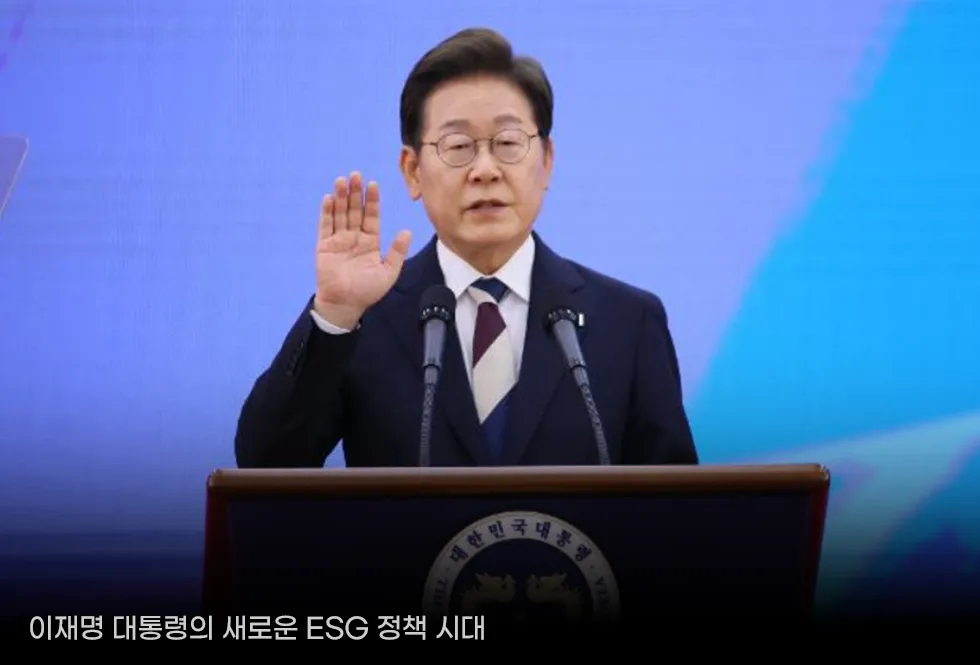
At last, a nEw president has been inaugurated. The 21st presidential election — which drew citizens' interest to the point of recording the highest turnout of 79.8% in 28 years — concluded with the victory of President Lee Jae-myung, who won 17.28 million votes, the most ever. The political and economic turmoil that all citizens had to experience due to the former president's martial law and impeachment is finding some stability amid the new president's inauguration.The same goes for ESG-related policy. It is worth noting that President Lee Jae-myung's inaugural address, which emphasized a message of integration and recovery, contains content related to ESG policy, unlike previous presidents' inaugural addresses. President Lee emphasized that his would be a pragmatic market-oriented government, backing corporate growth while, on the other hand, protecting citizens' lives and safety, workers' rights, and the weak, and preventing market threats from unfair trade. In addition, along with aspirations for national growth and development, concrete implementation plans for responding to the climate crisis — such as transitioning to a renewable-energy-centered society, replacing energy imports, and responding to RE100 — were also contained in the inaugural address. On the occasion of President Lee Jae-myung's "People's Sovereignty Government," where more active ESG-related policy discussion is expected to follow than before, we would like to organize the ESG policy direction promised in his campaign pledges and inaugural address.[ⓒESG.ONL]Climate-Crisis Response as an Economic-Growth Strategy[ⓒESG.ONL]In his inaugural address, President Lee Jae-myung defined the present as "a time to revive people's livelihoods, restore growth, and create a happy tomorrow for all," expressing the will to keep pace with the global trend of responding to the climate crisis. Specifically, President Lee had stated as a campaign pledge that he would push to establish a "Ministry of Climate and Energy" to realize carbon neutrality. This is intended to create an entity that will integrally manage climate and energy policy, which had been dispersed across the existing Ministry of Environment, Ministry of Trade, Industry and Energy, and Ministry of Economy and Finance. If a Ministry of Climate and Energy is created, it is expected to carry out the inaugural address's declaration of transitioning the industrial structure to an eco-friendly focus and integrally managing national energy policy with a renewable-energy focus. Also included in the inaugural address were the introduction of a dedicated PPA planned-siting system for expanding renewable energy — which progressed somewhat slowly under the previous government — and infrastructure expansion such as an energy highway connecting West Coast offshore-wind complexes with the metropolitan area. In addition, President Lee's pledges include the complete abolition of coal-fired power generation by 2040, the overhaul of the greenhouse-gas reduction roadmap, RE100 achievement for industrial complexes, and the reform of the greenhouse-gas emissions-trading system, so an active overhaul and application of carbon-neutrality policy is anticipated.President Lee's inaugural address contains both the content of "creating a country that grows and develops vigorously again" and a climate-crisis response strategy, giving rise to the expectation that he will pursue overcoming the economic crisis and the climate crisis — the pressing tasks of our society — from a perspective of integration. We should pay attention to the presentation of a growth model that catches two rabbits — economic growth and climate-crisis response — beyond the frame that renewable energy and eco-friendly policies are progressive policies.Inclusion of the Socially Disadvantaged and Realizing a Fair Society Through Strengthening Labor RightsPresident Lee Jae-myung also stated, on the premise that "growth is possible only when citizens' basic living conditions are guaranteed," that he would expand support for the socially disadvantaged and marginalized groups and raise the quality of workers' working environments through labor-market reform. As he led the labor-rights policy discourse of the presidential-election arena by emphasizing policies such as abolishing the comprehensive wage system, making a workers' representative committee permanent, and re-pushing the Yellow Envelope Act, a strengthening of the substantive protection of labor rights is expected going forward.Along with this, policies aimed at realizing a fair society are also expected to take shape. The enactment of a "Framework Act on Guaranteeing Workplace Rights" for platform workers and special-type employees, who have found it hard to receive labor-law protection; the phased expansion of the Labor Standards Act to small businesses with fewer than five employees; policies for work-family balance and for eliminating gender discrimination in the workplace; and the premise of the principle of equal pay for equal work were already foreshadowed as campaign pledges. President Lee revealed the will to create a society where all citizens can enjoy equal opportunity through strengthening social responsibility and inclusiveness. Through this, he appears to aim at strengthening the foundation of a sustainable society by improving the structure of the labor market and expanding the social safety net.Governance Innovation for Improving Trust and TransparencyAs can be seen from President Lee Jae-myung's inaugural address, which premised both social protection for the weak and a warning about threats to market order from unfair trade, the pursuit of policy in a direction that raises the trust and transparency of economic actors — including private and public — and emphasizes social responsibility is anticipated. Through his pledges, President Lee foreshadowed swift governance-innovation policy such as making ESG information disclosure mandatory, strengthening sustainability management reports, and amending the Commercial Act.Such policies also appear to drive the effect of raising the trust of domestic and foreign investors. Inducing listed companies to cancel treasury stock, separately electing audit-committee members, and standardizing ESG investment criteria for public funds such as the National Pension Service are also cited as major tasks. Governance-reform measures such as strengthening minority-shareholder rights and mandating the appointment of independent directors and audit-committee members are policies for resolving the stock market's "Korea Discount" (the undervaluation phenomenon of the domestic stock market) and creating a transparent, fair management environment that meets global standards.National Integration and Sustainability: Will a New Horizon of ESG Open?Sustainability is a central agenda for many countries and organizations. For this, ESG is emphasized. Looking at President Lee Jae-myung's policy pledges and inaugural address, one can see that we too are not outside this. President Lee, who during the presidential-election period fully agreed to the "7 major ESG policy tasks" presented by the Korea Sustainability Investing Forum (enacting a Framework Act on ESG, making sustainability disclosure mandatory, amending the Stewardship Code, reflecting climate-risk assessment by financial institutions, transitioning public finance to net zero, establishing a Green Finance Corporation, and a dedicated PPA planned-siting system for renewable energy), presented a blueprint for the next five years containing policies encompassing the major axes of ESG — climate-crisis response, protection of the socially disadvantaged, and strengthening transparent governance. Therefore, ESG is highly likely to function as a rudder for the national integration and restoration of trust that will secure our society's sustainability.With the inauguration of President Lee Jae-myung, ESG policy too has entered a new era. Hoping that the five years of the People's Sovereignty Government can be a great-transition momentum for a country with a sustainable future in which all citizens live well together, let us become citizens who take ceaseless interest in the drafting and pursuit of ESG policy for this. by Editor L

By Lee Choong-gul (essayist, former editor-in-chief of GQ Korea, author of the novel "Your Face") · June 9, 2025Sometimes I imagine this. If the thousands of coffee machines in the city stopped at once, what would happen? In that silence, what would we hear? Might we not hear a voice beyond the system, a sound long ignored?Seoul moves in "attoseconds" (an attosecond, an extremely short instant that divides one second into a quintillion). The subway stops at intervals of a few minutes, commercial districts change in a few months, and people pour several dictionaries' worth of emotion onto small screens. Whatever the case, there is exactly one place in this city where time flows slowly: the café.The Pil-dong of a May afternoon — the second floor of a building that was once a print shop was saturated with the scent of coffee beans. People talking, people writing, people holding meetings, people with their eyes closed. Everyone was reconstructing the space through the conductor called coffee, swimming inside the engine of the megacity. As a single nervous system maintained only through caffeine.To put the café back into the history of art, a coffee cup is a still life. It symbolizes the unresolvedness of relationships rather than the completeness of objects. Here coffee cuts the scenery into pieces, adds rhythm, and defines relationships. A sharp ritual that awakens a fear-soaked sense of reality, a way to endure the humiliation of work, a brief escape before a company dinner, a healing method that soothes the emptiness of a breakup. Eventually the latte foam became a shield that supports everyone in an era when mornings are hard, relationships are difficult, and emotions wear out quickly. Among the drinks of this planet, only coffee will grant the sense that one is holding on.More impressive than the statistic that one Korean adult drinks hundreds of cups of coffee a year, twice as impressive, is how coffee has seeped into the high-density life that is Seoul. Franchises and independent cafés, dessert cafés and theme cafés, even cafés without coffee, have seized the city with a power stronger than churches. Is this some pathology, or a form of evolution? Utterly crazy about coffee. The barista of three in the afternoon explained that he had roasted Guatemalan beans himself to bring out the acidity, but in my mouth, before coffee, quiet spread first. The senses always speak quietly. To let me briefly hide my flesh within the coffee.[ⓒESG.ONL]Coffee passes through two times. The consumer's time — choosing, under the lighting, a photo to post to social media while looking at the latte foam, then swallowing it down the throat. A pattern of excess and choice and self-esteem. There is also the producer's time — five in the morning in Colombia, the knees climbing a slope at an altitude of 1,800 meters. The time of knees clutching land drying up from climate change. When the two times mix in coffee, we understand something. Who made it? How did it come all the way here?Here ESG is an incompleteness that smooths over unbalanced time.To me, the reality thousands of kilometers beyond the coffee cup was too far away. But now I see that the bitter aftertaste that touches the tip of my tongue all day was the taste of the time a girl in the southern hemisphere harvested while inhaling dust. The humidity of the highlands in the early dawn, the prophecy of climate change, the weight of carbon, the shadow of an opaque supply chain, the knuckles of a boy sorting out worm-eaten coffee beans, the carbon footprint left by a single lungo, pesticide disguised under the part of speech "organic," the shell of fair trade's strange smile, the accounting ledger of a coffee brand, the scent of distant ports and sea routes faintly mixed in.The heart-shaped steamed-milk foam of the 5,800-won latte I drink today is, so to speak, a crystal that set out from the hand of a tenant farmer trapped between a valley of Brazil and the sea, and came through a cooperative in Costa Rica, an importer in Switzerland, a price-negotiation table in Amsterdam, and a washing plant in Southeast Asia — a moral fluid, a liquid ejected by the Earth's pressure difference.The labor is hot and long. Boy and girl workers, instead of going to school, hold baskets and turn like clockwork inside a disposable cup. A system designed to be beautiful yet not appear cruel. That is this coffee right now.In the process by which the alarm that wakes the morning transforms into a never-sleeping narrative of self-reproach, a question crouched — about how one drinks rather than what one drinks. Is this coffee really good? If I drink this coffee, will I really become a good person? The important questions are always like that, complex, ambiguous, with subtle acidity and guilt swirling. Just like coffee.[ⓒESG.ONL]Koreans are fast. They love efficiency.ESG's speed sometimes lags. Or it is so slow it wears you out. Some days even the process of drinking coffee is tiring. From the moment you open the café door. What should I drink? Latte? Americano? How should I ask them to grind the beans? Medium? Coarse? Milk? Half my personality is decision paralysis, the other half the guilt at the end of a decision. Ordering a single cup of coffee, I hesitate between helplessness and guilt. Too many choices, too much information, too much morality. The infinity of everything and everything. The act of drinking coffee is the product of labor that humanity has finely divided. I walk a tightrope between the compulsion to be a good consumer and ethical numbness. And even at the moment the ESG frame tries to grant legitimacy to that tightrope-walking, the motto of takeout coffee — drink it and throw it away right away — meddles not with the problem of paper cups or plastic straws but with the very attitude toward time itself.Just as a painter carefully lays color and line onto the canvas, today's barista, neither fast nor slow, adjusts the beans, water, temperature, time, and shape of the hand, quite like an ink-wash painter. The sound of ground beans falling as water droplets, the sight of the kettle's thin stream slowly sprinkled, abridges how this era handles coffee. Through that crevice, will is revealed. In fact, isn't ESG another name for will?When I brew hand-drip coffee at home, I too pour the water that way and gaze at the coffee swelling as I slowly draw circles. For a few minutes, becoming a citizen of the world called coffee. But that sense was arrogance. I did not labor, I did not sweat, and I directly experienced nothing. Choosing and drinking coffee was a consumer's privilege given to me without my knowing.The time I was truly convinced I had drunk ethical coffee was six years ago, at 11:37 a.m. on a Wednesday. I know the exact time because of guilt. In a Brooklyn café whose entire space was wrapped in exposed concrete, watching the shoulder of a barista dazzling with sapphire-dyed hair and the Chinese characters 李 (plum) and 竹 (bamboo) and lettering tattoos, I ordered a Colombian Cauca coffee, described in lowercase letters as "rich berry aroma and a multilayered citrus finish, with a floral scent rising at the end." The name of the coffee, which cost 7.25 dollars a cup, was, astonishingly, "The Scent of Your Child." There were also names like "Maria's Hill" and "The Warmth of a Rainy Afternoon," said to have been named by a community of Colombian women farmers. The fact that the menu marked the farm name, the processing method, and even the altitude of the origin was not a boast but a respect beyond imagination. Another narrative surrounding a single cup of coffee, a tender and clear message, mixed ethics into my discernment without threat or accusation. That sustainability could function as a design element.But the relief when seeing the "fair trade" mark connected to ignorance. In the status of a consumer, looking at the badge, one buys a kind of indulgence. But does that guarantee a fair life for the coffee-growing farmer? As the politics of everyday consumption, or a very private matter, what kind of consumer will I be? Whom do I think of, what do I believe, and in what way will I touch the world? How much do I know, how much do I turn away from, and how much can I take responsibility for? I am not perfect. Nor am I in complete ignorance. But that day, with a single cup of coffee, I tried to save myself, soothing my moral self, captured by the narrative of "good consumption."Space conceals responsibility. Or reveals it. The large franchise café on Gangnam-daero, while thousands of cups of coffee pass through in a day, lets you hear almost no information, no source, no voice. On the other hand, in the corner of a café on the third floor of an Euljiro shopping arcade, the edge of a coffee-bean sack was laid out. The gunny sack touching the floor declares that the coffee's origin, the land, and even the workers' body heat participate in the store. Here ESG would be revealed not as a slogan but as ethics in the choice and arrangement of space, in materials and structure, between the coffee cup and the trash can.[ⓒESG.ONL]Now some franchises have reduced disposable cups and give a small discount if you use a tumbler. Though I don't know how a few coins will handle the enormous vocabulary of corporate ethics and environmental protection. A coffee shop in Jeju melts plastic to use as cup coasters, a roastery in Gangneung creates a direct-trade structure with origin workers, a small café in Pohang provides coffee grounds as local fertilizer, and a coffee house in Mangwon-dong made tables from recycled wood. As a quiet and slow form of resistance, as an attitude that tunes cultural sensibility, slow and limited though it is. People are far more sensitive to the word "inconvenience" than to the word "sustainability." But detail is like a device that senses invisible pain.ESG, in the end, arises from the generosity of accepting inconvenience. When the consumer briefly withholds convenience, the system will have room to leap. Not so much a revolution as a subtle crack. But cracks change the world.This spring, I read a poem by a migrant worker who works at a coffee farm in Ethiopia.Before sunrise,this land catches its breath.Until my footprints are printed on the muddy path,[ⓒESG.ONL]I am neither a shadow nor a name.The basket is empty,the hand recalls memory.[ⓒESG.ONL]Before the sweat falls on my brow,the sunlight calls the red fruit.Crouching under the tree,I recall the sound of my daughter's footsteps.Seeping under my fingernails,the red juice of the husk,the collapsed knuckles,I do not leave the shade of the coffee tree.Every morning I drink coffee. To be exact, I drink the aftertaste of my dream, lick the tail end of my hesitation, and wash the clarity of my morality. About to call this time recovery, I stop and murmur. Whose life did this coffee pass through? Without swallowing everything floating on top of the coffee, I can no longer say I know coffee.By Lee Choong-gul (essayist, former editor-in-chief of GQ Korea, author of the novel "Your Face")
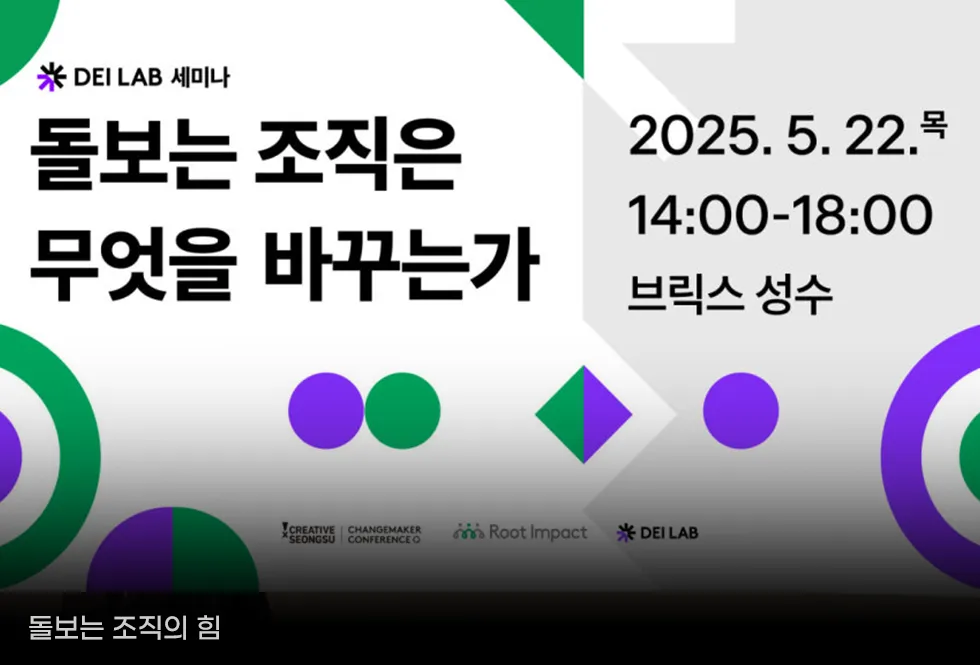
This past May 22, the DEI (Diversity, Equity, Inclusion) Lab seminar "What Does a Caring Organization Change?", held at Bricks Seongsu, was an occasion to share about the inclusive workplace, centered on the keyword "care." Here, through a keynote speech and three sessions, "care" was redefined and it was examined from multiple angles how a caring organization can affect the lives of its members. In particular, in the session "The Power of a Caring Organization," which ESG.ONL paid attention to, three organizations practicing DEI — "Root Impact," "FastFive," and "Toss" — introduced the workplace-daycare cases they have implemented. Let us confirm the power of the three organizations, which emphasized that care is an important task the organization should take responsibility for together, beyond a mere welfare system.[The DEI LAB seminar "What Does a Caring Organization Change?" © ESG.ONL]A Workplace-Daycare Solidarity That Shares the "Experience of Caring Together""Root Impact," a nonprofit incorporated association that pursues social value and impact, operates a consortium-type workplace daycare named "Everyone's Forest Daycare." It is the result of keenly feeling the need to establish a workplace daycare, as members faced the task of care according to their life cycle and experienced cases of being unable to return to work after childbirth. Though the intention was set, given the nature of a small organization, it was not easy to establish a daycare on its own. After much deliberation, Root Impact arrived at the solution of "a workplace-type daycare jointly operated in cooperation by multiple impact organizations.""Everyone's Forest Daycare" was designed as a space where children, parents, and teachers all create a culture together, beyond a mere childcare space. It maintains a teacher-to-child ratio lower than the legal standard and operates through parents' voluntary participation. Making use of the advantage that linkage activities among various organizations are possible, it is raising both the quality of and trust in care. Through this model, Root Impact presents the alternative that "it's hard alone, but possible together." It also shows the possibility of an organizational culture that expands care into a shared responsibility. The message resonates that one can experiment with an inclusive workplace through the "experience of caring together" and expand an organizational culture of care through organizational solidarity.[Panelists from Root Impact, FastFive, and Toss during the DEI LAB seminar © ESG.ONL]The Link Between Business Continuity and Care"FastFive," widely known as a shared-office-space service company, operates "Daram FastFive Daycare" to practically reduce the childcare burden of startup members. It began with the recognition — based on the fact that members of startups and other founding companies find it hard to enjoy welfare, and from seeing cases of women CEOs suspending their businesses over childcare issues — that childcare support is directly linked not merely to welfare but to business continuity. FastFive emphasized that expanding its scope beyond providing workspace to supporting the whole lives of its tenant members also connects to the company's brand value.True Care That Meets Members Close ByThe fintech company "Toss" developed the "Our Neighborhood Toss Daycare" model tailored to members' living environments, instead of installing physical infrastructure. Existing workplace daycares had the problems of low accessibility due to the inconvenience of having to commute with a child, and a low capacity-fulfillment rate. To solve this, Toss partners with excellent daycares in the base areas where members actually reside, supporting members in using childcare services closer to home. After introducing this model, a culture in which members naturally share childcare stories formed within the organization, and female members in particular came to feel the possibility of balancing work and life even after childbirth and childcare. The explanation is that this model, in that it could provide members with the trust that they can maintain the same performance as before even after childbirth and the sense of stability that it's okay to raise children, had a positive impact on the organizational culture as a whole, beyond mere welfare.[Care done together leads to immersion in work © ESG.ONL]Creating an Organizational Culture for a Sustainable OrganizationThe three organizations approached care in different ways, but commonly emphasized "the power of culture that goes beyond systems." The point is that, beyond simply providing parental leave, flexible work, and workplace daycare, real change is possible only when a culture is in place that lets members actually use those systems "safely" and "without being self-conscious." It was also an answer to how an organization can ease the parenting guilt and the anxiety about career interruption that female members commonly feel when they take on care responsibilities.Care in our society is no longer the responsibility of individuals and families alone. An organization can create sustainable relationships when it recognizes members' lives not as an "area outside of work" but as a condition of living together. This seminar showed with concrete cases what change a movement to embrace care as an organization's strategy and culture — rather than an individual's share — can create. The empathy and trust that arise in an organization that embraces care ultimately become an important foundation that raises the organization's resilience and prevents talent outflow. If you want to create a sustainable organization, you must first ponder how the organization "cares together" with its members. by Editor L
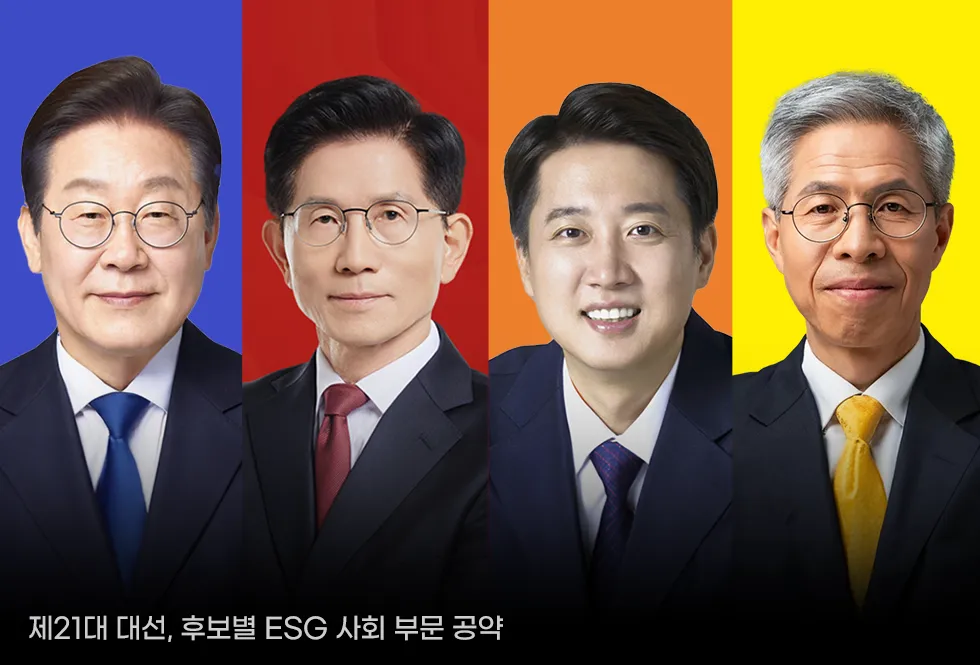
At last, tomorrow is the day of the 21st presidential election. Regarding the situation of holding an earlier-than-scheduled presidential election, the international community has offered commentary from various perspectives on the power of democracy and the public sphere that Korean society has shown. Will Korean society be able to keep protecting the policy realization of ESG, which had been solidifying its place as a standard of national competitiveness and social trust? The candidates are appealing for voters' choice, expressing their own and their parties' stances on various social values such as labor, safety, gender equality, and regional balance. Democratic Party candidate Lee Jae-myung and Democratic Labor Party candidate Kwon Young-guk revealed active stances on strengthening labor rights and protecting the socially disadvantaged, while People Power Party candidate Kim Moon-soo and Reform Party candidate Lee Jun-seok focused on labor-market flexibility and decentralization.ESG.ONL would like to look at the social-policy pledges among each party candidate's ESG policies, through which we can anticipate the society of the next five years we will live in.[Democratic Party candidate Lee Jae-myung © Lee Jae-myung's Facebook]Lee Jae-myung, Seeking to Protect Working People Through Strengthening Labor Rights and Improving Working ConditionsWage systems and labor-management relations improvement for labor-rights innovationCandidate Lee Jae-myung emphasized that improving the wage system is also necessary, and presented a pledge to introduce a phased 4.5-day workweek (a 36-hour work system) without a wage reduction, with the goal of achieving actual working hours below the OECD average by 2030. This is the will to improve Korea's long-working-hours practice and guarantee work-life balance. He also promised to improve the system so that "atypical workers (delivery and platform workers, special-type employees, freelancers, the self-employed)," who had not been covered by the existing Labor Standards Act, can also receive legal protection, saying he would reflect the changed labor-market environment and achieve the social value of "guaranteeing the rights of everyone who works."Candidate Lee, who says he will create a "society where labor is respected," also promised to re-push the "Yellow Envelope Act (amendment of Articles 2 and 3 of the Trade Union Act)." This law is pursued with the aim of improving inequality in labor-management relations by letting subcontractor workers also negotiate directly with the prime contractor, and preventing the company from filing retaliatory damage claims against disputes and legal strikes arising in this process. This bill, which has already gone through two proposal processes in the National Assembly, was scrapped in the previous administration when the president exercised a veto; Candidate Lee strongly advocates this policy to guarantee labor rights and improve labor-management relations.He also spoke of a plan to realize the "equal pay for equal work" principle — an unresolved task of our society — through a "wage-disclosure system" by job, rank, and gender.Successive accidents, improving citizens' working conditions and welfareThere is a strong perception that repeatedly occurring industrial accidents are also man-made disasters that could have been avoided. He announced a direction of strengthening safety measures across the entire construction-work process so as to fundamentally reduce industrial accidents. To raise the quality of life of Korean workers, who spend among the longest working hours in the world, concrete welfare proposals are also presented — pursuing a "national vacation-support system" policy, and encouraging "workation" (a combination of "work" and "vacation," i.e., "remote work at a vacation spot") by connecting local governments and companies.[People Power Party candidate Kim Moon-soo © Kim Moon-soo's Facebook]Kim Moon-soo: Labor-Market Flexibility, Improving the Business Environment, and Support for Youth, Women, and RegionsSupporting growth engines through a "business-friendly environment"Candidate Kim Moon-soo puts forward business-friendly policies that consider practicality — "labor-market flexibility and business-environment improvement," "support for youth and women," and "strengthening decentralization." First, for labor-market flexibility, he stated that he would ease the rigidity of the 52-hour workweek and activate telework and flexible-work systems so that, under labor-management agreement, both workers and companies broaden their options. For small and medium-sized enterprises, his position is to ease or exempt the application of the "Serious Accidents Punishment Act" to reduce companies' realistic burden. Pointing to regulatory issues as a factor hindering corporate investment, he plans to enact a "Free Economy Innovation Framework Act" for new-industry and new-technology fields to overhaul them. Besides this, he announced pledges for creating a "business-friendly environment," such as cutting corporate and inheritance taxes and indexing comprehensive income tax to prices.Sustainable-society solutions through decentralization and youth-and-women policiesCandidate Kim Moon-soo, who approaches our society's various agendas centered on practicality and growth, shows a balanced approach through decentralization and youth-and-women policies for social inclusiveness and sustainable development. Candidate Kim spoke of various balanced-regional-development pledges — a decentralization constitutional amendment, the transfer of central authority, region-specialized development, the nationwide expansion of the GTX, and the complete relocation of the National Assembly to Sejong City. His explanation is that resolving inter-regional imbalance will make the nation's balanced growth possible.For youth, the "3.3.3 Youth Housing" plan stands out. Candidate Kim promised to ease the housing burden by having the government support young people's housing costs for a total of nine years — three years of marriage, three years for the first child, and three years for the second child. He also seeks to contribute to expanding women's labor-market participation and improving families' quality of life by resolving the workplace wage gap for women, and supporting the re-employment of career-interrupted women and "work-family balance" through expanding the "gender-equality hiring-target system." Besides these, Candidate Kim also put forward his own solutions to youth and women's issues, such as a second reform of the National Pension, expanding large-corporate open recruitment, reviving the military-service bonus-points system, and introducing a voluntary military-service system for women.[Reform Party candidate Lee Jun-seok © Lee Jun-seok's Facebook]Lee Jun-seok, Emphasizing Efficient Strengthening of Industrial Competitiveness and Social ReformSecuring industrial competitiveness through labor-market flexibility including the wage systemCandidate Lee Jun-seok, who points to the inefficiency of a single nationwide minimum-wage system and argues that the authority to set the minimum wage should be transferred to local governments, stated that he would grant local governments the autonomy to adjust the minimum wage by up to ±30% according to regional economic conditions. He also presented a pledge for "support for reshoring (relocation of production facilities back home) companies" that, only for "companies returning to national industrial complexes," would "allow foreign workers to be paid wages lower than the minimum wage for ten years." The aim is to bring companies that went abroad back home. This pledge, presented as a measure to secure industrial competitiveness, drew public attention for its unconventionality — in that it violates International Labour Organization (ILO) conventions and is a discriminatory policy that removes the incentive for migrant workers to work in Korea — but could not avoid criticism that its feasibility is low.Reformist social-development measures beyond the traditional concept of social inclusionCandidate Lee Jun-seok's regional-differentiation bills also include corporate tax. He presents, as a balanced-regional-development policy, applying the tax system differentially by region and expanding local governments' discretion over attracting investment and creating jobs. He criticizes working-hour reductions such as the four-day workweek or 4.5-day workweek — which, since social discussion began, were also included in Candidate Lee Jae-myung's pledges — as "populist" policies pandering to public popularity, and emphasizes that structural reform such as productivity and technological innovation should be prioritized. The point is that our society's economic activity should be changed based on efficiency-strengthening policies such as small government, regulatory innovation, and shortened approval procedures, for an environment where companies work well. There are also worker-oriented policies, such as introducing a "worker representative system" so that the diverse voices of working people, including women and non-regular workers, can be reflected.[Democratic Labor Party candidate Kwon Young-guk © Kwon Young-guk's X (formerly Twitter)]Kwon Young-guk, Seeking to Lead a Coexistence Economy Based on Guaranteeing Workers' RightsProtecting workers' rights by securing the right to industrial safety and the right to equalityCandidate Kwon Young-guk foreshadowed an expansion of labor-related policy — strengthening the "Occupational Safety and Health Act" to fundamentally reduce recurring serious accidents and safety accidents, and protecting vulnerable groups such as subcontractor and non-regular workers to ease inequality within the labor market. Like Candidate Lee Jae-myung, he promised the passage of the "Yellow Envelope Act." He also presented many substantive measures for strengthening workers' rights, such as expanding the "right to immediately stop work" for dangerous work to subcontractor and non-regular workers, and strictly holding employers responsible in the event of a safety accident. He revealed the stance that he would also guarantee the rights of "platform workers (those who work based on delivery apps, secondhand-trading apps, and transport apps)," who have been excluded from labor rights including the Labor Standards Act.In addition, Candidate Kwon stated that he would make it mandatory for companies to disclose key indicators such as employment rates by gender, the ratio of managers, wages, and the ratio of those on parental leave, so that companies realize gender equality in the labor market. Through this, the point is that companies raise their transparency and sense of social responsibility and create a substantively gender-equal working environment.Strengthening state guarantees, such as jobs for which the state takes responsibilityAmong Candidate Kwon Young-guk's policies, the state-responsibility job-guarantee system is a policy to guarantee citizens' right to work. It is a plan to greatly expand public investment to create public jobs for care, medical care, safety, and climate-crisis response, and to solve the employment problem. This policy, also reported as a "Swedish-style youth job-guarantee system," has the goal of raising the current 3% mandatory-employment ratio for unemployed youth to 10%. To realize tax justice, he also announced a policy of raising inheritance and gift taxes.The presidential candidates' social-sector policies are not limited to welfare or labor-related topics. This is because the environment surrounding the nation's sustainability, securing global trust, and the quality of life to be provided to future generations holds countless agendas. Each candidate's policies and vision will have a direct impact on creating the standards by which to consider how to approach those countless agendas.Tomorrow, on the main polling day of the 21st presidential election, we can choose what standards and values we will bring to the countless problems our society will solve going forward. The wise choice of each and every voter will create a new path for Korean society. Be sure to exercise your right to vote — a precious right as a democratic citizen — and let us open the start of the new government together. by Editor L
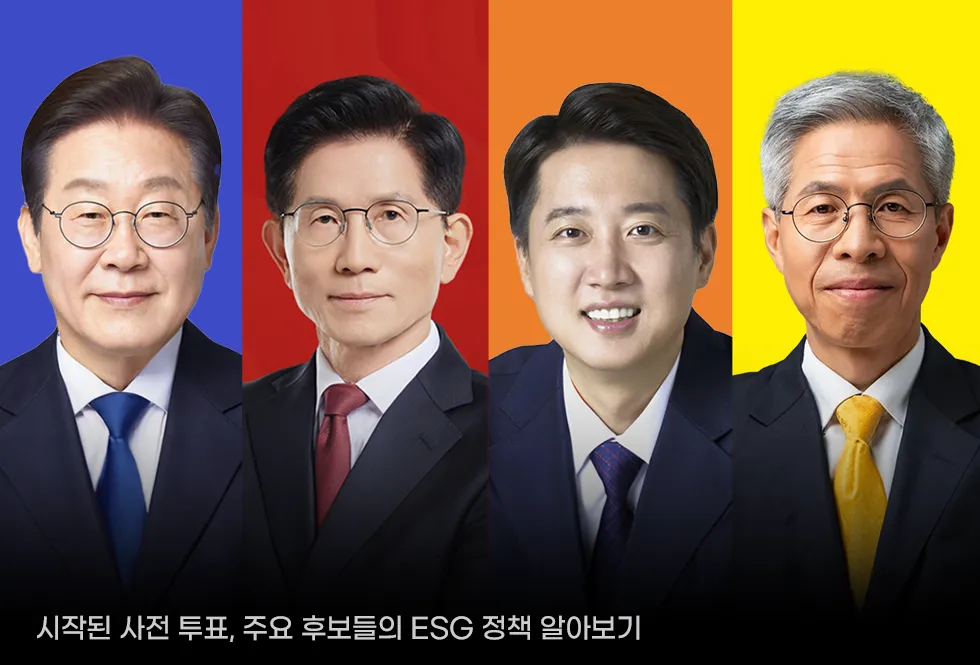
Ahead of the 21st presidential election on June 3, the candidates' policies naturally include ESG. Amid discussion of the climate crisis — now a reality before our eyes — and renewable-energy policy for carbon neutrality, interest cannot help but concentrate on the Environment-related ESG policy direction each party's major candidate holds. At this point, when making sustainability disclosure mandatory is also emerging as a key policy task, the "Korea Sustainability Investing Forum (KoSIF)" sent an "ESG·Climate·Renewable Energy Policy Questionnaire" to each party's presidential candidate and disclosed the candidates' responses on May 26.The questionnaire consisted of asking, on 7 key policy tasks such as enacting a Framework Act on ESG, making sustainability disclosure mandatory, and reflecting climate risk by financial institutions, whether the candidate was for or against and their concrete implementation plans. Candidate Lee Jae-myung and Candidate Kwon Young-guk submitted official answers, but the camps of Kim Moon-soo and Lee Jun-seok, who had withheld a statement of position on ESG policy as a whole, did not submit answers. ESG.ONL has organized, in an easy-to-understand way, the ESG-related positions even of the candidates who did not submit answers, adding their existing statements and pledges related to climate and renewable energy.Lee Jae-myung, Seeking to Secure a Sustainable Future Through Active ESG PolicyDemocratic Party candidate Lee Jae-myung, together with Candidate Kwon Young-guk, expressed intent to actively pursue ESG policy. First, Candidate Lee expressed strong will to make ESG policy a key task of national innovation, and presents climate-crisis response, industrial transition, and balanced regional development as measures to add to our society's sustainability.An eco-friendly economic transition adding corporate responsible management and Green FinanceCandidate Lee Jae-myung promised to "realize ESG information disclosure." The point is to make it mandatory for listed companies with assets of 2 trillion won or more to disclose ESG information first. Through this, he said companies would not hide their impact on society and the environment but transparently reveal it before citizens and investors, completing responsible management. He also revealed the goal of having global climate leadership by encouraging an eco-friendly transition across industry and society to build circular-economy infrastructure. Policies such as expanding "RE100 industrial complexes (industrial complexes operated on 100% renewable energy)" and introducing a "sunlight and wind pension system (a system for sharing renewable-energy generation profits with local residents)" also fit this context, aiming to make both regions and industry agents of the eco-friendly transition.Along with a circular-economy infrastructure plan, there is also a policy to change the flow of money in the financial sector toward eco-friendliness. He is pursuing the introduction of a financed-emissions reduction indicator that has financial institutions carefully assess the risks from climate change when lending or investing, and take responsibility even for the greenhouse-gas emissions of the companies they invest in. That is, it is a strategy to accelerate the green transition of the economic sector by inducing more funds to flow to eco-friendly industries and companies. His will is also clear to strengthen the institutional foundation — enacting a Framework Act on ESG, amending the Stewardship Code (the responsible-investment principles of institutional investors), and establishing a Green Finance Corporation — so that ESG management and green finance take root as a national standard rather than a temporary trend.An energy-network plan to strengthen global climate leadership and companies' eco-friendly competitivenessCandidate Lee Jae-myung plans to hasten carbon neutrality by completely abolishing coal power by 2040 and expanding electric vehicles, reducing fine dust, and expanding Biodiversity protection zones. In addition, he pledged the goal of reducing greenhouse gases by 2030 and securing global climate leadership, such as by hosting "COP33 (the UN Climate Change Conference)" in Korea. It is his aspiration to have the Republic of Korea leap forward as a leading nation guiding the world in the era of the climate crisis.There is also a policy to open the way for renewable energy by building an energy highway. It is the conception of newly installing a power grid that can send electricity produced from renewable energy such as solar and wind quickly and efficiently anywhere in the country, and a plan to create a "self-reliant energy society" structure by making a regionally self-sufficient renewable-energy system that can produce energy to be consumed directly within the region. Candidate Lee stated that he would also lead the strengthening of companies' eco-friendly competitiveness by improving the "PPA (power purchase agreement) system," in which companies sign direct contracts with renewable-energy generators.[Comparison table of each party's answers to the ESG-policy inquiry © Korea Sustainability Investing Forum (KoSIF)]Kim Moon-soo, an Advancement Strategy and Energy Mix Relying on the Role of Autonomy and the MarketPeople Power Party candidate Kim Moon-soo did not respond to the inquiry on "the climate crisis and renewable energy." However, one could confirm the candidate's thinking on policies related to the Environmental sector of ESG, such as strengthening energy infrastructure.Candidate Kim, emphasizing the role of autonomy and the market on ESG issues, is maintaining a deferring attitude of "deciding after gathering the opinions of stakeholders once the ESG disclosure standards are announced." Candidate Kim has a strong tendency to view ESG as a supplementary means for economic growth and strengthening industrial competitiveness, and tends to raise questions about the global ESG trend — a concern over feasibility. For example, regarding "RE100," he expressed a skeptical position, saying it is a good slogan in itself but virtually impossible.An energy mix centered on nuclear power rather than expanding renewablesTo realize carbon reduction in the energy field, the candidate also revealed a plan to expand the share of nuclear power among energy supply sources to 60% — rather than expanding renewable energy — through measures such as building and commercializing six large nuclear reactors and one small modular reactor (SMR) and extending the lifespan of aging reactors. Candidate Kim's position is to further strengthen industrial competitiveness through such cheap electricity supply based on nuclear power. He did not answer about the realistic limits of nuclear power, such as the treatment of high-level spent nuclear fuel.Lee Jun-seok, Aiming First at Education and Awareness Improvement for Climate PolicyReform Party candidate Lee Jun-seok did not put forward an official questionnaire answer or a concrete policy roadmap on ESG policy. He did not state an official position on the "Korea Sustainability Investing Forum"'s 7 ESG policy tasks either, and the term ESG cannot be found in the presidential debates or his policy-proposal document. Instead, Candidate Lee and the Reform Party focus on industrial competitiveness, education, and awareness improvement in climate and environmental policy. The Reform Party's campaign committee emphasized that "the most important thing in solving climate and environmental problems is education and awareness improvement in which all generations can participate," presenting as a key task the strengthening of basic environmental education such as waste-separation education and climate-sensitivity education in kindergartens and elementary schools. Also, according to the perception that "climate is industrial competitiveness itself," he pointed out that insufficient "RE100" preparation could create constraints on exports, and mentioned the need for various energy-transition strategies rather than a single method such as solar or ocean power.Proposing a gradual approach considering the burden on industryCandidate Lee Jun-seok proposed gradual promotion, considering the burden on industry and realistic conditions from realizing the energy-transition strategy. He stated that discussion is needed on realistic burdens such as increases in industrial electricity rates in the process of implementing climate policy, and his position is to disclose related detailed policies later. Overall, he did not present concrete ESG policies, but an industry-friendly approach considering realistic burdens appears likely to be a major standard for establishing his policies.Kwon Young-guk, Climate-Crisis Response and Transition to a Just Decarbonized SocietyDemocratic Labor Party candidate Kwon Young-guk is the candidate who put forward the most active and concrete position on ESG among the candidates. Candidate Kwon fully agrees with the 7 ESG policy tasks presented by the Korea Sustainability Investing Forum, and presented a concrete roadmap to also expand mandatory ESG disclosure for unlisted large corporations in 2027.A bold energy-transition policy putting forward exact target timelinesCandidate Kwon Young-guk promised to establish a "Ministry of Climate and Energy" overseeing climate, energy, and industrial policy, and to set up a presidential "Committee for Transition to a Decarbonized Society" and a National Assembly "Climate Economy Committee." He also stated that, with the goal of achieving carbon neutrality by 2050, he would sharply raise the "Nationally Determined Contribution (NDC)" to 70% by 2035. Bold energy-transition policies putting forward target timelines are a feature of Candidate Kwon's policies — a ban on new coal-fired power plant construction in 2030, a declaration of coal phase-out in 2035, achieving a 60% share of renewable-energy generation, a ban on the sale of fossil-fuel cars from 2035, and the closure of reactors reaching their design lifespan and the halt of new reactor construction.A climate transition encompassing even the protection of the socially disadvantagedCandidate Kwon Young-guk presented, as his core vision, important considerations of ESG such as a just transition and the realization of climate justice. He plans to enact a "Just Transition Act" and an "Energy Welfare Act" to support the groups harmed in the energy-transition process. He also seeks to pursue the expansion of social safety nets and green-finance infrastructure together — expanding green investment equivalent to 4% of the economy each year, and strengthening the Korea Development Bank's role as a green investment bank. Candidate Kwon also advocates a nuclear phase-out, opposite to Candidate Kim Moon-soo's nuclear policy.[21st presidential election promotional poster © National Election Commission]Looking at each party's presidential candidate's opinions on climate and renewable-energy-related ESG policy, one can confirm that clear differences are revealed among the candidates in concrete will to implement and in direction. Regarding this, Korea Sustainability Investing Forum Secretary-General Lee Jong-oh pointed out, "The Democratic Party and the Democratic Labor Party generally revealed clear positions on major ESG policies, but it is a very regrettable point that the second-largest party in the Assembly, the People Power Party, and the Reform Party did not submit official answers." Whatever the outcome of this presidential election, we hope that, on ESG-related matters requiring bipartisan handling, policies for a sustainable society will be realized through constructive discussion and responsible legislation and implementation. by Editor L
There is a forecast that "in 2050, the amount of ocean plastic will exceed the amount of fish." This is content frequently mentioned since it was noted in a report released in 2016 by the "World Economic Forum (WEF)" and the "Ellen MacArthur Foundation," a nonprofit that promotes the Circular Economy and works to solve the plastic problem. There are already 150 million tons of plastic waste in the ocean, and given the trend of more than about 11 million tons flowing in additionally each year, such a result is anticipated.Environmental problems from marine plastic are at a serious level, and beyond simply a crisis of marine ecosystems, they are being treated as a key ESG issue to which companies and society as a whole must respond responsibly. According to recent research, as many as 171 trillion microplastic particles (solid plastic 1 mm to 5 mm or less in diameter) are floating in the ocean, weighing about 2.3 million tons. Because plastic, once used and thrown away, is hard to disappear in nature — taking up to 450 years to decompose — it poses a long-term threat to ecosystems and human health.[2025 World Environment Day, held in Jeju in June © World Environment Day official website]The Official Theme of 2025 "World Environment Day," Held in Jeju, Is "Ending Plastic Pollution"Given its nature, plastic quickly breaks into small pieces by sunlight, waves, and wind, and the microplastics in the sea accumulate in the bodies of marine life and are transmitted even to humans through the food chain. The speed of plastic's miniaturization proceeds very fast, and it is now being detected in various marine life, including endangered species. Amid an overall sense of crisis, the official theme of "World Environment Day" on June 5 this year was also set as "Ending Plastic Pollution."This time, it is significant that the global official commemorative event is held in Jeju, Korea. Jeju declared a vision aiming for "zero plastic pollution" by 2040. Our government too has recently created a comprehensive plastic strategy encompassing the entire cycle — from the production, design, and consumption of plastic to reuse and recycling — and is pursuing a transition to a Circular Economy. The plan is to reduce the amount of marine plastic waste generated by 60% by 2030 and to completely remove it, making it zero, by 2050. In addition, it is accelerating the supply of eco-friendly fishing gear, the collection of marine trash, and the development of recycling technology.[A faucet dripping plastic bottles, exhibited next to the "international plastic negotiation venue" in Ottawa, Canada © Reuters]Production Management Rather Than Waste Management, but Complex InterestsOn the plastic issue, all respondents in a survey of the government delegations of 27 countries that recently participated in the "UN Global Plastics Treaty" negotiations expressed great concern about the impact of plastic pollution on human health. Some delegations even pointed out that plastic is being detected in human organs, blood, and even in the bodies of fetuses. Amid the international community's such worry, the "Global Plastics Treaty" final negotiation is scheduled for this coming August in Geneva, Switzerland.But ahead of much discussion, there are also loud voices that reducing plastic production should take priority over waste management or recycling. This is because current plastic recycling and waste management alone find it hard to keep up with the rapidly increasing plastic use, so much plastic still flows into the natural environment. However, as the main raw material of plastic is petroleum, major oil-producing countries such as China and the US and the petrochemical industry strongly oppose production reduction, citing maintaining industrial competitiveness, so preparing a solution is not easy.[Marine trash floating in the sea © UNEP]If Production Cannot Be Reduced, Solve Plastic Pollution Through Technological AdvancementThanks to plastic, humanity has enjoyed much convenience. If plastic cannot be avoided entirely right away, alternatives are needed, so the development of substitute materials such as bioplastics and research on microplastic-removal technology are actively under way. At existing fishing sites, "ghost fishing" — in which marine life gets caught and dies in lost fishing gear made from plastic-based synthetic fibers such as nylon and polyethylene — occurred. Because of this, "biodegradable fishing gear (nets, traps, etc.)," which naturally decomposes over time by water and carbon dioxide, is being used.Of course, 100% biodegradation of the bioplastics currently distributed in the market is difficult, and there is controversy over whether their environmental problems are sufficiently resolved. For problems that cannot be solved in a short time, direction matters. Experts emphasize that only when scientific research, policy, and international cooperation combine, aiming to solve the problem, can this complex plastic-pollution problem be solved. When government, companies, and civil society pool their strength and take an active interest in reducing plastic use, expanding recycling, and developing effective technology, we will be able to pass on a healthy sea and a sustainable Earth to the next generation. by Editor L

Kim Ha-yeon, CEO of Nanum Vitamin, is a young entrepreneur who confronted the reality of children at risk of missing meals while doing educational volunteer work. CEO Kim, connecting her warm heart for children with technology, is presenting a new welfare paradigm to Korea's donation market, which reaches 16 trillion won. ESG.ONL met Nanum Vitamin CEO Kim Ha-yeon to hear about the innovative business model and social impact she has unfolded, and her bold vision toward an ESG unicorn.CEO Kim Ha-yeon, on leave one semester before graduating from Seoul National University's Business Administration department, founded the social venture "Nanum Vitamin" in her early twenties and began operating "Nabiyam," an innovative meal-sharing platform for children at risk of missing meals. Having done educational volunteer work at local children's centers and libraries for more than six years since her high-school days, she came to hear in detail, through deep emotional communion with children, the inner circumstances and problems of those in welfare blind spots. Rather than merely worrying about their difficulties as an individual-level problem, CEO Kim Ha-yeon connected them to an idea for "solving a social problem."[Nanum Vitamin CEO Kim Ha-yeon © ESG.ONL]The "Nabiyam" App That Goes Beyond the Limits of the Existing Welfare System"Even if technology advances and resources increase, it's meaningless if they aren't properly delivered to those who need them."Children at risk of missing meals are in many cases hard-pressed to access information on welfare services. Even when they do access welfare benefits, it can be hard to use the service freely because of self-consciousness or an uncomfortable feeling. Such feelings cannot be known until one is in their position. CEO Kim realized that, although there are many well-intentioned shops and good owners here and there, there was no platform that could connect these shops with children at risk of missing meals. That is when the first business idea came to her — to connect shops and children directly.["Nabiyam," the meal-sharing platform of the social venture "Nanum Vitamin" © Nanum Vitamin]"The existing welfare system goes through intermediary support organizations, but in our app the user is at the center."Born on the basis of that idea, Nanum Vitamin's flagship service "Nabiyam" is a donation-matching service that overcame "decoupling," a limit of the existing welfare system in which donors and recipients are hard to match. Rather than the form of the existing welfare system, in which benefits are received only for designated items, it lets the party using the service choose "what to eat" through mobile meal vouchers.*Decoupling refers to a situation in which the provided institution or service is separated from actual activity.It also supports securing the transparency of welfare-service operation in administration and finance by providing donors with data-based reports through the app. Transparent information disclosure is made possible by Nabiyam's real-time dashboard. Reports based on general data and behavioral data have the advantage that partner companies or institutions can immediately confirm the effect of their social contribution and their brand favorability. Companies and local governments satisfied with Nabiyam's data often carry out projects again. Of the 30-odd domestic companies and local governments — including SK E&S, POSCO, the Korea Association of Health Promotion, and Woowa Brothers — more than 85% of partners chose to re-collaborate with Nanum Vitamin. CEO Kim emphasized that such digital-welfare innovation is the core of a new welfare model created by the public and private sectors together.[Various collaboration cases of "Nanum Vitamin" © Nanum Vitamin]Stigma-Free Connection Through User-Centered Welfare"Our customers should become subjects who 'choose and enjoy,' not 'recipients of benefits.' Instead of the 'stigma' of receiving a donation, we want to give the experience of naturally 'using' a rightful meal entitlement."Korea's children at risk of missing meals number about 280,000. In addition, there are still many who experience difficulty with a single meal among youth preparing for self-reliance, elderly people in tiny sublet rooms, and the unemployed young population. Nabiyam seeks to expand the meaning by having these people, beyond simply receiving benefit-based support, be provided a service that raises their self-esteem. First, it changed the term for the support target to "user." It is the result of listening to the voices of those who have experienced receiving donations. It also designed a UX that enables two-way communication so that cheering messages and thank-you messages can be exchanged. Users connected to some 60,000 small businesses nationwide gathered in this donation app, which allows real-time two-way communication, can now build a usage experience free of psychological burden amid natural communication as they use meal vouchers.[The participation menu for the general public on "Nabiyam" © Nanum Vitamin]The Sustainable Social-Impact Structure Nanum Vitamin Creates"At the boundary of social welfare and innovation, I pondered a structure that can be self-sustaining without external support."Nanum Vitamin is realizing transparency in welfare-service operation through a "structure in which 100% of donations are transparently delivered to users." One cannot help but wonder how it covers company operating costs. CEO Kim explained that Nanum Vitamin is building a profit structure by contributing to local-community sales through public-institution collaboration and external donations and discount linkages. She also said that while the connection between donors and users on Nabiyam is done transparently, the company built a model in which multifaceted profit can arise through platform brokerage fees, campaign-operation costs, advertising, and so on. The brokerage fee is receiving a portion of sales in the form of a donation through the connection with the merchant the user uses; the shop likes it because users come through the app and sales rise, and it feels great meaning in being able to realize social value while making a small per-transaction donation. Leading the economic value created through linkage with the local community and small businesses — beyond the frame of welfare-service users and donors — into sustainable social impact: this is, in effect, Nanum Vitamin's ESG management model.A Next-Generation Leader's Responsibility and the Ambition of an ESG Unicorn"We will become a company that maximizes social value with technology and data, without losing the essence of donation and welfare."CEO Kim Ha-yeon has also won the "Presidential Award, Grand Prize at the grand championship of the Public Data Utilization Startup Competition" and the "Republic of Korea Talent Award" conferred by the Minister of Education. With such awards and four technology patents, she is recognized for her expertise in the social-services field and for extraordinary achievement in technological capability and innovation. Not long ago, she also had the honor of being named — as the only Korean — to SisaJournal's "100 Next-Generation Leaders of 2024" and "Forbes 30 Under 30 Asia 2025." "Winning an award or being selected doesn't change anything. But using these awards as an occasion, I have to strive to grow more professionally together with stakeholders," she conveyed her calm aspiration.[The various award plaques Nanum Vitamin CEO Kim Ha-yeon has received © ESG.ONL]What is CEO Kim's goal for 2025, having achieved various results in only three years? CEO Kim first wants to ponder platform scalability more. Innovative projects — such as creating an algorithm for automatic connection between food companies and donation recipients, and digital-transformation collaboration with domestic marts — are already under way. She is also seeking overseas expansion, beyond the domestic donation market, to Southeast Asia and other places where welfare-delivery systems are not yet built up.CEO Kim Ha-yeon and Nanum Vitamin are creating a new donation-and-welfare ecosystem combining technology, data, and a warm heart. Under the philosophy that "donation is connection," they aim for a platform where the socially disadvantaged, local communities, and companies grow together. The keynote of the world she dreams of is "connection where everyone is respected, a society where everyone grows." Finally, CEO Kim resolved, "I will prove firsthand that, even as a social venture, one can develop in a sustainable and scalable direction through system-based innovation." We cheer that the confidence of CEO Kim Ha-yeon — who fulfills social responsibility by combining forward-thinking awareness and technology — leads to a bright future for our society's ESG social-contribution field and sustainable management. by Editor L