Loading Data
Please wait a moment...
Update Cal.
2026.08
03
Mon
04
Tue
05
Wed
06
Thu
07
Fri
08
Sat
09
Sun
Update Calendar
2026.08
01
Sat
02
Sun
03
Mon
04
Tue
05
Wed
06
Thu
07
Fri
08
Sat
09
Sun
10
Mon
11
Tue
12
Wed
13
Thu
14
Fri

Loading Data
Please wait a moment...
Evening ESG news and briefings to wrap up your day.

Early voting for the June 3 local elections begins in three days. What choice should we make? If you have not yet decided, it may be worth consulting the ‘2026 Local Election 10-Domain Climate Policy Proposal (hereinafter the Proposal).’ Jointly announced on May 21, the first day of the official election campaign period, by Climate Politics Baram, Cultural Solidarity, and Citizens’ Coalition for Walkable Cities, the Proposal is a policy proposal presented by civil society as a framework for vetting candidates. Under the banner of ‘Reduce Carbon, Increase Welfare,’ it contains a total of 30 policies across 10 domains. Civil society has taken the initiative in providing criteria, from Environmental (E), Social (S), and Governance (G) perspectives, for evaluating the pledges of metropolitan and local government heads.[2026 Local Election 10-Domain Climate Policy Proposal © Green Transition Institute]The 10 domains covered by the Proposal are: ▲Region-Led Carbon Neutrality Policy ▲Energy Transition ▲Mobility Rights ▲Housing Rights ▲Education ▲Green Jobs ▲Climate Care ▲Agriculture & Food ▲Ecology ▲Resource Circulation. As the slogan suggests, the policy focus is oriented toward reducing the burden on citizens. The common goal across the 30 policies is to create regional circular structures for transportation costs, heating and cooling costs, food costs, energy, jobs, food, and care. In this way, the Proposal places weight on articulating concrete items through which citizens can experience and verify climate pledges. In the publication statement, civic groups argued that “voters must directly seek out and scrutinize the climate pledges that local election candidates have not put forward,” and that “they must demand that candidates strengthen their climate pledges and policies by election day.”Analysis Also Shines Light on Governance Blind SpotsAmong the quantitative data presented in the Proposal, there are figures worth noting from the ESG Governance perspective. A comprehensive analysis by the Green Transition Institute of the 1st Carbon Neutrality Master Plans of all 226 local governments revealed that the average 2030 carbon emission reduction rate was 25.3%, falling short of the Nationally Determined Contribution target of approximately 40% reduction from 2018 levels. A total of 87 local governments (38.5%) received a D grade, requiring a full-scale redesign.The state of governance operations is even more deficient. Among the 226 local governments, only 147 (65.0%) have actually constituted and are operating a Carbon Neutrality and Green Growth Commission, and even those that are constituted have been limited to holding just 1–2 meetings per year on average. Only 7 (3.1%) operate subcommittees dealing with more detailed agendas. The fact that 28.5% of appointed members are concentrated in academia and research, while labor and farmers account for only 2.0% and youth and students for just 1.3%, is also disappointing from a diversity perspective. Among the 147 operating commissions, 51 (34.7%) were found to be male-dominated in violation of statutory gender balance provisions. This is the backdrop for the Proposal’s first domain — ‘Region-Led Carbon Neutrality Policy’ — calling for a citizen-participatory plan redesign and the establishment of a climate deliberation body.The disparity in the energy domain is also clear. As of 2024, South Korea’s renewable energy generation share stands at approximately 9%, just one-third of the OECD average (31.0%). While Germany installed an additional 430,000 balcony solar units in 2024 alone, South Korea remains at the initial stage for both institutional frameworks and deployment infrastructure. Energy-poor households are estimated at 1.58 million, and homes aged 30 years or older total 5,563,000, accounting for roughly 28% of all housing. The Proposal’s ‘One Household, One Solar’ deployment system and ‘Grand Housing Renovation’ are policy cards directly targeting these disparities.[2026 Local Election 10-Domain 30 Climate Policy Proposals © Green Transition Institute]Partial Alignment Between Proposal and Candidate PledgesExamining metropolitan government head candidates’ pledges against the 30 policy items presented by civil society reveals variation in the degree of alignment by domain. In the mobility sector, Democratic Party Seoul mayoral candidate Jeong Won-o’s pledge for ‘full expansion of the Climate Companion Card across the metropolitan area’ points in the same direction as the Proposal’s call for expanding flat-rate climate passes. Data showing 20 million cumulative Climate Companion Card top-ups and 800,000 monthly users were even cited in the Proposal itself as evidence of policy effectiveness. In the green jobs sector, Democratic Party candidate Kim Young-rok’s pledge for 2 million pyeong of RE100 industrial complexes as Governor of the integrated Jeonnam-Gwangju Special City partially aligns with the Proposal’s call for offshore wind and renewable energy industrial belt creation.Conversely, some domains are key items in the Proposal yet rarely appear in candidate pledges. The ‘Grand Housing Renovation’ policy in the housing rights domain barely features in core metropolitan government head pledges, despite the building sector accounting for 22.2% of domestic greenhouse gas emissions. The protection of climate-vulnerable groups, mandated by the amended Framework Act on Carbon Neutrality that took effect on April 7, is only mentioned at the party level — the Democratic Party’s ‘Climate Insurance’ and the Rebuilding Korea Party’s ‘Climate Allowance’ — while implementation plans at the metropolitan government head level remain rare.Another signal of party-level interest was evident at the debate hosted by Climate Politics Baram on May 7. While officials from the Democratic Party, Rebuilding Korea Party, Progressive Party, and Justice Party attended the mayoral and gubernatorial debate, the People Power Party and New Reform Party did not respond to the organizer’s invitation.[‘Climate Pledges That Change My Life: Are Mayors and Governors Ready?’ Debate Venue © Green Transition Institute]By-Elections as a Legislative VariableThe 14 National Assembly by-elections being held on the same day are also a variable. This is because the legislative momentum for bills pending in the 22nd National Assembly — such as the ESG Adoption and Promotion Support Act, the SME Carbon Neutrality Support Act, and the RE100 Industrial Complex Special Act — will be influenced by the election results. While metropolitan and local government heads will steer policies for the next four years, the composition of the National Assembly that will provide the legal basis for those policies is being decided on the same day. The Proposal also addresses the division of roles between local and central governments. In the publication statement, the civic groups noted that “while the central government can secure funding and introduce institutions for carbon neutrality, the actual realization of climate response requires local governments, regional communities, and citizens to act,” and that “the success or failure of the Nationally Determined Contribution ultimately rests with local governments.”Ko Yi-ji-sun, Regional Transition Team Lead at the Green Transition Institute who oversaw the drafting of the Proposal, explained in the press release that “the emphasis was on restructuring climate policy not as a mere environmental agenda but as a civic livelihood agenda,” and that “both candidates and voters must recognize that policies that substantively reduce transportation, heating, cooling, and food costs are the very policies that reduce carbon.” In particular, the ‘Region-Led Carbon Neutrality Policy’ — which the Proposal placed as the first domain — calls for establishing carbon neutrality targets before 2050, installing dedicated carbon neutrality organizations, creating regional climate funds, and redesigning citizen-participatory plans, all of which must be initiated in the first year of the elected official’s term. The extent to which the 30 items flagged by the Proposal take root in local administration within the four-year term will also provide a rough outline of the ESG report cards of South Korean local governments in 2030. by Editor N

‘World Migratory Bird Day’ is a commemorative day observed on the second Saturday of May and October each year, established by an organization under the United Nations Environment Programme to protect migratory bird habitats and preserve their populations. Because migratory bird movements peak at different times in the Southern and Northern Hemispheres, Migratory Bird Day is celebrated twice a year. The significance of Migratory Bird Day lies in the fact that migratory birds are indicators of ecological connectivity, linking continents, seas, wetlands, and cities. This year’s World Migratory Bird Day has chosen ‘Every Bird Counts — Your Observations Matter!’ as its official theme, raising the questions of who will observe and record migratory birds and how that can be turned into a basis for their conservation.‘Citizen Science’ Emphasized on World Migratory Bird DaySince migratory birds cross borders and traverse continents, it is difficult to fully capture their changes through the surveys of a single researcher or institution alone. This is why World Migratory Bird Day emphasizes the importance of community science — the act of citizens observing and recording — in protecting migratory birds. A single birdwatching record left by someone observing birds at a stream today, or the birdsong recorded at a wetland, can, over the long term, serve as data for reading the migration routes of migratory birds.[2026 World Migratory Bird Day Poster © World Migratory Bird Day (migratorybird.org)]Moreover, 2026 marks the 60th anniversary of the International Waterbird Census (IWC), a long-term project surveying changes in global waterbird populations. Waterbird data accumulated over decades by scientists, nature volunteers, and local communities has become a crucial basis showing the state of wetlands and waterbirds. In this way, birdwatching events and migratory bird observation projects held around the world go beyond mere commemorative events, becoming part of an international monitoring system through data accumulation.Birdwatching: A Hobby That Accumulates Public DataBirdwatching, once considered an activity of a few bird enthusiasts, is spreading as a popular hobby with the combination of binoculars, bird identification apps, and online birding record tools. This change aligns with the background of why World Migratory Bird Day has put citizen science front and center this year. The more people observe birds, the more records accumulate, and the stronger the basis for migratory bird conservation becomes. In particular, the global participatory bird data platform ‘eBird’ accumulates citizen observation records and uses them for avian research and habitat management.[Far Eastern Curlew stopping over at Korean tidal flats during autumn migration © eBird Official Instagram ]Domestically, to foster this virtuous cycle, Suncheon Bay Wetland operates the ‘Suncheon Bay Birdwatching Program,’ where citizens observe birds together, and the Seoul Metropolitan Government has steadily operated birdwatching and walking programs for citizens at Namsan Mountain. Additionally, the Goyang Janghang Wetland offers observation decks for migratory bird watching and monthly educational programs. These initiatives by public institutions also demonstrate that more people are visiting wetlands and forests for the experience of observing and recording birds.Birdwatching Data Leading to Cooperation and DecisionsWorld Migratory Bird Day operates under a structure of international cooperation. The Convention on the Conservation of Migratory Species of Wild Animals (CMS), the Agreement on the Conservation of African-Eurasian Migratory Waterbirds (AEWA), the East Asian-Australasian Flyway Partnership (EAAFP), and the non-profit organization Environment for the Americas (EFTA) jointly support World Migratory Bird Day as a global campaign. As noted, migratory birds do not live solely within the borders of a single nation but connect multiple continents and seas as they travel between breeding sites, stopover sites, and wintering grounds. Since 2020, EAAFP has conducted projects in Incheon and Hwaseong in Korea, including the International Black-faced Spoonbill Forum, the Songdo-Ganghwa waterbird survey, and the Hwaseong Wetland ecological survey, linking local observation and education to international cooperation.[The Black Redstart, known as a representative summer migrant © eBird Official Instagram ]What matters is what comes next. The records left by citizens in the field and the data accumulated by cooperative bodies like the EAAFP must be followed by decisions on how they are used. Only when choices follow — such as when to reduce lighting to avoid harming bird migration, which wetlands to preserve, and where to adjust development — can the meaning of all these activities be preserved. It is at this point that the role of local governments and companies emerges. While citizen participation and cooperative bodies provide the starting point for conservation, reflecting that data in spatial management, site selection decisions, and local policy is the responsibility of government and business.In this way, when migratory bird migration route data accumulated through the observations of countless citizens leads to actual decisions by companies and governments, the original goal of migratory bird conservation can finally be achieved. Migratory bird conservation is, in the end, about leaving places for migratory birds to return to. World Migratory Bird Day reminds us that this role and responsibility can begin with all of our records and be completed through social decisions. by Editor N

Stella McCartney is a designer who has utilized vegan materials and recycling technologies for over 20 years. Her first collaboration collection with the fashion brand H&M in November 2005 sold out within minutes of its release. At the time, this collaboration drew attention simply for being a meeting between a world-class fashion designer and an SPA (Specialty Store Retailer of Private Label Apparel) brand, but it carried an even more significant meaning: it was a signal that vegan fashion pursuing sustainability could reach the masses. Twenty-one years after that first collaboration, on May 7, 2026, the two brands once again joined forces with the goal of presenting a collection that is sustainable and familiar to the public. All products in this collection by Stella McCartney and H&M were made using certified eco-friendly materials. [Printed cotton hoodie from the Stella McCartney x H&M collaboration collection © H&M Official Instagram]Connecting Vegan Philosophy and the MassesSince the founding of her brand in 2001, Stella McCartney has steadfastly adhered to a vegan philosophy, refusing to use not only leather, feathers, and fur but even animal-based adhesives. This collaboration collection with H&M likewise utilizes eco-friendly materials such as metal chains made from 100% recyclable aluminum, regenerated fibers from collected clothing, and organic cotton.Stella McCartney has previously showcased products using next-generation vegan materials such as Mylo mushroom leather and AppleSkin leather made from apple waste, but there was the downside that these products carried high price tags. In the summer of 2025, when Stella McCartney collaborated with the American biotech startup Hydefy, the handbags made from vegan textiles that the two brands introduced at the time reached prices in the millions of won. However, the products in this H&M collaboration are presented to the public at relatively accessible prices ranging from KRW 50,000 to 400,000.[Trench coat made from organic cotton from the Stella McCartney x H&M collaboration © H&M Official Website]A Virtuous Cycle Driven by Sustainable InfrastructureIn its 2025 Sustainability Report, H&M announced that 91% of the materials used in its products were either recycled or from sustainable sources. Among these, the share of recycled materials was 32%, exceeding the 2025 target of 30%. Greenhouse gas emissions were reduced by 41% in Scope 1·2 and by 34.6% in Scope 3 compared to 2019. The supply chain transformation goes further. The number of suppliers using coal-fired boilers decreased from 118 in 2022 to 27 in 2025, with the goal of completely phasing out coal boilers by 2026.H&M’s global supply chain and mass-production infrastructure play a decisive role in scaling up sustainable materials. For materials like the vegan leather and natural rubber leather used by Stella McCartney to be produced at a commercial scale, large-volume orders are necessary. When a global SPA brand like H&M adopts these materials, suppliers can expand production lines, and unit costs fall, making them accessible to more brands. At the time of the Stella McCartney and H&M collaboration in 2005, the materials used amounted to little more than organic cotton and recycled polyester. This year’s collaboration between the two brands has expanded the range to include coating materials derived from raw materials such as sugarcane and industrial corn, and even mushroom-based leather alternatives.Brand Value Expanding Alongside SustainabilityEven before the full launch of the Stella McCartney and H&M collection began, H&M released campaign photos and videos announcing the collaboration through its official website and social media. The campaign video centers on the key phrase ‘&Stella (Stella and You).’ The &Stella concept expands into meanings such as ‘&Here,’ ‘&Now,’ ‘&Me,’ and ‘&You,’ conveying values of care and connection that encompass the past, present, and future. Stella McCartney said, “This collaboration collection brings together the materials I use now with those I have long loved. It is playful, sparkly, joyful, and chic.” [Stella McCartney x H&M collaboration campaign image © H&M Official Instagram]This collaboration collection with H&M carries meaning not only in the pursuit of sustainability but also in how it looks toward Stella McCartney’s past and future. It is also important that vegan materials can now become the mainstream rather than merely an alternative in fashion, and that sustainability can become a choice for everyone, not just a select few. The meaning of the Stella McCartney and H&M collaboration collection, officially launched on May 7, will endure not in whether it sells out but in how many people get to experience sustainable fashion in their daily lives. by Editor N

How big a footprint does a cup of coffee or a can of cola leave on the planet? As consumers begin to consider both health and the environment, a new beverage market that substitutes the core raw ingredients of coffee and cola is growing rapidly. Alternative coffee, sometimes called bean-free coffee, is drawing attention for going beyond a mere wellness trend to directly address the ESG challenge of supply chain carbon reduction.The Dawn of the Alternative Coffee EraAccording to World Coffee Research, a non-profit agricultural research and development organization, global coffee demand is projected to double by 2050, while the land suitable for growing coffee is expected to shrink to half its current level. Just as the world’s tropical rainforests are declining for the purpose of cultivating agricultural products including coffee, the coffee industry also bears responsibility for deforestation. [MushBean Coffee, combining coffee beans with Lion’s Mane mushroom © Dolsan Mushroom Farm]To reduce this environmental burden, the alternative coffee market is entering a maturation phase. Belgian food-tech startup Koppie has introduced an alternative coffee based on chickpeas, recording carbon emissions of just 1 kg CO₂eq per kilogram under Life Cycle Assessment (LCA) standards — a markedly lower figure compared to conventional coffee, which is at least double. The mushroom coffee market — where coffee beans are blended with extract powders from mushrooms such as chaga and reishi — is also expanding. The global mushroom coffee market is projected to grow to USD 4.12 billion by 2030, with an expected compound annual growth rate of 5.5% from 2023. Similar changes are being detected domestically as well. Korean coffee company Equitable has launched the carbon-reducing bean brand ‘Tomorrow’s Coffee.’ Consuming 1 kg of Tomorrow’s Coffee beans can reduce carbon by 16.6 kg. Healthy and Kind Drinks? The Beverage Industry Is ChangingVerification work on whether the environmental benefits of alternative ingredients are as substantive as the market claims is also intensifying. Compared to conventional coffee, alternative coffee involves no fermentation process, resulting in lower energy consumption and wastewater generation, and can reduce environmental burden through use of locally sourced ingredients and by-products. On the other hand, systematic Life Cycle Assessment (LCA) research on fermented beverages including kombucha has not yet been sufficiently conducted, and some point out that additional scientific review is needed to solidify their status as sustainable alternatives. [Olipop, promoting a healthy soda containing prebiotic ingredients © Olipop Official X Account]Beverage companies are also pursuing packaging innovation alongside ingredient conversion. Prebiotic soda brands such as Olipop and Poppi are penetrating the MZ generation’s demand for ‘conscious consumption’ with products that lower sugar content and add plant-based dietary fiber. Coca-Cola HBC, a production and distribution partner, uses 100% renewable energy across all its operations in Europe and Switzerland, and as of 2024, its renewable and clean energy usage rate reached 53%, earlier than its 2025 target of 50%.A Single Sip’s Choice Becomes Climate ActionThe alternative coffee and alternative beverage trend does not stop at mere diversification of taste. From tropical forest degradation stemming from coffee bean cultivation to water resource depletion and carbon emissions caused by sugarcane production — these two issues reveal the structural limitations of the global food and beverage supply chain. The chain in which consumer choices change the supply chain, and supply chain transformation leads to climate response, has already begun to form. An era is arriving in which ‘what you drink’ becomes a unit of ESG practice. by Editor N

The Green Transformation International Week (GX International Week) and Climate Change Week kicked off on April 20. At this event hosted by the Ministry of Climate, Energy and Environment, 16 institutions and organizations spanning government, public agencies, and private companies are introducing carbon neutrality practice cases and information at outdoor booths at the Yeosu Venezia Convention site. If you are planning to visit Yeosu during this special week, take note of the booths that ESG Today has highlighted.① Ministry of Climate, Energy and Environment — Promoting GX International Week and Climate Change Week Is Climate Action ItselfThe Ministry of Climate, Energy and Environment, which organized this event, is running an event in which souvenirs are given to those who share messages of support for GX International Week and Climate Change Week on social media. It is participatory promotion that naturally spreads the purpose of the event, conveying the message that climate action is not something far away.[Ministry of Climate, Energy and Environment booth at the venue entrance © ESG.ONL]② Presidential Commission on Carbon Neutrality and Green Growth — Figuring Out the Gains of Green Activities with ‘Green Pig Geudeuki’The Presidential Commission on Carbon Neutrality and Green Growth is operating an information booth where visitors can check everything from the commission’s organizational structure to its major activities at a glance. The Chairperson personally attended the GX International Week opening ceremony and emphasized the commission’s role. The booth is drawing visitors with an event giving away items featuring the character ‘Green Pig Geudeuki,’ which introduces the benefits that can be gained through green activities.[Event booth of the Presidential Commission on Carbon Neutrality and Green Growth © ESG.ONL]③ Korea Environmental Industry and Technology Institute — Even a Seal Knows Carbon Neutrality Points, Plus Double Earning TipsAt the booth of the Korea Environmental Industry and Technology Institute, where a cute seal character catches the eye, the Carbon Neutrality Point system is intensively introduced. It explains how to earn points and receive incentives through everyday green activities such as issuing electronic receipts, using reusable containers, and recycling, and also shares information about limited-time events for earning double points.[Korea Environmental Industry and Technology Institute seal character and event booth © ESG.ONL]④ Climate Solutions — Discovering the Truth of 1.5°C While Making Your Own SandwichThe most eye-catching booth is undoubtedly the Climate Solutions booth, decorated in a red bakery concept. Centered on the theme of global efforts to limit Earth’s temperature rise to within 1.5°C and the impacts of the climate crisis, it operates a hands-on activity in which participants complete a sandwich by connecting sandwich ingredient cards, each containing a piece of climate knowledge. The method of learning climate information by assembling it with one’s own hands is drawing the interest of participants.[Climate Solutions booth where participants learn about climate crisis information by choosing bread and ingredients © ESG.ONL]⑤ H&M — Fashion Asks About SustainabilityAt this event, H&M — the only fashion brand — conveys its sustainability message through an O/X quiz format participation event. From Earth Day-related general knowledge to the procurement methods of the materials H&M uses in its products, the brand unpacks its eco-friendly efforts through quizzes in a natural way. [H&M event booth drawing interest through a quiz game © ESG.ONL]⑥ Sudogwon Landfill Site Management Corporation — Feeling the Possibility of Regeneration Through Sock Toe OffcutsThe Sudogwon Landfill Site Management Corporation, which manages and processes waste discharged by 26 million citizens in the Seoul metropolitan area including Seoul, Gyeonggi, and Incheon, operates a hands-on activity of making pot holders from recycled sock toe offcuts. During the activity, guides explain the corporation’s role and the importance of resource circulation, helping participants to directly feel how meaningful the process of reducing and regenerating waste can be.[Sudogwon Landfill Site Management Corporation information booth offering sock toe offcut item making © ESG.ONL]The GX International Week promotion booths are open from 10 AM to 6 PM at the outdoor Yeosu Venezia Convention site until the 25th. While policy declarations and international forums take place inside the conference halls, the outdoor booths are functioning as a space where citizens pause their steps and experience climate action. These promotion booths, where government, public institutions, and private companies gather in one place to introduce climate action in their own ways, are a microcosm demonstrating that green transformation is not a task for any single entity. If you are curious about how small and large practices toward carbon neutrality are connected, do not miss this week. by Editor N
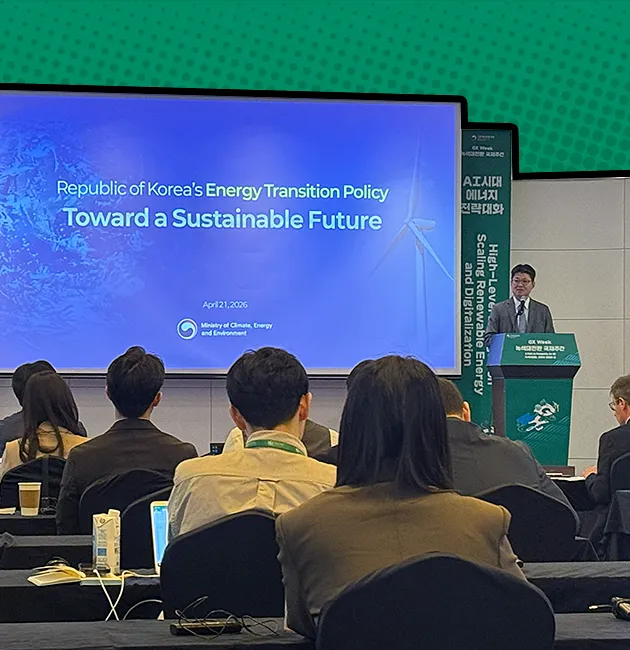
On April 21, the Ministry of Climate, Energy and Environment and the Climate Group, the operating body of the global RE100 initiative, jointly hosted the ‘Energy Strategy Dialogue in the AI Era’ at the Sono Calm Hotel in Yeosu. Organized as a key session of the Green Transformation International Week held in conjunction with UNFCCC Climate Week, the event drew officials from the Ministry of Climate, Energy and Environment, GE Vernova, domestic and international RE100-implementing companies, and global energy solution organizations. Let us examine the discussions that took place among institutions and companies on energy transition in the AI era.[UNFCCC Deputy Executive Secretary Noura Hamladji speaking at the ‘Energy Strategy Dialogue in the AI Era’ © ESG.ONL]First, the UNFCCC warned that in the era of digital transformation, energy transition is essential, and that failing to handle power energy in a responsible manner could slow the pace of energy transition. In a situation of surging data center power consumption, securing clean power has become a necessity rather than an option. To advance digitalization for all while preventing electricity price increases, securing finance through international cooperation is essential. As the digital divide widens, ensuring that the benefits of innovation are shared by all requires not only energy transition but also sustainable political leadership at this juncture. The Climate Group then emphasized that while South Korea’s policy direction regarding renewable energy is clear, stronger demand forecasting and enhanced support for RE100-compliant companies are needed.Discussions also continued on the day’s key agenda items: responding to the surge in power demand driven by the spread of AI and data centers, managing energy supply chain risks, and building the RE100 ecosystem. The Ministry of Climate, Energy and Environment stated that its goal is to achieve 100 GW of renewable energy installed capacity by 2030. Three major transition directions were also presented: the phased phase-out of coal-fired power, expansion of electric vehicle deployment, and utilization of transition finance. The Ministry also emphasized that a significant portion of the 6.9 tons of greenhouse gas emissions comes from the steel, city gas, and petrochemical sectors, making the electrification of the industrial sector a key task.[Group photo of panelists at the ‘Energy Strategy Dialogue in the AI Era’ © ESG.ONL]Naver shared its implementation strategy from the consumer perspective. It presented the case of leveraging outside air and geothermal energy for data center cooling, reducing cooling equipment utilization to below 10%, and applying double-glazed windows, rooftop solar panels, and geothermal pipes at its headquarters building to reduce energy consumption itself. It is also aiming to achieve 40% RE100 by 2028 by combining long-term renewable energy Power Purchase Agreements (PPA) with direct investment in power plants. In terms of the RE100 initiative, Naver stressed that as the renewable energy demand of Asian companies is rapidly growing, there is an urgent need to revitalize the PPA market and improve the institutional framework so that companies can procure renewable energy at predictable prices. Finally, GE Vernova introduced its ultra-high-voltage direct current (HVDC) and Flexible AC Transmission System (FACTS) technology solutions that address the issue of renewable energy’s lack of inertia, and expressed expectations for cooperation with South Korea by mentioning the West Coast renewable energy interconnection project.Now, as the speed and direction of energy transition are being reshaped faster than ever before, we look forward to seeing what energy policy formulation will result from the dialogue shared in Yeosu. by Editor N

In 1984, James Cameron’s film ‘The Terminator’ depicted a dystopia in which the machine civilization Skynet, having taken over the Earth, uses humanity as an energy source. The scenes in which human body heat and bioelectricity were used as fuel were dismissed at the time as science fiction grounded in abundant imagination. Yet the reality we now face is moving faster than imagination. As the AI industry grows at a pace exceeding expectations, a question confronts us: to coexist with AI, from where must we draw power, and how much of it?Data Centers Shake the Power GridAccording to the report ‘Energy and AI’ published by the International Energy Agency (IEA) in 2024, global data center electricity consumption in 2024 was approximately 415 TWh (terawatt-hours), accounting for 1.5% of total electricity consumption. This figure is projected to more than double to around 945 TWh by 2030. In particular, the power consumption of accelerator servers dedicated to AI computation is expected to grow at an annual average rate of 30%. Hyperscale AI data centers consume over 100 MW (megawatts) of power 24 hours a day without rest, which is 4 to 10 times the level of conventional data centers. Goldman Sachs has projected that data center power demand will increase by 165% by 2030 compared to 2023, and that USD 720 billion (approximately KRW 1,056 trillion) in grid investment alone will be needed to meet it.[Hyundai Engineering & Construction Yongin Jukjeon Pacific Sunny Data Center © Hyundai Motor Company Official Website]South Korea is no exception. In its 2025 report ‘South Korea Datacenter Operations and Colocation Services Market Trends,’ IDC Korea projected that domestic data center power demand would increase from 4,461 MW in 2025 to 6,175 MW in 2028, at an annual average growth of 11%. Already, over the 11 months from August 2024 to June 2025, 290 applications for data center power use were filed nationwide, roughly two-thirds of which were concentrated in the Seoul metropolitan area. The requested capacity in the capital region alone reaches approximately 20 GW (gigawatts) — equivalent to the new power demand of 20 one-GW nuclear reactors. The National Assembly Research Service estimates that a single AI data center consumes up to six times the power of existing facilities and is urging countermeasures.Insufficient Renewable Energy, Lagging PolicyAs demand explodes, supply strategies are also fluctuating. The IEA foresees that while renewable energy will cover half of the additional data center power demand by 2030, natural gas-fired generation will still play a key buffering role amid the demand surge. Big Tech’s investment in Small Modular Reactors (SMRs) with electric output of 300 MW or less has also begun in earnest. It is in this context that Google, Amazon, and Microsoft invested trillions of won in SMR developers in 2024. Governments and companies across the globe are engaged in a complex balancing act between the ideal of energy transition and the reality of power supply. [Computer graphic image of Google SMR © Google Official Website]The policy vacuum is already spilling over into social problems. In Ireland, where data centers are projected to account for 32% of total power demand by 2026, the power grid has become unable to sustain itself, leading to a situation in which new housing development has become impossible. Virginia in the U.S. and Germany have introduced regulations restricting data center permits in residential areas and mandating renewable energy supply and waste heat recycling. The EU has formulated the ‘AI Continent Action Plan’ to build a self-sustaining AI ecosystem across Europe, with the policy of tripling data center processing capacity within 5 to 7 years, but simplifying permits only for projects that meet energy and water efficiency requirements. In contrast, in South Korea, the structure in which energy consumption is concentrated in the Seoul metropolitan area has become entrenched, intensifying regional conflicts, yet a systematic energy supply and demand roadmap remains ambiguous.The machines in the film ‘The Terminator’ use human skin and blood for the maintenance of their metal frameworks. Through this, the sci-fi film showed us both a vision of the future and a warning. Today, AI is rapidly depleting the power grids and industrial energy of cities. In this situation, the next generation faces the question of where to obtain fuel. If the pace of renewable energy expansion cannot keep up with the power consumption of AI, we may end up choosing yet another form of ‘energy exploitation.’ Now, as we must set the direction of the AI industry, a social consensus on the source of fuel and who bears the cost is more urgent than ever. by Editor N

On weekend mornings, a long line forms in front of the Cheongnyeongpo ferry dock in Yeongwol-gun, Gangwon-do. Testimonies of visitors keep appearing on social media: arriving at 9 AM only to find an already lengthy queue, with some saying they waited three hours just to board the ferry. This is the overtourism scene driven by the film ‘The Man Living with the King,’ which has surpassed 16 million viewers. Since late February, the cumulative number of tourists visiting Jangneung and Cheongnyeongpo has exceeded 80,000. Buoyed by the film’s box office success, visitors to Cheongnyeongpo — the place of exile of King Danjong — have surged explosively, and Gangwon State has launched an emergency response.[Poster for the film <The Man Living with the King> © Showbox]An Island on Land Overwhelmed by CrowdsCheongnyeongpo is a peninsular landform surrounded on its east, south, and north sides by the upper reaches of the Namhangang River, with its west side blocked by cliffs. With no road access and reachable only by ferry, Cheongnyeongpo is called an ‘island on land.’ It is also a geological landmark forming part of the Gangwon Paleozoic National Geopark — a park spanning Yeongwol, Jeongseon, Taebaek, and Pyeongchang that showcases Korea’s representative Paleozoic sedimentary rocks — and is designated Scenic Site No. 50. It is precisely this Cheongnyeongpo that draws crowds exceeding 6,000 per day on weekends. Yeongwol-gun ultimately posted a social media notice warning that visitors scheduled to arrive at Cheongnyeongpo after 4 PM might face restricted same-day entry. Ecological Debt Carried by the FerryOvertourism does not simply mean there are many tourists. The problem arises when tourism exceeds the carrying capacity — the level at which the local ecosystem and residents’ quality of life are substantively damaged. At Cheongnyeongpo, this problem becomes more complex. The grove of pine trees over 600 years old filling the interior of the island is an ecological and historical resource that has stood since the time of King Danjong’s exile. When the footsteps of tens of thousands repeatedly press down on the soil, the root systems of the trees are damaged, and when rain falls, soil and sand can be eroded and washed away. National park research has also confirmed that concentrated visitor patterns are a primary factor in the degradation of vegetation and soil around trails. The Cheongnyeongpo ferry carries not only tourists but also the ecological debt that accumulates with every footprint.[Cheongnyeongpo © National Heritage Portal]The Ministry of Food and Drug Safety also conducted inspections from March 4 to 13 of approximately 100 restaurants near Cheongnyeongpo for hygiene conditions and price labeling compliance. This is a short-term response focused on the safety and hygiene of the suddenly increased number of tourists. However, a long-term institutional framework for managing tourist capacity remains weak. The first place in South Korea to tackle overtourism was Bukchon Hanok Village in Seoul, which was designated a ‘Special Management Area’ under the Tourism Promotion Act in July 2024. It was the first case nationwide, yet even that merely amounted to nighttime passage guidance without separate mandatory regulations. Discussions on visitor cap systems or reservation systems for scenic sites remain at the discussion level. [Cheongnyeongpo Closure Day Notice © Yeongwol-gun Instagram]What Remains After the Box Office SuccessThe box office success of a film will subside someday. The problem is what comes after. Especially when specific photo spots rapidly gain fame through social media, concentrated tourist visits over a short period can sharply damage the ecosystem, and that damage remains even after the popularity fades. What Cheongnyeongpo needs now to pass on its value as a geological landmark intact to the next generation is not a welcome banner for visitors, but a management plan based on carrying capacity. As long as tourism policy uses only economic effects as its performance indicator, the degradation of natural and historical assets is bound to repeat. For sustainable tourism, the invisible costs of ecosystem degradation around cultural heritage sites must be reflected in policy design. Cheongnyeongpo has withstood some 600 years of time; making the island endure the years ahead is the responsibility of the system. by Editor N